
As an Amazon Associate I earn from qualifying purchases.
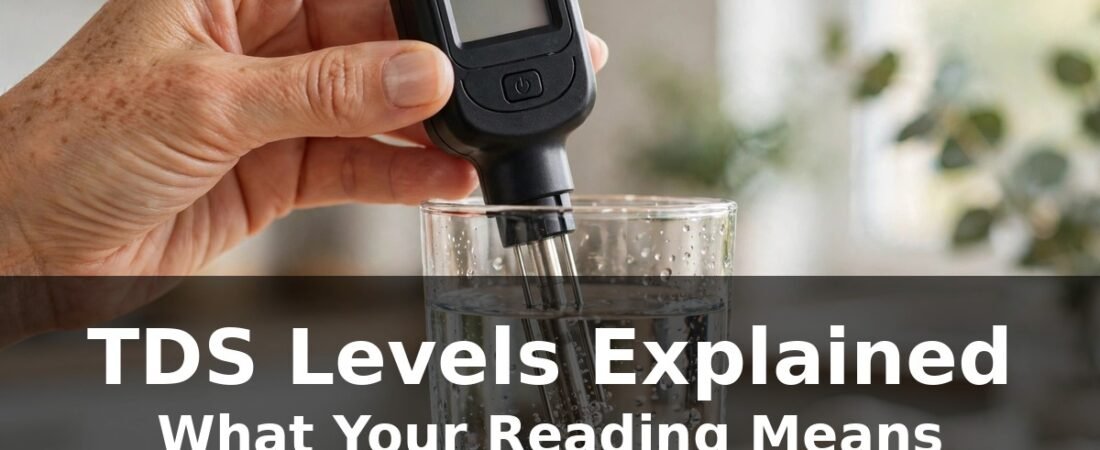
You finally bought a TDS meter — or your reverse osmosis system came with a built-in display — and now you’re staring at a number. 214. 386. Maybe 48. And the obvious question: is that good?
Fair question, and one most of the internet answers badly. I’ve dug through what the EPA and WHO actually say about TDS, and this guide explains TDS levels in plain English — what the number means, what counts as good for drinking water, what US regulators require, and the big thing your meter can’t tell you (which matters more than most people think).
What TDS Actually Means (Plain English)
TDS stands for Total Dissolved Solids — the total amount of stuff dissolved in your water: minerals, salts, metals. For water, 1 ppm equals 1 mg/L, so a 200 ppm reading is 200 mg/L. Use them interchangeably; nobody will correct you.
Those solids mostly come from nature: water picks up calcium, magnesium, sodium, potassium, chlorides, sulfates, and bicarbonates moving through soil and rock. City treatment adds a bit too. Nothing inherently scary — some, like calcium and magnesium, are in your food.
The part that trips people up: TDS is a quantity measurement, not a quality judgment. It tells you how much is dissolved in your water. It says nothing about what is dissolved. Two glasses can both read 250 ppm and be completely different water. Keep that in your pocket — it matters for everything below.
The TDS Level Chart: What Your Reading Really Means
Here’s the industry-standard chart you’ll see everywhere (water-treatment companies and filter brands use versions of this that line up closely):
| TDS Reading (ppm) | Rating | What It Means |
|---|---|---|
| 0 – 50 | Ultra-pure / very low | Distilled/demineralized territory. Can taste flat; slightly corrosive to plumbing over time. |
| 50 – 150 | Excellent | Clean-tasting, with enough minerals left for good flavor. |
| 150 – 300 | Good | Typical of good tap water and remineralized RO water. |
| 300 – 500 | Acceptable | Drinkable by US standards; taste is noticeably minerally or hard. |
| 500+ | Treat | Above the EPA’s secondary standard. Noticeable taste issues and scaling — worth filtering. |
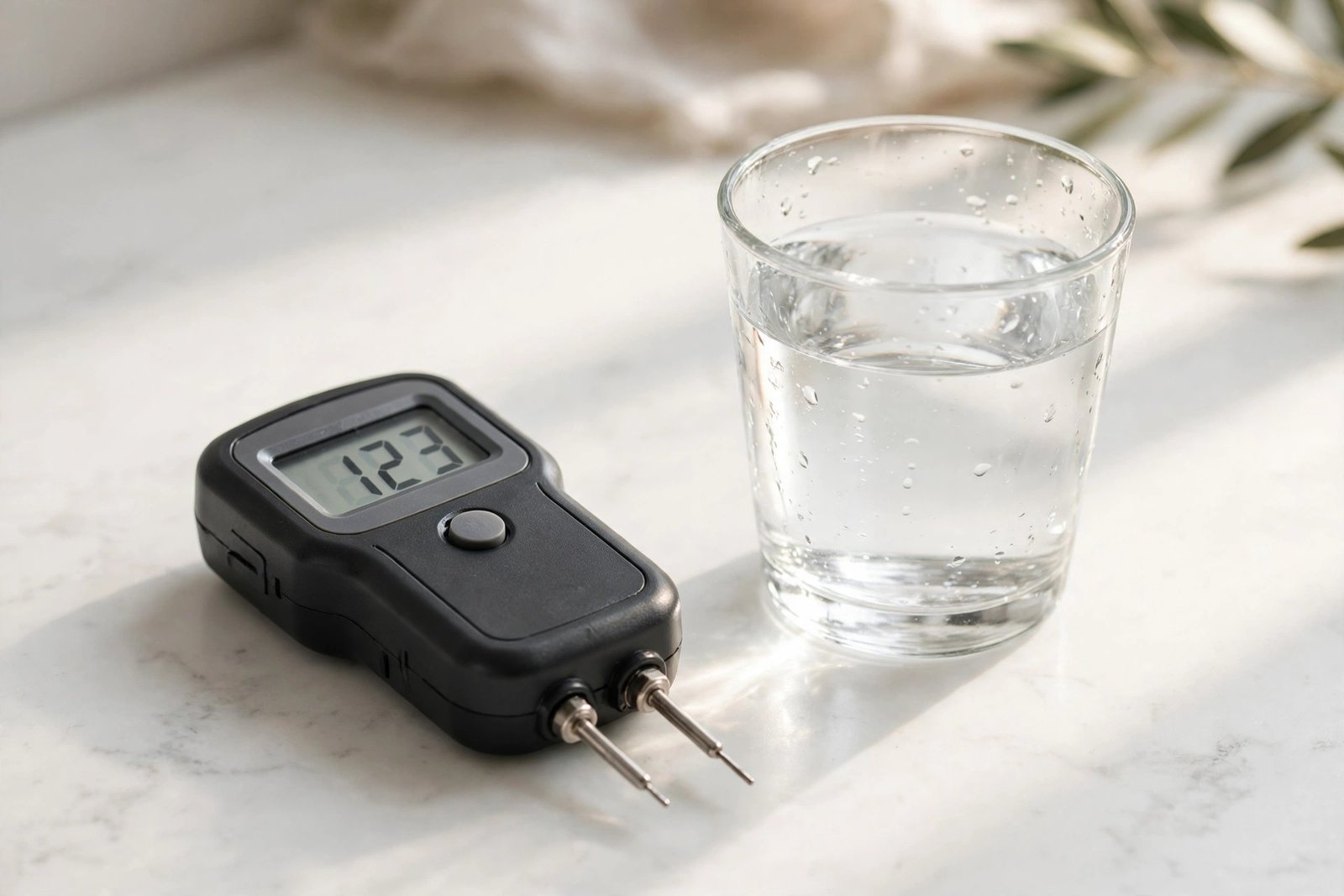
Quick reality check: these bands are practical guides, not safety verdicts. 420 ppm isn’t dangerous, and 30 ppm doesn’t guarantee pristine water. Here’s what the regulators actually say.
What the US EPA and WHO Say About TDS
A lot of top Google results for TDS topics are written for the Indian market. Here’s the American picture.
EPA: 500 mg/L — But It’s Not a Health Rule
The US Environmental Protection Agency sets a secondary drinking water standard of 500 mg/L for TDS. That sounds strict until you learn what “secondary” means.
EPA secondary standards are guidelines for nuisance issues — taste, odor, color, staining, and scale buildup on your fixtures. They are not federally enforceable health standards; states may adopt them, but no federal law is broken if your tap reads 600 ppm. Above 500 mg/L, the EPA notes you can expect hardness, mineral deposits, colored water, staining, and a noticeably salty taste.
Translation: the EPA’s TDS number is about whether your water tastes fine and behaves nicely in your pipes — not whether it’ll hurt you. A meaningful distinction most articles skip.
WHO: Palatability Ratings, Not a Hard Limit
The World Health Organization doesn’t set a health-based TDS limit either. Instead, its drinking-water guidelines rate water by palatability:
- Excellent: under 300 mg/L
- Good: 300 – 600 mg/L
- Fair: 600 – 900 mg/L
- Poor: 900 – 1,200 mg/L
- Unacceptable: over 1,200 mg/L
One notable footnote: water with very low TDS can taste flat, and WHO’s taster panel found people often prefer moderate mineral content. So if your RO water reads 12 ppm and tastes like nothing — that’s normal.
What’s Actually in Your TDS Reading — and What It’s Hiding
Your reading mostly reflects harmless minerals: calcium, magnesium, sodium, potassium, chlorides, sulfates, bicarbonates. But a TDS meter measures electrical conductivity and converts it to a ppm estimate (typically using a 0.5–0.7 factor for tap water) — an estimate, not a lab result. It can’t tell you which ions produced the number.
That means a TDS meter cannot detect lead, arsenic, or PFAS at toxic levels. Those contaminants cause harm at parts-per-billion (ppb) concentrations; your meter measures parts-per-million (ppm). That’s a 1,000× gap. A glass of water could contain dangerous lead and still read 150 ppm — completely normal-looking — because the lead is such a tiny fraction of the total.
It’s physics: a TDS meter is a screening tool, not a contaminant test. Worried about lead (old pipes), arsenic (well water), or PFAS? You need a lab test or a filtration system certified to remove them — not a $15 meter reading. We cover the PFAS side in our RO and PFAS guide.
What Should Your Reading Be? Tap Water vs RO vs Distilled
What number should you aim for? It depends entirely on where the water came from.
Regular tap water
Normal US municipal tap water usually lands between 150 and 400 ppm (groundwater tends to run higher in minerals than surface water). Anything between 150 and 500 ppm is in the normal, EPA-acceptable range. Over 500? Worth looking into filtration, if only for taste.
RO (reverse osmosis) water
A properly working RO system strips out roughly 90–99% of dissolved solids. Normal RO output lands in the 10–50 ppm range (manufacturers often target 5–15 ppm straight off the membrane). Systems with a remineralization stage — increasingly common on tankless models — read 40–100 ppm, because minerals are deliberately added back for taste.
Distilled / demineralized water
Typically 0–5 ppm. Fine for irons and aquariums; flat-tasting for drinking, and ultra-low mineral content can be mildly corrosive to some plumbing over time.
Is 25 ppm too low for drinking?
No — 25 ppm is normal, safe RO water. It may taste slightly flat compared to mineral-rich tap, but that’s preference — a remineralization cartridge (many modern RO systems include one) brings it up to the pleasant 40–100 range.
How to Use a TDS Meter (Step by Step)
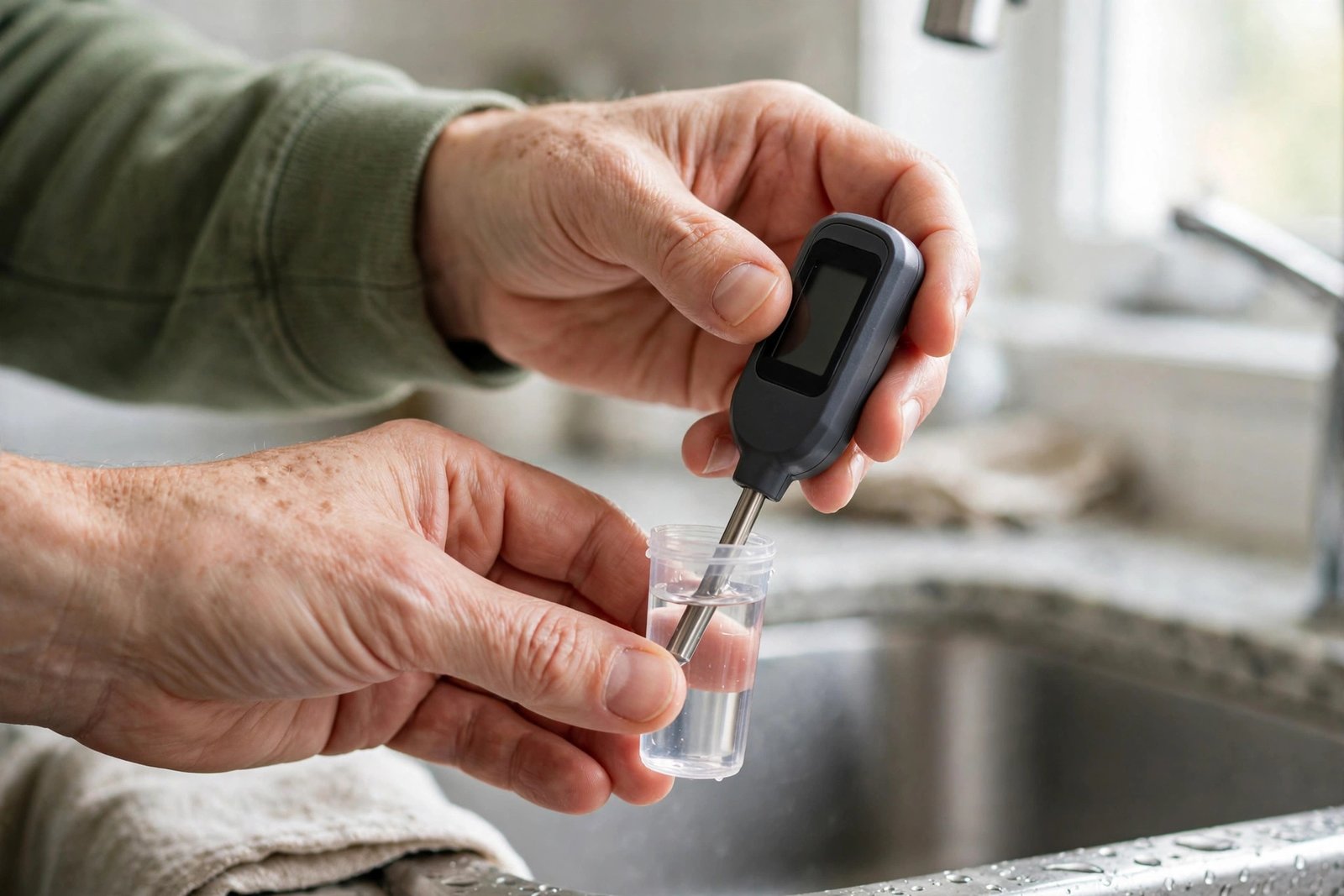
Never used one? It takes about thirty seconds. Here’s the routine:
- Rinse a clean glass (or small sample cup) and fill it with the water you want to test. Room temperature is fine — meters auto-compensate for temperature, but consistency helps comparisons.
- Power on the meter and confirm the display reads zero in air first.
- Immerse the probes — dip the sensor end up to the immersion line, never the meter itself. Swirl gently to knock air bubbles off the electrodes.
- Wait for the number to stabilize, usually 5–10 seconds. Note the reading.
- Rinse the probes with clean water and shake off excess before storing.
Now the use case that makes a meter earn its keep:
Rising TDS Is Your RO Membrane’s Early Warning System
If you own an RO system, a TDS meter is a health monitor for your membrane. Test RO water at the dedicated faucet every month or two — ideally before any remineralization or post-filter stages, so you’re measuring the membrane’s actual performance.
Here’s the rule of thumb: a healthy membrane keeps RO output well under 50 ppm. If that number starts climbing — 60, 80, 100+ — your membrane is wearing out and letting dissolved solids slip through. Climbing TDS = time to check your filters and plan a membrane replacement. RO membranes typically last 2–3 years depending on your source water and pre-filter maintenance.
A tired membrane doesn’t just mean worse-tasting water — contaminants it was holding back start getting through. See our iSpring filter replacement guide for how filter wear shows up in practice.
High TDS? Here’s What Actually Fixes It
Your tap reads 650 ppm and you’re not thrilled. What actually lowers TDS at home?
Reverse osmosis: yes. The home method that genuinely removes dissolved solids — 90–99% of them. If lowering your TDS reading is the goal, RO is the answer, under-sink or tankless.
Water softeners: no. One of the most common mix-ups. A softener swaps calcium and magnesium ions for sodium — it doesn’t remove dissolved solids, so your meter will barely budge. Softening and TDS reduction are two different jobs.
Standard pitcher carbon filters: no. They improve taste and remove chlorine, but don’t meaningfully reduce TDS. “Cleaner water” on a pitcher box means chlorine and odor reduction — not dissolved-solids reduction.
Distillation: yes, but… It drops TDS to near zero — slowly, and with lots of energy. Wildly impractical as a household’s daily solution. RO wins on every practical axis.
Bottom line: if the number on your meter bothers you, a reverse osmosis system is the fix. Softeners and pitchers solve different problems — good problems to solve, but not this one.
Start With the Cheapest Tool in the Game
Everything in this guide is only useful if you actually know your numbers. Finding out costs less than a pizza.
The HM Digital TDS-3 is the meter most people end up with: 0–9990 ppm range, 1 ppm resolution, ±2% accuracy, carrying case included. It’s Amazon’s #1 best seller in its category, with hundreds of purchases a month and thousands of ratings averaging around 4.5 stars.
Check the HM Digital TDS-3 on Amazon — see the live listing for the current price
Honestly, I’d call a meter the single highest-value purchase in water quality. Test your tap. Test your RO output monthly. When the numbers start climbing, you’ll know exactly what’s happening instead of guessing.
And If Your Numbers Say You Need RO?
A meter tells you what’s going on. An RO system changes it. If your tap reads in the 500+ range — or you just want that clean 10–50 ppm output — the next step is picking the right system. Start with our roundup of the 5 best tankless reverse osmosis systems of 2026, and if you’re deciding between the two most popular under-sink workhorses, our iSpring vs APEC comparison breaks down which one fits which household.
TDS Questions, Answered
1. What is a good TDS level for drinking water?
50–300 ppm is the sweet spot — clean-tasting with enough minerals for good flavor. The EPA allows up to 500 mg/L, and the WHO rates under 300 mg/L “excellent.” There’s no single magic number; taste is the main variable within the range.
2. Is 25 TDS safe for drinking water?
Yes — 25 ppm is typical of good RO water and completely safe. It’s low in minerals by design. If it tastes flat, that’s preference — a remineralization cartridge can add some back.
3. What should TDS be after reverse osmosis?
Normal RO output is 10–50 ppm — 90–99% of dissolved solids removed. Systems with a remineralization stage typically read 40–100 ppm. If your RO water suddenly reads well above 50 ppm, check your membrane and pre-filters.
4. What is the maximum TDS limit for drinking water?
The EPA’s secondary standard is 500 mg/L — a non-enforceable guideline aimed at taste, odor, and appearance, not a health limit. The WHO calls anything over 1,200 mg/L unacceptable for palatability.
5. How can I lower the TDS in my drinking water?
Reverse osmosis is the practical home solution — it removes 90–99% of dissolved solids. Distillation also works but is slow and energy-intensive. Water softeners and standard pitcher filters do not meaningfully lower TDS.
6. Does a water softener reduce TDS?
No. A softener exchanges calcium and magnesium ions for sodium ions, so total dissolved solids stay roughly the same. Your TDS meter will read nearly the same number before and after softening. Different job, different tool.
7. Can a TDS meter detect lead or PFAS?
No — and this is critical. Meters read parts per million; lead, arsenic, and PFAS are dangerous at parts per billion — a 1,000× gap. For specific contaminants you need lab testing or certified filtration (see our RO and PFAS guide).
8. Is 300 TDS safe to drink?
Yes — 300 ppm is in the “good” range and well under the EPA’s 500 mg/L standard. The WHO rates under 300 mg/L excellent for palatability. Slight mineral taste vs RO water, but safe.