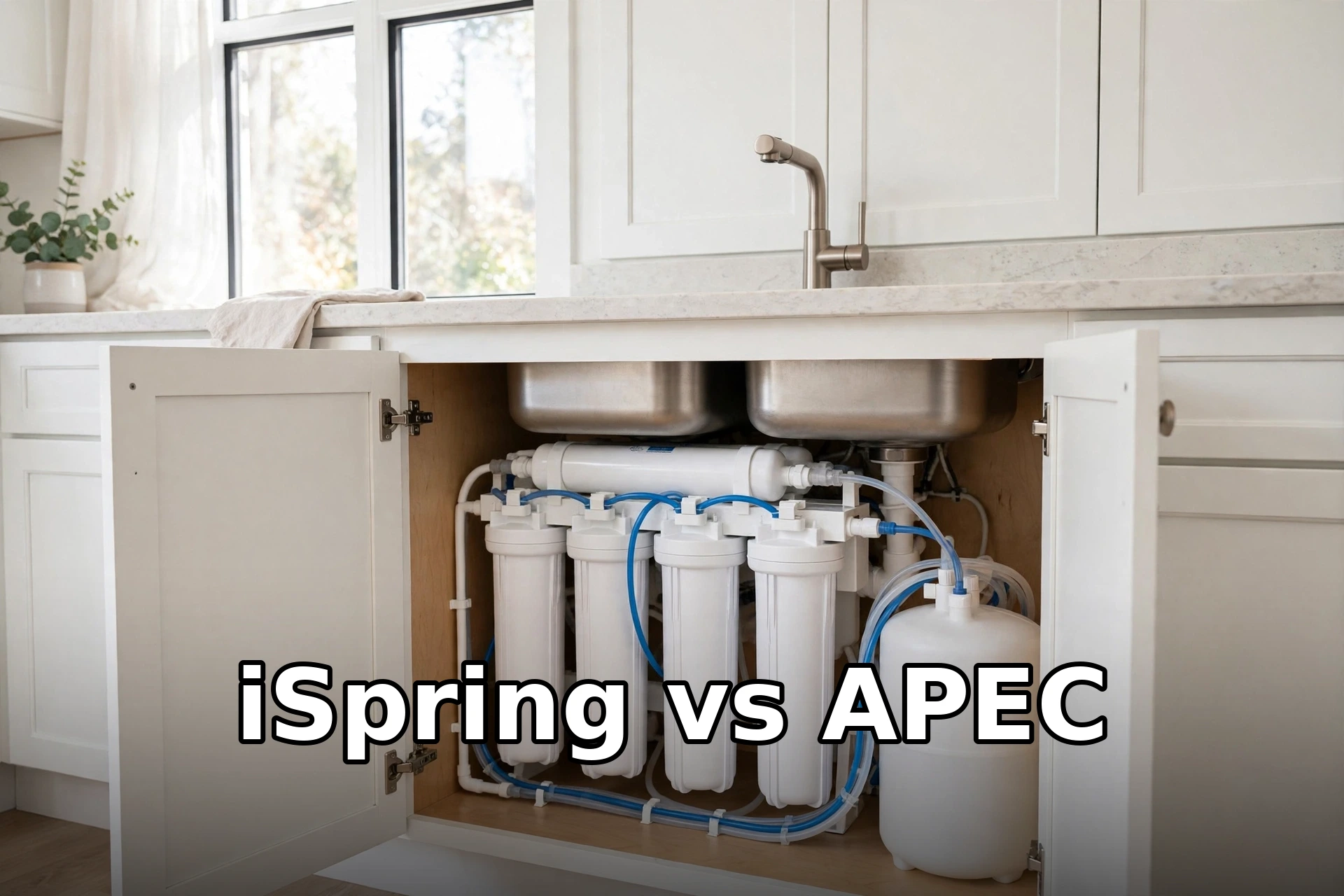
iSpring vs APEC: Which Under-Sink RO System Is Better in 2026?
If you’ve narrowed your search to iSpring vs APEC, you’re already looking at the two most trusted names in under-sink reverse osmosis. Both companies have been building RO systems in the USA for years, both sell tens of thousands of units, and both will absolutely clean up your tap water. The real question is which one fits your kitchen, your water, and your budget.
I dug through the current specs, certifications, filter costs, and thousands of owner experiences to give you a straight answer — no brand loyalty, no sponsored ranking.
The short answer
Buy the iSpring RCC7AK if you want alkaline, mineral-balanced water and the strongest third-party certification story (NSF/ANSI 58 for the whole system). Buy the APEC ROES-50 if you want the simplest, most proven 5-stage workhorse at the lowest long-term cost — it’s the best value RO system in America, full stop. If alkaline water matters to you on the APEC side, step up to the APEC ROES-PH75 instead.
Both are excellent. Neither is a mistake. Here’s how they actually differ.
iSpring vs APEC: spec comparison
| iSpring RCC7AK | APEC ROES-50 | APEC ROES-PH75 | |
|---|---|---|---|
| Filtration stages | 6 (with alkaline remineralization) | 5 | 6 (with alkaline pH+ filter) |
| Daily output | 75 GPD | 50 GPD | 75 GPD |
| System certification | NSF/ANSI 58 (whole system) | WQA certified | WQA certified |
| Alkaline / pH+ | Yes (red mineral stone + calcite) | No | Yes (calcium carbonate) |
| Power needed | No | No | No |
| Storage tank | Yes (3.2 gal) | Yes | Yes |
| Fluoride reduction | Yes (NSF-tested 97.4%) | Yes (listed) | Yes (listed) |
| Faucet included | Yes (lead-free, brushed nickel) | Yes (brushed nickel) | Yes |
| Warranty | 1-year limited | 1-year limited | 1-year limited |
| Best for | Mineral taste lovers, certification sticklers | Budget-first buyers, simple installs | APEC fans who want alkaline water |
Specs from the manufacturers’ Amazon listings, checked October 2026. Prices change often — check the live listings.
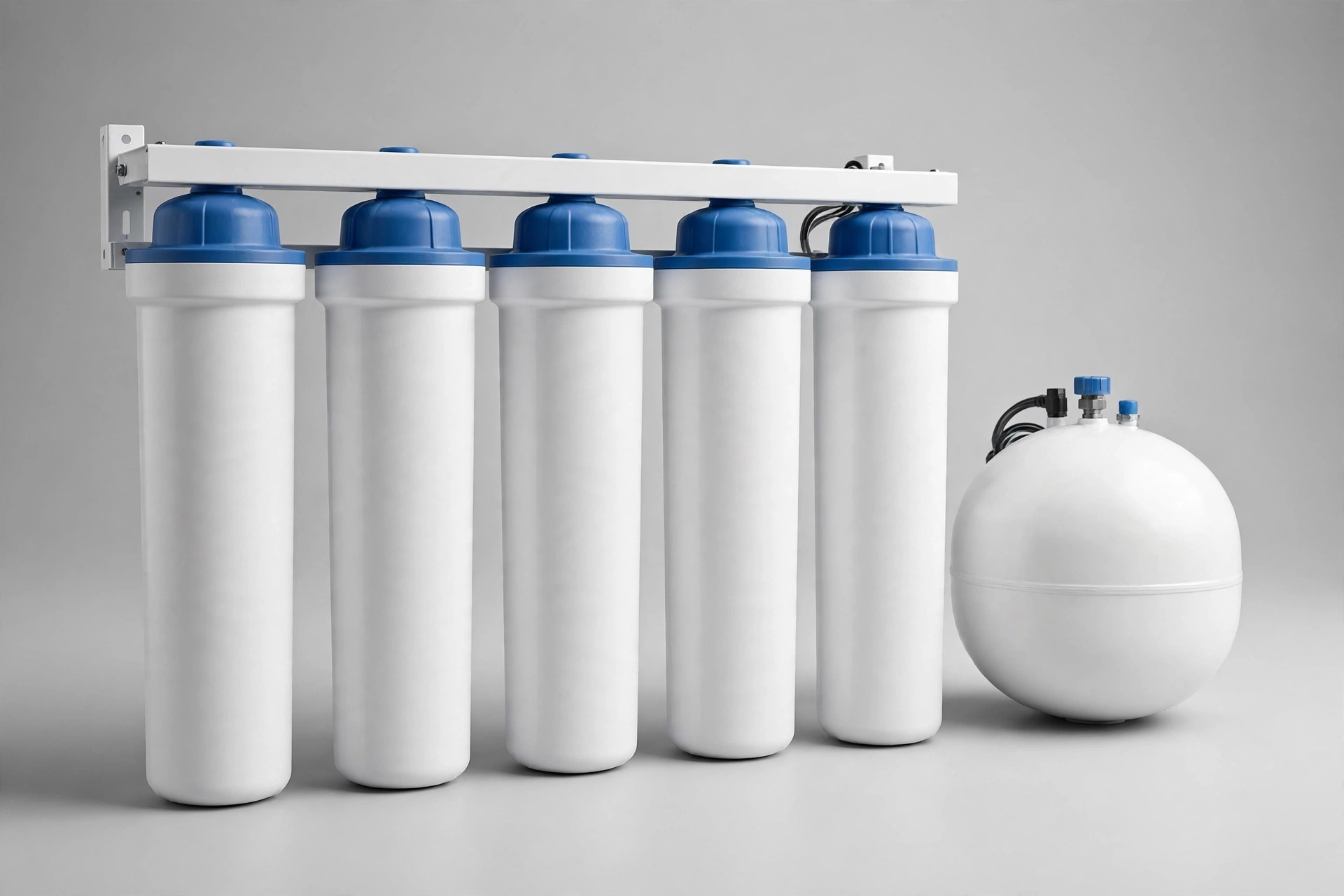
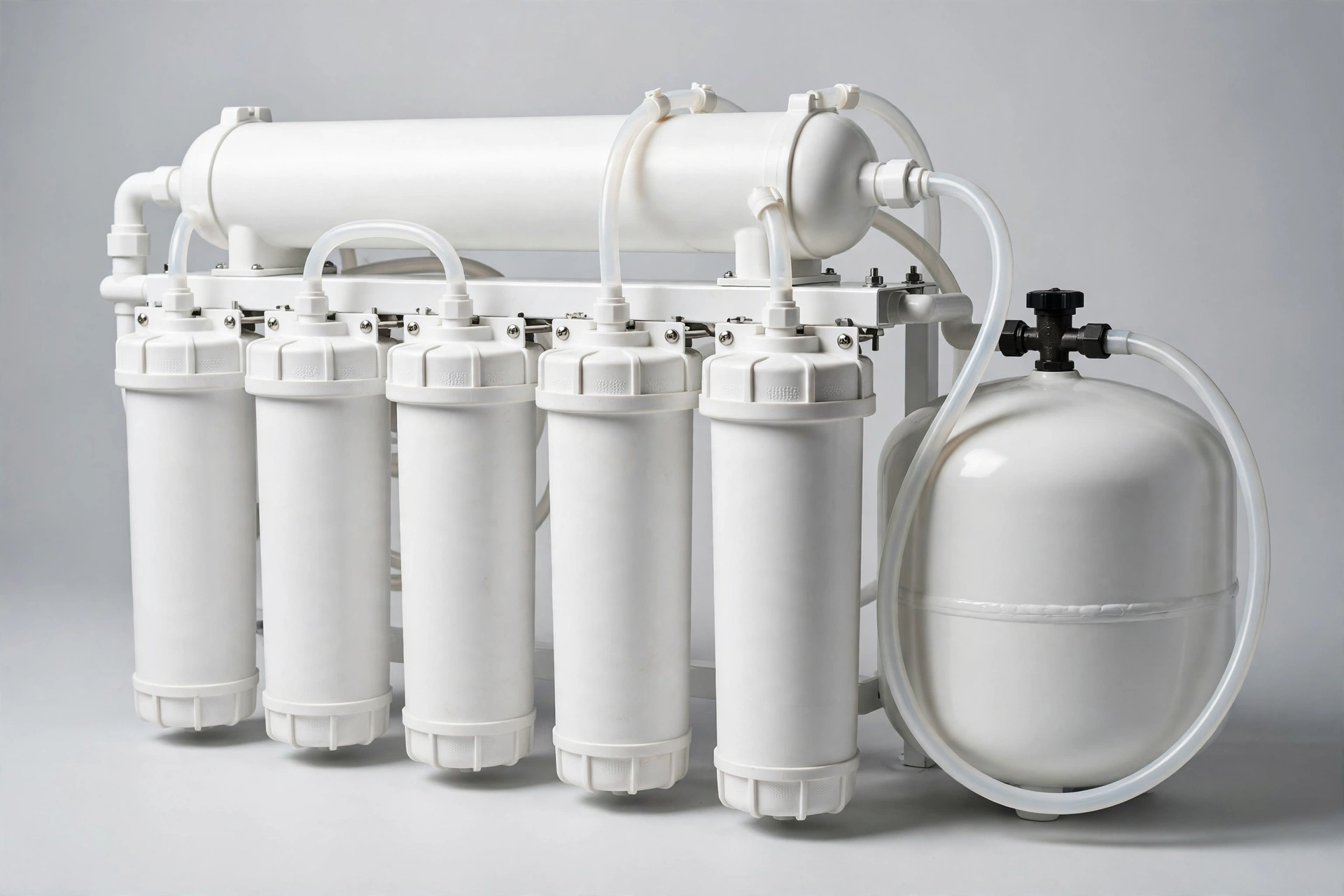
Filtration performance: both are the real deal
Let’s clear this up first: both brands use genuine reverse osmosis membranes that remove up to 99% of 1,000+ contaminants — lead, fluoride, chlorine, arsenic, nitrates, and dissolved solids. This isn’t marketing fluff; it’s how RO works, and both companies’ membranes do the job.
Where they differ is the paperwork. iSpring’s RCC7AK carries NSF/ANSI 58 certification for the entire system, tested by NSF International — including specific reduction numbers (lead 98.9%, fluoride 97.4%, TDS 97.9%). APEC’s systems are WQA certified, which is also a legitimate third-party certification, just through a different body (the Water Quality Association).
In practice? Owners of both report the same thing: TDS readings dropping from 300–400 ppm to under 20 ppm, noticeably better-tasting water, and filters that last as advertised. If certifications help you sleep at night, iSpring’s NSF numbers are more detailed. If you trust two decades of APEC’s track record, the WQA badge is plenty.
The alkaline question: RCC7AK vs ROES-PH75
Standard RO water is slightly acidic and stripped of minerals — some people find it tastes “flat.” Both brands sell an alkaline version that adds minerals back:
- iSpring RCC7AK adds a 6th stage with red mineral stone and calcite, raising pH and restoring calcium and other minerals. No electricity needed.
- APEC ROES-PH75 adds a calcium-carbonate mineral cartridge (75 GPD, 6 stages) for the same purpose.
The plain APEC ROES-50 has no remineralization stage. If you want that mineral taste from APEC, you need the PH75 — don’t buy the ROES-50 expecting alkaline water.
Honest take: alkaline RO water tastes better to most people, but the health claims around alkaline water are overblown. Buy it for taste, not for miracles.
Installation and living with them
Both systems install under a standard kitchen sink in 1–2 hours with basic tools. Both include the faucet, tank, tubing, and color-coded fittings. Both need 40+ psi of incoming water pressure (if yours is lower, iSpring sells a booster-pump version, the RCC1UP-AK).
Day to day, they’re equally low-maintenance: no electricity, no noise, no moving parts. The tank refills automatically. You’ll change pre-filters twice a year and barely think about the system otherwise.
One practical difference: iSpring’s first-stage housing is transparent, so you can see when the sediment filter is getting dirty. It’s a small thing, but owners genuinely like it.
A note on water pressure: both systems want 40–85 psi of incoming pressure (iSpring specifies 40–95). Most city homes sit comfortably in that range. If yours runs low — slow faucets, weak shower — the RO will produce water slowly and waste more to drain. iSpring sells the RCC1UP-AK with a built-in booster pump for exactly this situation; APEC’s answer is the RO-PERM with a permeate pump. Don’t buy a standard system for a low-pressure home and hope for the best.
Filter cost per year: the math nobody shows you
This is where the real comparison happens, because the system price is a one-time cost and filters are forever.
iSpring RCC7AK — roughly $55–65/year:
- Pre-filters (stages 1–3) + post-carbon: the F7-GAC 1-year pack (7 filters) runs about $40–45 and covers a full year of scheduled changes.
- RO membrane: every 2–3 years, roughly $30–40 → about $12–15/year amortized.
- Alkaline filter: every 6–12 months depending on use, roughly $15–20/year if you replace it annually.
APEC ROES-50 — roughly $57/year:
- The FILTER-MAX-ES50 complete 5-stage set sells for around $57 on Amazon and covers a full year (pre-filters every 6–12 months, membrane and post-filter every 2–4 years depending on your water).
Bottom line: annual ownership costs are nearly identical. APEC’s single complete set is simpler to buy; iSpring’s pack system is slightly more flexible. Neither will surprise you.
(Prices move on Amazon — treat these as ballparks and check the live listings. Our full maintenance walkthrough: iSpring RCC7 Filter Replacement Schedule & Cost Guide.)
Who should NOT buy these
- Renters who can’t drill — both need a hole for the faucet and a drain connection. Look at a countertop RO like the AquaTru instead (see our 5 best tankless RO systems for no-plumbing options).
- Well water with heavy sediment — RO membranes clog fast on untreated well water. You need pre-treatment first, regardless of brand.
- Anyone wanting instant hot water or a tankless footprint — these are traditional tank systems. Tankless options are in our Waterdrop G3P600 vs G3P800 comparison.
The verdict
Get the iSpring RCC7AK if you want alkaline mineral water plus the most detailed NSF certification paperwork — it’s the best all-around package for households that care about taste and verified performance. See it on Amazon
Get the APEC ROES-50 if you want the proven, no-nonsense 5-stage system at the lowest price with dead-simple filter changes. It’s been America’s default recommendation for a decade for a reason. See it on Amazon
Get the APEC ROES-PH75 if you’re team APEC but want the alkaline mineral stage too. See it on Amazon
On a tight budget and don’t care about alkaline? The plain iSpring RCC7 (5-stage, no remineralization) is usually the cheapest entry point into either brand’s ecosystem.
Frequently asked questions
Which is better, iSpring or APEC?
Neither is objectively better — they’re the two most reputable RO brands in the US. iSpring leads on certification detail (NSF/ANSI 58) and alkaline options; APEC leads on simplicity, track record, and slightly lower filter costs. Match the model to your needs, not the brand to your loyalty.
What is the difference between the iSpring RCC7AK and the APEC ROES-50?
The RCC7AK is a 6-stage, 75 GPD system with alkaline remineralization and NSF/ANSI 58 whole-system certification. The ROES-50 is a 5-stage, 50 GPD system without remineralization, WQA certified. The iSpring produces more water per day and adds minerals; the APEC is simpler and usually cheaper.
Is APEC RO worth the money?
Yes. The ROES-50 is consistently the best-reviewed under-sink RO on Amazon, with replacement filters that cost under $60 a year. It’s the value king of the category.
How long do iSpring and APEC filters last?
Pre-filters (sediment + carbon): 6–12 months depending on water quality. RO membranes: 2–3 years for iSpring, 2–4 years for APEC. Post-carbon/alkaline filters: 6–12 months.
Which RO system has the lower annual filter cost?
They’re essentially tied at roughly $55–65/year. APEC’s complete FILTER-MAX-ES50 set (~$57) is the simplest one-click option; iSpring’s F7-GAC annual pack (~$40–45) plus a membrane every few years lands in the same range.
Do iSpring and APEC systems remove fluoride?
Yes, both. iSpring’s NSF testing shows 97.4% fluoride reduction on the RCC7AK; APEC lists fluoride among the contaminants its membranes remove.
Related: Waterdrop G3P600 vs G3P800: Is the Upgrade Worth It? · Does Reverse Osmosis Remove PFAS?
Have a dog at home? Our friends at Furveko publish genuinely useful dog care guides — and if you’d rather earn from your laptop, JobyRoz breaks down practical ways to make money online.