

The tankless RO market has a loud, expensive problem: everyone promises “instant pure water,” almost nobody publishes honest numbers, and half the reviews read like press releases with better lighting. The Waterdrop G3P600 has been selling since long enough to have a real owner track record, a real certification (not the marketing kind), and — importantly — real complaints you can learn from. I pulled its spec sheet from Waterdrop’s own pages, cross-checked owner reviews and hands-on tests, and this is the no-hype version of what’s actually under your sink if you buy one.
As an Amazon Associate, Clearove may earn from qualifying purchases — at no extra cost to you. Prices and availability change; the price on Amazon at checkout is what counts.
The short version
The G3P600 is a 600 GPD tankless reverse-osmosis system with an 8-stage filter chain, a 2:1 pure-to-drain rating, and genuine NSF/ANSI 58 and 372 certification. It fills an 8-ounce glass in about 8 seconds, its smart faucet shows real-time TDS and filter life, and annual filter costs run about $145 according to third-party estimates (waterfilterportal, techgearlab). It’s the sweet spot in Waterdrop’s lineup if you want serious flow without the G3P800’s bigger price tag — but only if you have municipal tap water, an under-sink power outlet, and realistic expectations about the drain ratio. Here’s the full picture.
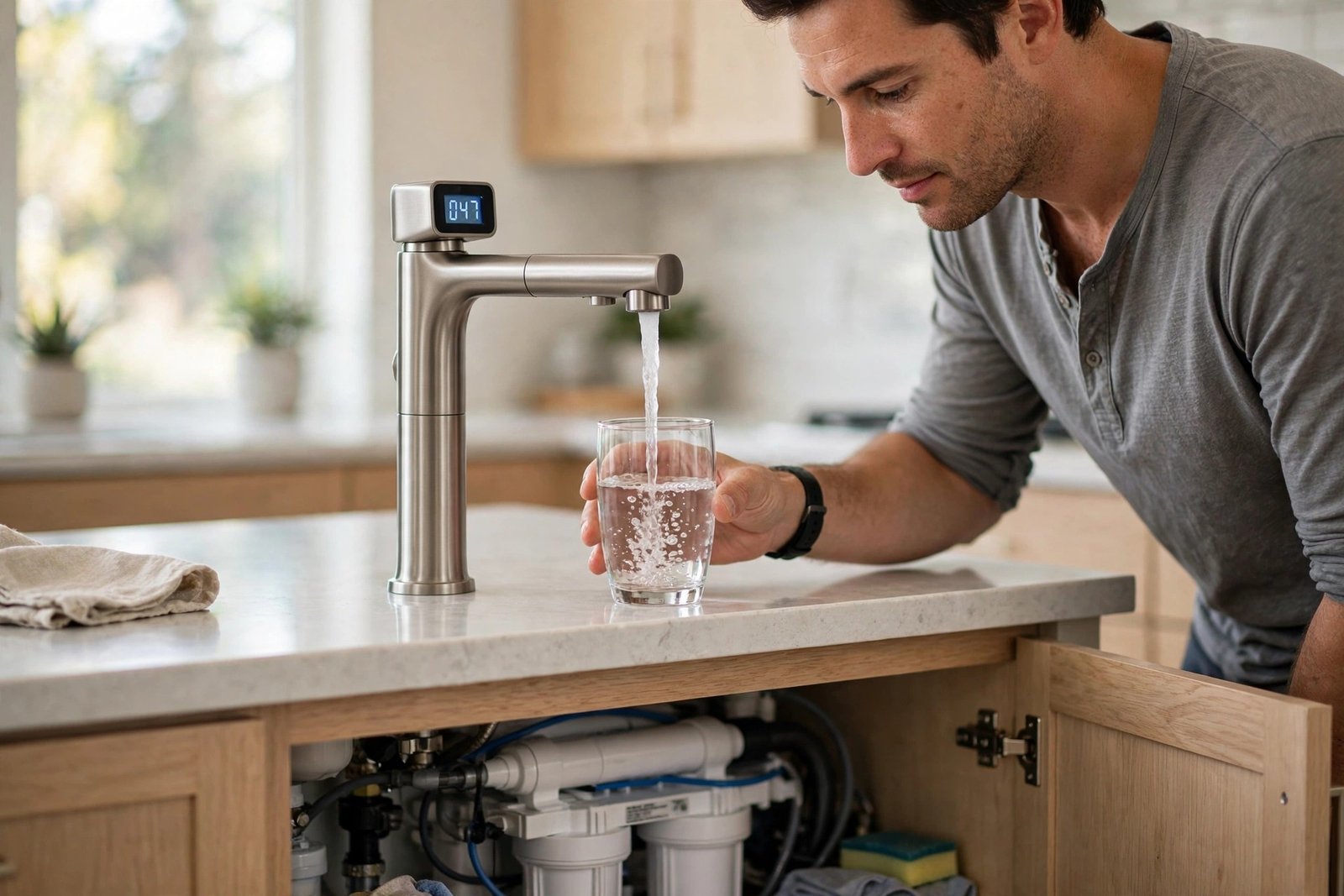
Waterdrop G3P600 — full spec sheet (verified)
Every number below comes from Waterdrop’s official pages (waterdropfilter.com and waterdropfilter.eu), not a thin affiliate table copied three blogs deep:
| Specification | Waterdrop G3P600 |
|---|---|
| Model number | WD-G3P600 |
| Daily output | 600 GPD (0.42 GPM) — an 8 oz cup in ~8 seconds |
| Filter stages | 8-stage (CF pre-filter → RO membrane → CB post-filter) |
| Pure-to-drain ratio | 2:1 rated (see the honesty section below — real world differs) |
| Certifications | NSF/ANSI 58 & 372 certified (genuinely certified, not “tested to 53” like thin blogs claim) |
| Smart faucet | Yes — real-time TDS display + filter-life indicator |
| Dimensions | 18.11″ × 5.67″ × 17.73″ |
| Weight | 32.4 lbs |
| Power | Required — 90″ power cord, under-sink outlet needed |
| Feed water limits | 14.5–87 psi, 41–100°F, TDS below 750 ppm, hardness below 7 gpg |
| Warranty | 1 year + lifetime technical support |
G3P600 vs G3P800 — which one actually fits your kitchen?
This is the question the search data keeps asking, and we already answered it head-to-head in our Waterdrop G3P600 vs G3P800 comparison — so I won’t rehash every row here. The honest summary: the G3P800 is the 800 GPD flagship with more daily capacity, but it costs more up front and its replacement filters cost more too. If you’re a couple, a small family, or you mostly fill pitchers and glasses, 600 GPD is already a firehose — across owner reviews, nobody is standing around waiting on the G3P600. You buy the 800 when you have high-TDS water, a big household drinking tap water all day, or you just like headroom. Everyone else saves the difference and never misses it. Our full G3P800 review covers the bigger unit in detail if you’re on the fence.
Filter cost per year — the real math
Annual filter cost: ~$145/year (third-party estimate)
- WD-G3-N1CF (CF pre-filter) — every 6 months
- WD-G3P600-RO (RO membrane) — every 24 months
- WD-G3-N3CB (CB post-filter) — every 12 months
That’s the schedule from Waterdrop’s official compare table (resellers like aquahomesupply corroborate it), and the ~$145/year figure comes from waterfilterportal and techgearlab’s own cost math — not Waterdrop’s marketing. One naming note: older listings call these WD-G3CF / WD-G3RO / WD-G3CB; the current official names are WD-G3-N1CF, WD-G3P600-RO, and WD-G3-N3CB, so search with the new names when buying replacements. (Target’s own listing confirms the WD-G3-N1CF part number.) Compared with bottled water — a family spending even $2 a day on bottles is out ~$730 a year — the G3P600’s running cost is genuinely one of its strongest selling points.
Price — the honest, hedged version
I don’t quote fixed prices here because they move constantly, but here’s the observed range: dealnews showed the G3P600 recently seen around $429 on sale (October 2026) with a $539 regular price, and Waterdrop’s own cost guide lists $539 as the base price. That’s meaningfully cheaper than the 800 GPD flagship, which is the whole value proposition: flagship-tier filtration and flow at mid-range money. Check the current price with the button above — Amazon runs deals on this one regularly.
Who should NOT buy the Waterdrop G3P600
Most reviews skip this section. I consider it the most important one in the article, because this system has real, documented caveats:
- No under-sink power outlet, and no plan to get one. This is a powered system — the 90-inch cord needs a real outlet. No outlet, no purchase.
- You’re on well water. The G3P600 is rated for municipal water only. There’s no UV stage, so it makes no bacteria or microbe claims, and feed limits top out at 750 ppm TDS / 7 gpg hardness. Well owners need pre-treatment first — we explain the full contaminant picture in our RO drain ratio and waste-water guide context pieces on feed-water limits.
- You’re counting on exactly 2:1 efficiency. Techgearlab’s hands-on test measured 1 gallon of waste per 2.3 gallons of clean water, and a recent UK review notes the real-world ratio gets worse once the auto-flush cycles kick in. Still better than old tank systems — but don’t budget your water bill on the marketing number.
- You want alkaline/mineralized output. This is a straight RO system; output TDS reads near zero. If you miss the mineral taste, you’d need a remineralization cartridge — it doesn’t ship with one.
- You’re sensitive to operating noise. Target’s owner reviews mention minor noise during operation. It’s a pump-driven system; it’s not silent.
Two more honesty notes from the owner-review record: some buyers report TDS readings on the faucet display that don’t match their own independent meters, and a few report replacement-filter availability hiccups. Neither is a dealbreaker across the board, but both are worth knowing before you click buy. Our G3P600 filter replacement guide walks through the swap schedule, costs, and where the official filter names matter.
Pros and cons
Pros
- 600 GPD is genuinely fast — no more pitcher-refill purgatory
- Tankless design: no bulky tank eating cabinet space, fresher water (no stored water sitting around)
- Real NSF/ANSI 58 & 372 certification — rare at this price
- Smart faucet with live TDS + filter-life readout actually works as advertised
- 8-stage chain with a long 24-month membrane life keeps yearly costs ~$145
- 1-year warranty plus lifetime tech support (support quality gets decent marks across reviews)
Cons
- Requires an under-sink power outlet — renters and old kitchens beware
- Real-world drain ratio worse than the 2:1 claim (measured ~1:2.3)
- Municipal water only; no UV stage, no bacteria claims
- Minor operating noise reported by owners
- Only a 1-year warranty on a $400+ appliance
- Near-zero TDS output — add a remineralization filter separately if you want minerals back
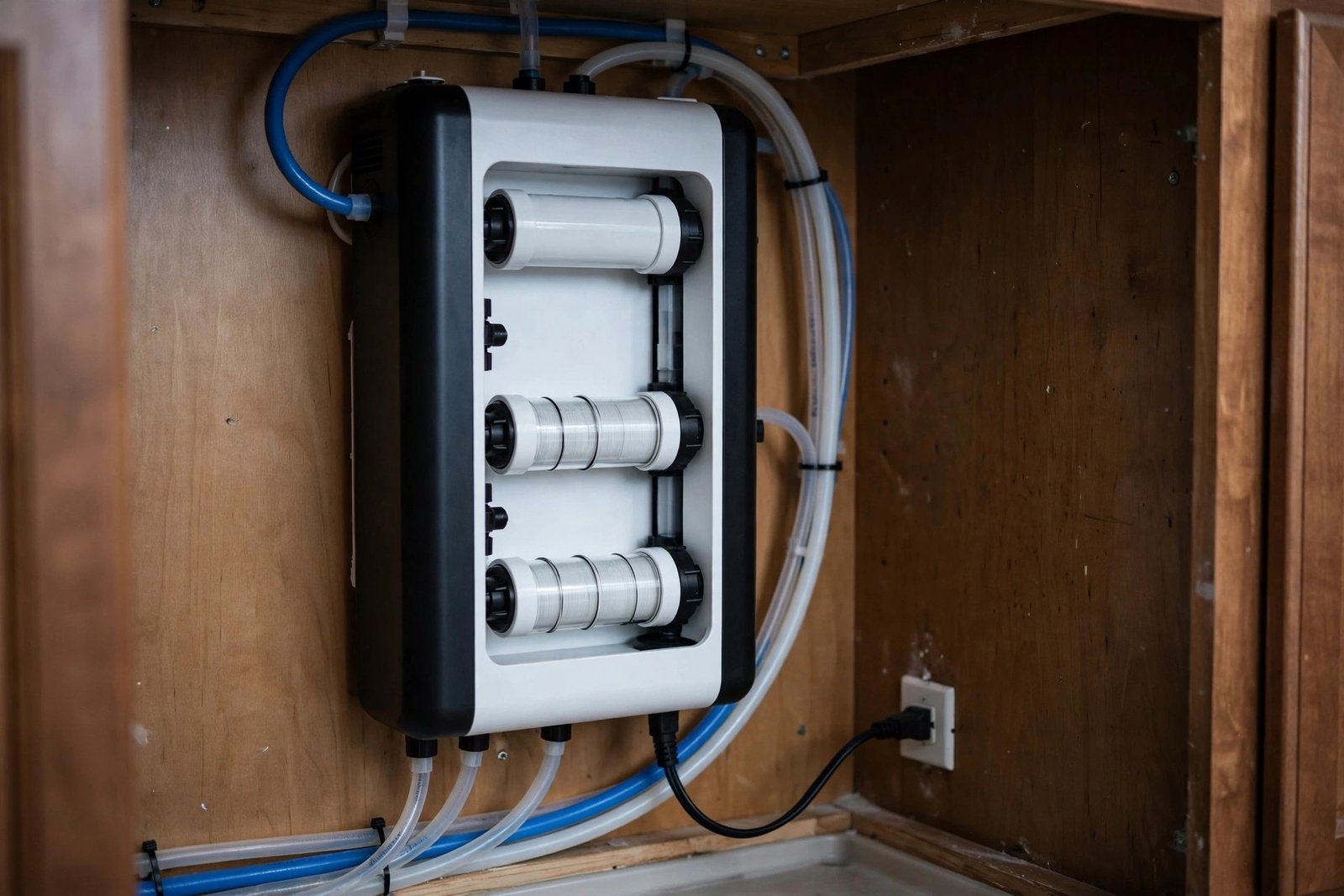
Installation — what you’re really signing up for
At 18.11″ tall and only 5.67″ wide, the unit slides into most standard under-sink cabinets, and the quick-twist filter cartridges make swaps a seconds-long job — the 6/12/24-month schedule above is about as low-maintenance as RO gets. The install itself is standard under-sink plumbing: tee into the cold water line, hang the drain saddle, mount the smart faucet through a 1.5″ hole (or the sink’s existing soap-dispenser hole), and plug in. What catches people off guard is the electrical step — older kitchens often have no outlet under the sink, and that’s an electrician visit, not a plumbing one. Also verify your feed water against the limits in the table: 14.5–87 psi, TDS under 750 ppm, hardness under 7 gpg. Outside those, the membrane’s lifespan takes the hit and your ~$145/year math stops being ~$145/year.
FAQ
Is the Waterdrop G3P600 worth it over the regular G3?
For most buyers, yes — the P-series brings the 2:1 drain ratio, the smart display faucet, and the 600 GPD flow. The older G3 is cheaper but you’re giving up the parts that make this system feel premium day to day. If budget is the whole decision, check the G3’s current sale price before ruling it out.
G3P600 vs G3P800 — which should I buy?
600 GPD already covers a typical household with headroom. Buy the G3P800 if you have a big family on tap water all day, high-TDS feed water that will chew through the membrane faster, or you simply want maximum capacity. Otherwise the G3P600’s lower upfront and filter costs win. The detailed head-to-head lives in our G3P600 vs G3P800 comparison.
How long do G3P600 filters last?
Official schedule: CF pre-filter (WD-G3-N1CF) every 6 months, CB post-filter (WD-G3-N3CB) every 12 months, RO membrane (WD-G3P600-RO) every 24 months. The smart faucet tracks filter life and tells you when each is due — owners consistently cite this as one of the system’s best features.
What is the real drain ratio of the G3P600?
Rated 2:1 pure-to-drain. Measured hands-on by techgearlab: 1 gallon of waste per 2.3 gallons of clean water, and real-world efficiency dips further when auto-flush cycles run. Still far better than the 1:3 or 1:4 of old tank systems — just don’t treat 2:1 as a guarantee.
Can I use the G3P600 on well water?
Waterdrop rates it for municipal water. There’s no UV stage and no microbiological claims, so on well water you’d need pre-treatment (sediment/softening as required) plus lab testing first. Feed limits: 750 ppm TDS, 7 gpg hardness max.
Does the G3P600 need electricity?
Yes — it’s a pump-driven tankless system and won’t function without power. It ships with a 90-inch cord, so you need a standard outlet inside or near the cabinet.
How much does it cost per year to run?
About $145/year in filters per third-party estimates (waterfilterportal, techgearlab), on the 6/12/24-month schedule. Electricity and the small amount of waste water add a little more, but filters dominate the running cost.
Is it really NSF certified?
Yes — NSF/ANSI 58 and 372 certification, which covers the RO reduction claims and the lead-free materials claim. Be careful with thin review blogs that write “NSF/ANSI 53 certified” — Waterdrop’s own pages don’t make that claim, and neither do I.
Final verdict
Across the owner reviews, the hands-on tests, and Waterdrop’s own spec sheets, the G3P600 earns its reputation: it’s the tankless RO I’d point most households toward in 2026. The 600 GPD flow is the real thing (8 seconds a glass), the ~$145/year filter math is honest, the smart faucet’s TDS + filter-life readout is genuinely useful, and NSF/ANSI 58 certification at this price is rare. The caveats are equally real: you need a power outlet, municipal water, and the acceptance that 2:1 is a rating, not a measurement.
If you’re deciding between this and the flagship, our G3P600 vs G3P800 head-to-head and the G3P800 review lay out the differences. If you’re new to tankless entirely, start with our best tankless RO roundup to see the whole field.