

Let’s not dance around the number on the box. The Waterdrop X12 sells for around $1,099 at the time of writing — check the current price — which puts it squarely in flagship territory. So the only question that matters is the one in the headline: is it actually worth it?
After digging through owner reports, hands-on reviews, and Waterdrop’s own manuals, here’s where I landed: this is a genuinely excellent machine for the right kitchen. A busy family that burns through filtered water will feel the difference daily. A couple drinking two glasses each? You’ll never use what you’re paying for.
One thing first: Waterdrop sells several different “X12” models. This review covers the WD-X12-Alkaline — the 11-stage version with the silver smart faucet (the exact variant linked below). The X12-Pro, X12-WAB, and X12-Basic are different machines — details in the variant section below.
As an Amazon Associate, Clearove may earn from qualifying purchases – at no extra cost to you. Prices and availability change; the price on Amazon at checkout is what counts.
The 30-second verdict: The X12-Alkaline is Waterdrop’s flagship tankless RO for a reason — 1,200 GPD of real flow, an alkaline mineralization stage, a smart faucet that actually tells you things, and honest filter economics (~$95/year plus a membrane every two years). The 3:1 drain-ratio marketing is optimistic (an independent test measured 2:1), the faucet wobbles slightly, and you need an outlet under your sink. Worth it for households of 3+ or serious home cooks. Overkill for one or two people — the 600 GPD tier does the same job for roughly half the money.
Waterdrop X12 (Alkaline) — Specs at a Glance
| Spec | Detail |
|---|---|
| Model reviewed | WD-X12-Alkaline (silver smart faucet) |
| Flow rate | 1,200 GPD (0.4 GPM); one reviewer measured ~1,418 GPD actual |
| Stages | 11-stage; 16-layer 0.0001-micron RO membrane |
| Alkaline stage | F1A filter — carbon + alkaline mineralization, infuses calcium/magnesium, pH 7.5± |
| UV | LED UV sterilizer with indicator light on the faucet |
| Drain ratio | 3:1 pure-to-drain (official); 2:1 measured by gadgetreview |
| Certifications | “Tested and certified by IAPMO R&T against NSF/ANSI 42 & 58 & 372 standard” |
| Smart faucet | Digital TDS readout, filter-life indicators (F1/F2/F3 + UV), preset ounce dispensing, energy-saving mode |
| Filters | F2: 6 mo / ~$30.99 · F1A: 12 mo / ~$32.99 · X12-F3 membrane: 24 mo / ~$159.99; tool-free 3-second swap |
| Size / weight | 18.2 × 6.25 × 16.72 in; 38.2 lbs; tankless (no storage tank) |
| Power | Corded — requires an outlet under the sink |
| Price | MSRP $1,299; street ~$1,039–$1,099; promo dips to $899 |
| Warranty | 30-day money-back; 2-year manufacturer warranty; lifetime tech support |
The exact variant reviewed here (X12-Alkaline, silver faucet):
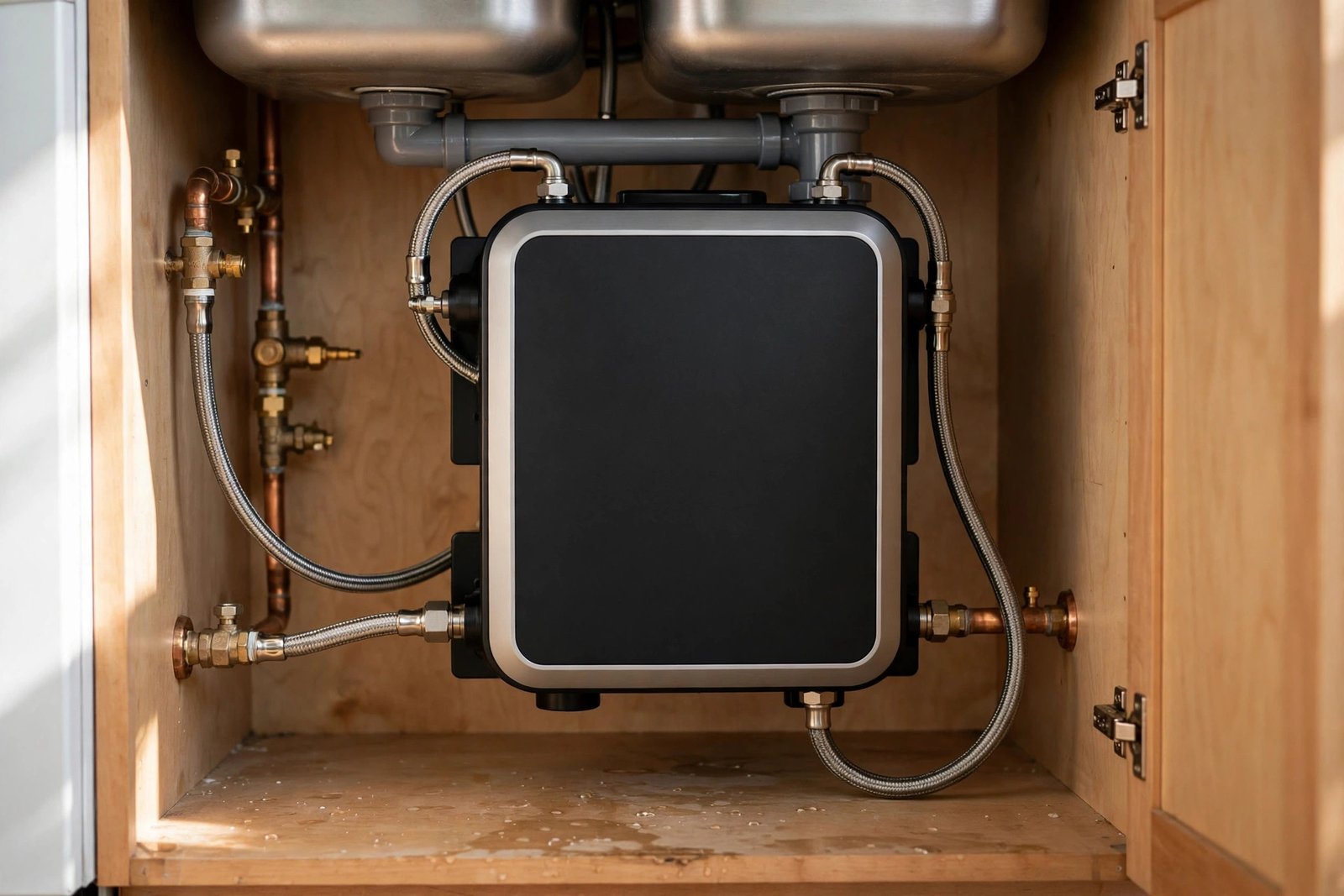
What 1,200 GPD Actually Feels Like in a Real Kitchen
At 0.4 gallons per minute, the X12 fills a 150 ml cup in about 3 seconds. A reviewer at the-gadgeteer.com actually measured output and got roughly 1,418 GPD — above the rated figure, which almost never happens with RO systems.
Day to day that means no waiting for a tank to refill and no trickle when the tank runs low. Turn the faucet, water comes out at full pressure, turn it off. If you’ve ever stood at a sink waiting on an old 50 GPD tank system to fill a pasta pot, this feels like a different appliance category.
Two honest caveats. At full blast the stream can splash — 1,200 GPD through a drinking faucet is genuinely powerful. Waterdrop buried the fix in the manual: a “faucet mode” activated by holding F1+F2 during power-on. And installation ends with a 35-minute auto-flush cycle (confirmed by housedigest’s hands-on), so don’t plan your first glass for the minute the plumber leaves.
The Alkaline Stage, Explained Without the Marketing Fog
The F1A filter is what makes this the “Alkaline” X12: after the RO membrane strips the water down, this carbon + alkaline mineralization stage puts a little back — calcium and magnesium — landing pH around 7.5±. Straight RO water can taste flat; the remineralized output tastes rounder.
Now the part that confuses new owners: your TDS meter will read 15–30 ppm higher than you’d expect — and that’s by design. The minerals the F1A adds back show up as dissolved solids. It’s not a failing membrane; it’s the feature working. Real-world output lands around 9–30 ppm, and the top end of that range is the alkaline stage doing its job. If you want the lowest possible TDS number, buy the non-alkaline variant — but you’ll give up the better taste.
The Smart Faucet: Genuinely Useful, Slightly Wobbly
The faucet is the X12’s party trick. The digital readout shows your water’s TDS in real time. Filter-life indicators track F1, F2, F3, and the UV lamp separately, so you know exactly which cartridge to swap. There’s preset ounce dispensing, and an energy-saving mode that quiets the system (at the cost of some flow; the light ring shifts from white to green).
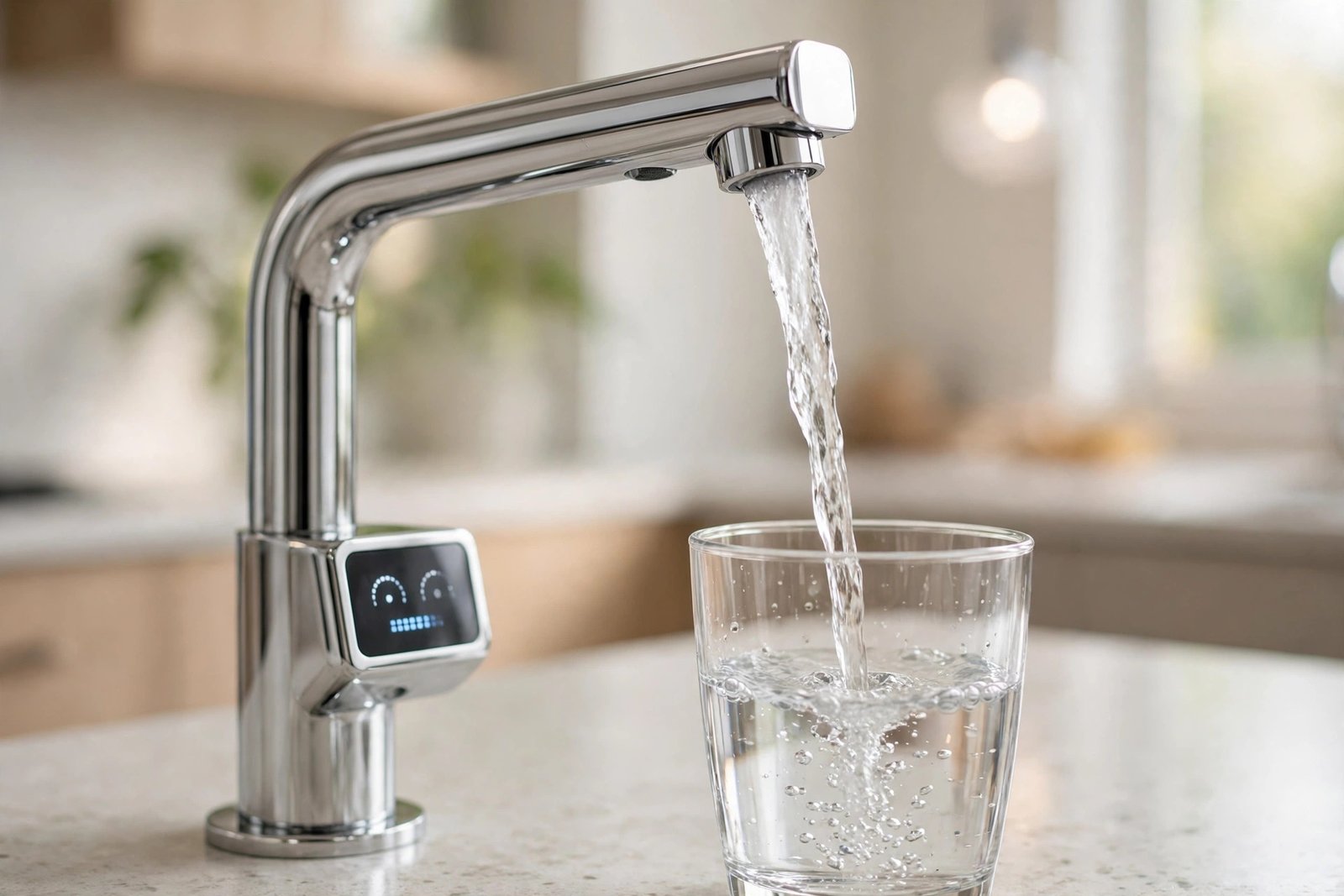
Owners love the TDS readout most — it’s the earliest warning you’ll get that a filter is aging. The knocks: a slight wobble at the base (confirmed hands-on) and splashback at full flow in shallow glasses.
The UV Sterilizer: What It Actually Does
The X12 carries a built-in LED UV sterilizer with its own indicator light on the faucet, and the faucet tracks the lamp’s life separately from the filters. Think of it as a final polishing pass on already-filtered water as it leaves the system — a nice extra layer, and genuinely useful peace of mind. Keep it in proportion, though: this is still a drinking-water RO system, not a disinfection device for microbially risky well water.
Drain Ratio: Read This Before You Believe the 3:1
Waterdrop’s official figure is 3:1 pure-to-drain. But gadgetreview ran the same platform through real testing and measured 2:1. You get both numbers because drain ratio shifts with water pressure, temperature, and input TDS — neither the marketing sheet nor a single test tells the whole story.
Is 2:1 bad? Not remotely — plenty of tank systems waste three to four cups per clean cup. But if “3:1” on the box was the selling point, calibrate accordingly. Our full breakdown of how RO drain ratios actually work walks through what moves the number in real homes.
One more claim to deflate: you’ll see “removes 99%+ of TDS” language floating around RO marketing generally. The NSF/ANSI 58 bar is ≥75% TDS reduction. The X12’s official line — “Tested and certified by IAPMO R&T against NSF/ANSI 42 & 58 & 372 standard” — is the wording to trust. Note the phrasing: tested and certified by IAPMO R&T against the standards. That’s meaningful, and it’s not the same as “NSF certified,” so I won’t phrase it that way.
Filter Economics: What the X12 Really Costs Per Year
Most X12 reviews skip this; I’d read it first. The cartridges are refreshingly straightforward:
X12 filter costs (US pricing, estimate):
F2 (pre-sediment + carbon block) — every 6 months — ~$30.99
F1A (carbon + alkaline) — every 12 months — ~$32.99
X12-F3 (RO membrane) — every 24 months — ~$159.99Yearly total: roughly $95/year ($30.99 × 2 + $32.99), plus ~$160 every two years for the membrane — about $115/year averaged over three years. Swaps are tool-free, about 3 seconds per cartridge. Filter prices drift; treat these as estimates.
For a $1,099 appliance that’s a fair running cost — far cheaper than a bottled-water habit, and competitive with systems costing half as much up front. Still, four figures deserves real household math before you buy. If you’re the type who runs the numbers on big home purchases, EarnRove is built for exactly that kind of payback-versus-price thinking.
The Variant Trap: Not Every “X12” Is This X12
The Amazon listing at the button above (B0C7GFMP8Z) is the WD-X12-Alkaline — 11 stages, F1A alkaline filter, silver smart faucet. That’s the machine in this review.
The siblings: the X12-Pro is a separate dual-flow variant (it’s the one gadgetreview tested — similar platform, different configuration). The X12-WAB ships with a black faucet instead of silver. The X12-Basic is a 10-stage version, most likely without the alkaline step. Filter SKUs and manuals aren’t freely interchangeable across these, so match the model name on the listing to the filters you buy later. And if a deal looks too good — an “X12” at $700 — check which variant it is before celebrating.
One Thing Waterdrop Itself Contradicts
A UK retailer’s X12 spec sheet lists 300 ppm as the maximum input TDS; Waterdrop’s own French manual suggests up to 1,000 ppm. Both can’t be the engineering limit. Practical takeaway: if you’re on a well or very hard municipal water, test your water first and confirm with Waterdrop support that your numbers are in range. City water in the 100–400 ppm range — where most US buyers sit — is uncontroversial territory for this system.
Pros and Cons
What I like
- Genuinely fast: 1,200 GPD rated, ~1,418 measured by one reviewer — no waiting, ever
- Alkaline remineralization tastes better than flat RO output (pH ~7.5)
- Smart faucet with live TDS + per-filter life indicators is useful, not gimmicky
- Honest filter economics: ~$95/year, tool-free 3-second swaps
- LED UV sterilizer adds a final polishing pass with a faucet indicator
- Tankless design frees the whole under-sink cabinet; no tank to sanitize
- Strong owner sentiment: 9/10 from 333 reviews per pricehistory.app; 200+ bought in the past month per valuepicksmart
What I’d flag
- 3:1 drain ratio is the marketing number; independent testing measured 2:1
- Needs a power outlet under the sink — no outlet, no X12
- Faucet wobbles slightly (confirmed hands-on) and can splash at full flow
- 35-minute auto-flush on install; energy-saving mode cuts flow
- Alkaline stage reads higher TDS by design — confusing if unexpected
- Max input TDS guidance contradicts itself across Waterdrop’s own materials
- $1,099 is real money — overkill if your household doesn’t drink much filtered water
Who Should NOT Buy the X12
- One- or two-person households. You’ll never touch 1,200 GPD. A 600 GPD tankless like the one in our Waterdrop G3P600 review does the same job at roughly half the price.
- Renters. Drilled faucet hole plus corded power — your landlord will have opinions.
- No outlet under the sink. Hard requirement, not a nice-to-have. Check before buying, not after.
- Low-TDS city water on a budget. At 100–150 ppm tap TDS, a ~$400 tankless from our roundup of the best tankless RO systems gets you 90% of the experience.
If the UV sterilizer is what’s pulling you toward the X12, detour through our iSpring RO500 vs Waterdrop G3P800 comparison first — the G3P800’s UVC-LED setup is a different approach to the same idea.
X12 FAQ
How long do Waterdrop X12 filters last?
F2: ~6 months. F1A: ~12 months. X12-F3 RO membrane: ~24 months. The faucet tracks each separately, so you replace on actual life remaining. Budget roughly $95/year plus ~$160 every two years for the membrane (estimate).
What is the X12’s pure-to-drain ratio?
Official: 3:1. Gadgetreview’s hands-on testing measured 2:1 on the same platform. Real results vary with pressure, temperature, and input TDS.
Why is my TDS reading higher than expected?
The F1A alkaline stage adds calcium and magnesium back by design, raising TDS ~15–30 ppm. Output around 9–30 ppm is normal. It’s the feature working, not a failing membrane.
Is the smart faucet wobbly?
Slightly — hands-on reviewers confirmed a small amount of play at the base. Noticeable if you look for it; doesn’t affect function.
Does the X12 need electricity?
Yes — corded, with an outlet required under the sink. Energy-saving mode cuts noise and power but also reduces flow.
X12 vs X16 — which one?
The X16 pushes 1,600 GPD, but owners report serious splashback and recommend the X12 for normal cups and glasses. Unless you’re filling stockpots all day, the X12 is the sweet spot.
What’s the difference between the X12 variants?
X12-Alkaline (this review): 11-stage, F1A alkaline filter, silver faucet. X12-Pro: separate dual-flow variant. X12-WAB: black faucet. X12-Basic: 10-stage. Match the exact model name on any listing.
How much does the X12 cost per year to run?
Roughly $95/year in filters plus ~$160 every two years for the membrane — about $115/year over three years. An estimate; filter prices move.
Does the X12 have UV sterilization?
Yes — built-in LED UV sterilizer with a faucet indicator light, tracked separately from the filters. A final polishing pass on already-filtered water.
What TDS does the X12 output?
Around 9–30 ppm in the real world. The upper end comes from alkaline remineralization adding minerals back by design.