
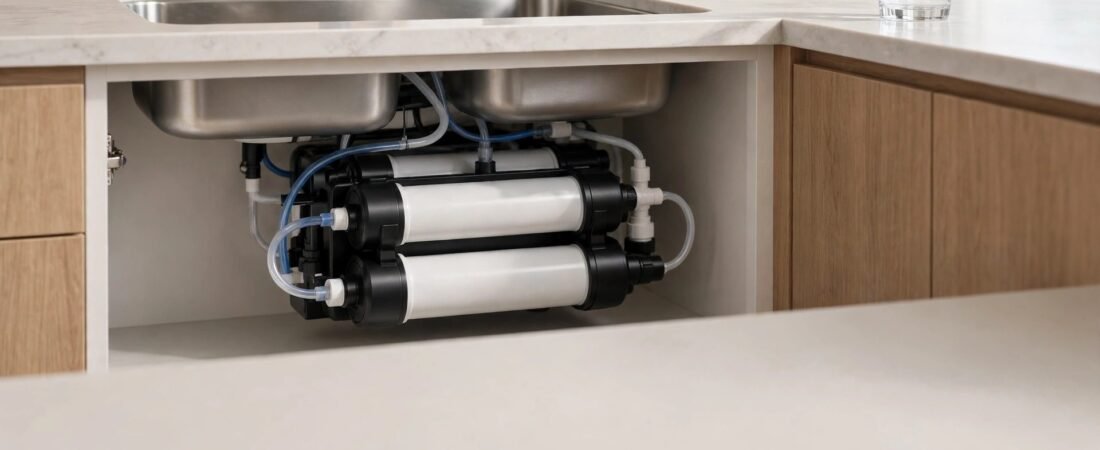
Shopping for a premium tankless RO usually comes down to two names: the iSpring RO500 and the Waterdrop G3P800. Both sit at the top of the category, both promise restaurant-quality water on demand, and both cost a good chunk more than a basic under-sink unit. So which one deserves the space under your sink?
I dug through owner reviews, manufacturer data, certification documents, and independent lab testing. The short version: one is simple, certified, and cheap to run; the other is powerful, loaded with tech, and costs roughly twice as much over five years. Here’s how they stack up.
As an Amazon Associate, Clearove may earn from qualifying purchases — at no extra cost to you. Prices and availability change; the price on Amazon at checkout is what counts.
Quick verdict: RO500 or G3P800?
If you just want the answer: get the iSpring RO500 for the lowest running costs and genuine NSF certification; get the Waterdrop G3P800 for the most capacity, UV sterilization, and the smartest faucet. The G3P800 is the better machine on paper — the RO500 is the smarter buy for most households, costing roughly half as much to run.
The certification story is worth reading before you decide — it’s the one thing most comparison posts get wrong. Keep scrolling: I’ll explain exactly what “NSF certified” means on each box, and why the wording matters.
iSpring RO500 vs Waterdrop G3P800: side-by-side specs
| Spec | iSpring RO500 | Waterdrop G3P800 |
|---|---|---|
| Daily capacity | 500 GPD | 800 GPD |
| Flow rate | Up to 0.4 GPM (8 oz in ~10 sec) | 800 GPD (6 oz in ~5 sec) |
| Pure-to-drain ratio | 2:1 | 3:1 |
| Filtration stages | 3-stage (composite sediment + carbon block, RO membrane, post carbon) | 10-stage with 0.0001 µm RO membrane + UVC-LED UV sterilizer |
| Certifications | NSF 58 certified for TDS reduction, certified by NSF International | System certified by IAPMO R&T to NSF/ANSI 42, 53, and 58 (reduction claims on Performance Data Sheet) and NSF/ANSI 372 for low lead |
| Smart features | Auto self-cleaning (20-sec membrane rinse after 24h idle) | Smart display faucet: real-time TDS, filter life, water intake |
| Feed water | Municipal water only, up to 750 ppm TDS | Municipal water only (not for well water) |
| Dimensions | 17.5″ × 5.2″ × 16.25″ (RO500-BN), 21 lbs | 18.11″ × 5.67″ × 17.73″, 32.4 lbs |
| Power | Corded electric 100–240V, built-in boost pump | Grounded outlet required |
| Estimated price | ~$600–630 (hedged band — check current price) | $759 on sale from $999 (waterdropfilter.com, fetched 2026-10-21) |
| Annual filter cost | ~$80–90/yr (third-party estimate) | $159.97/yr (Waterdrop official) |
| Warranty | 1-year limited, 30-day money-back, lifetime Atlanta-based support | Check current Waterdrop warranty terms before buying |
Want a deeper dive? Read our full iSpring RO500 review and our full Waterdrop G3P800 review, or browse the best tankless RO systems we’ve covered.
iSpring RO500: the simple, certified workhorse
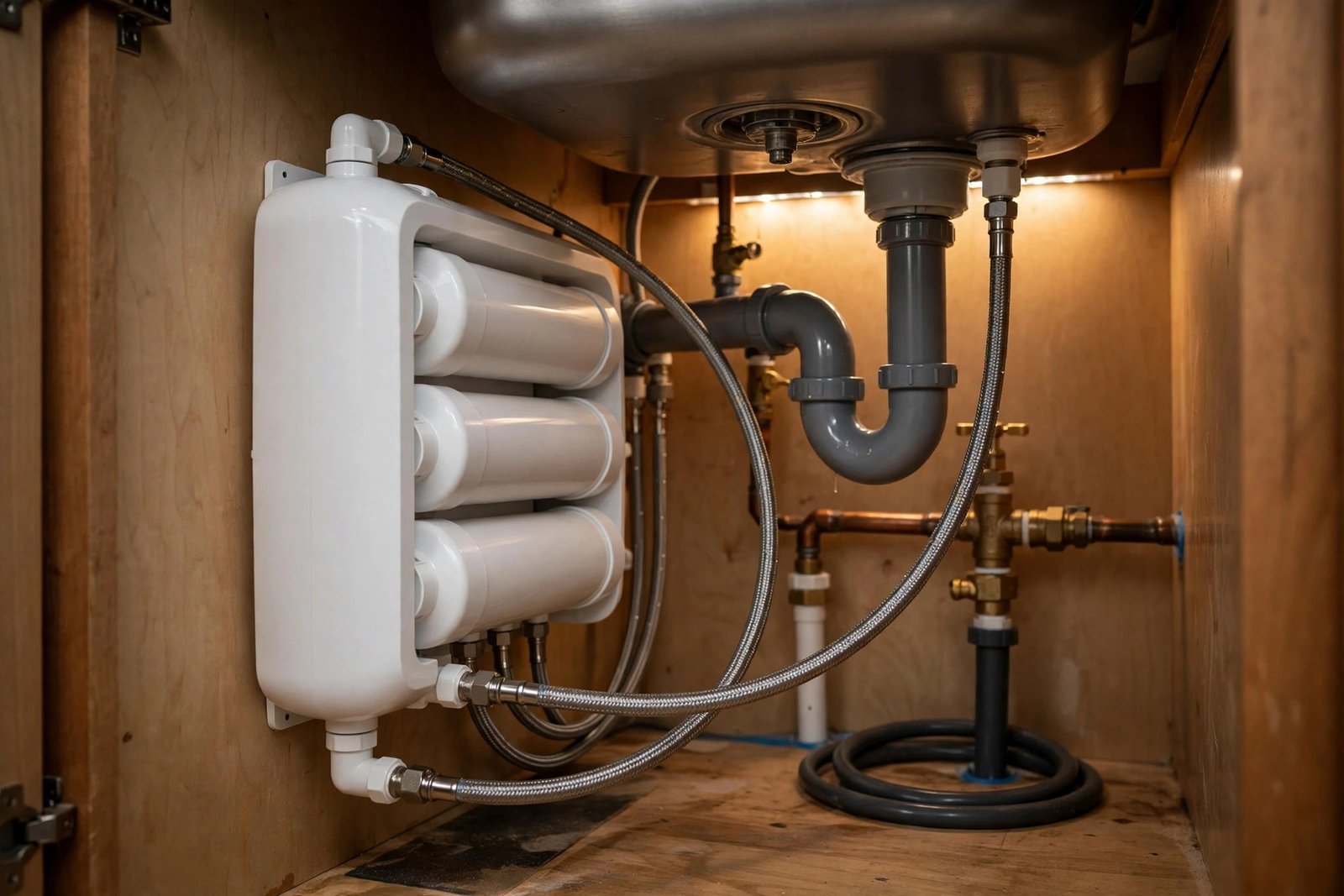
The RO500 is iSpring’s premium tankless system: three stages, done right. A 2-in-1 composite sediment and carbon block grabs the big stuff, the RO membrane does the heavy lifting, and a post carbon block polishes the taste. No UV lamp to replace, no ten-stage cartridge maze — just core RO with a boost pump.
At 500 GPD and up to 0.4 GPM, it fills an 8 oz cup in roughly 10 seconds. It’s rated 2:1 pure-to-drain: two cups of clean water per cup down the drain (our drain ratio explainer has the details).
What stands out: genuine NSF 58 certification. Not “tested to NSF standards” — the RO500 is certified by NSF International itself for TDS reduction under NSF 58, the only unit in this comparison that can say that. Paired with iSpring’s lifetime Atlanta-based support and a 30-day money-back window, it’s the safer bet for buyers who read the fine print.
Watch the variants: RO500, RO500-BN, RO500-ORB, RO500AK (adds alkaline), RO500AK-BN, and RO5004F (adds UV). If a listing attaches alkaline or UV claims to an “RO500,” check which variant it actually is — the base model has neither; those live on the AK and 4F.
iSpring RO500 pros
- NSF 58 certified for TDS reduction by NSF International itself
- Simple 3-stage design — fewer filters to buy, ~$80–90/yr upkeep
- Compact footprint (5.2″ wide) fits tight under-sink cabinets
- Auto 20-second membrane rinse after 24h idle keeps performance stable
- Lifetime Atlanta-based support, 30-day money-back guarantee
iSpring RO500 cons
- No UV on the base model (see the RO5004F variant)
- No alkaline on the base model (see the RO500AK variant)
- No NSF 53 health-claim certification — TDS reduction only
- Municipal water only (up to 750 ppm TDS) — not for wells
- 2:1 drain ratio wastes more water than the G3P800
Waterdrop G3P800: the high-tech powerhouse
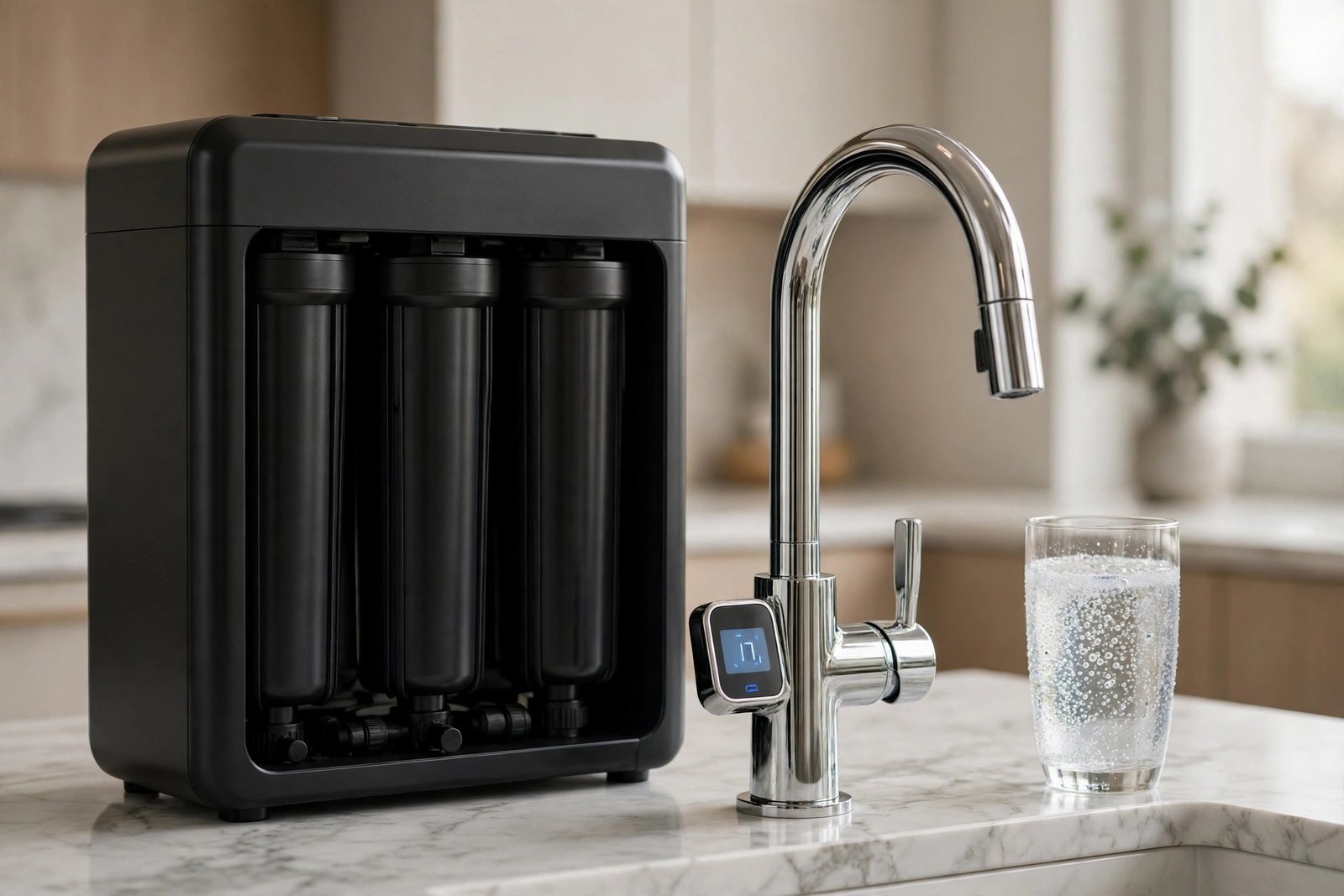
The G3P800 is Waterdrop’s flagship tankless RO, and it goes in the opposite direction: more of everything. 800 GPD, a 10-stage path with a 0.0001-micron RO membrane, a built-in UVC-LED UV sterilizer, and a smart display faucet showing real-time TDS, filter life, and water intake at a glance. It fills a 6 oz cup in about 5 seconds — noticeably quicker than the RO500 — at a 3:1 pure-to-drain ratio, which is excellent for an RO system.
Waterdrop claims 99% PFOA/PFOS reduction and 1,000+ contaminants including fluoride, lead, and chromium — brand claims, so check the Performance Data Sheet. Independent lab testing (Water Filter Guru) found 94.8% TDS rejection, 33 ppm creep, 12 ounces in 9.14 seconds, 46.2 dB, and ~11¢/gal. Strong numbers.
The trade-off is the running cost: $29.99 CF filter (6 months), $29.99 CB filter (12 months), $139.99 RO filter (24 months) — $159.97/year by Waterdrop’s own figures, roughly double the RO500. It’s also bigger (32.4 lbs, 18.11″ tall), needs a grounded outlet under the sink, can’t feed a fridge or ice maker, and its remineralization/alkaline add-ons are sold separately. Municipal water only.
Waterdrop G3P800 pros
- 800 GPD with a fast fill (6 oz in ~5 sec)
- 3:1 pure-to-drain ratio — less water wasted than the RO500
- 10-stage filtration, 0.0001 µm membrane + UVC-LED UV sterilizer
- Smart display faucet with real-time TDS, filter life, and water intake
- Broad IAPMO R&T certifications to NSF/ANSI 42, 53, and 58 plus NSF/ANSI 372 for low lead
- Strong independent lab numbers: 94.8% TDS rejection, 46.2 dB, ~11¢/gal
Waterdrop G3P800 cons
- $159.97/yr filter cost — roughly double the RO500
- $759 sale ($999 regular on waterdropfilter.com) costs more up front
- Not NSF-International certified — certifications are IAPMO-issued (see below)
- Remineralization/alkaline add-ons sold separately
- No fridge/ice-maker hookup; grounded outlet under the sink is required
- Municipal water only — not for well water
The certification story most sites get wrong
Slow down here — the word “certified” gets thrown around loosely in the RO world.
The iSpring RO500 is certified by NSF International itself for TDS reduction under NSF 58 — the organization that wrote the standard did the certifying. Genuinely NSF-certified, and the only unit in this article that can say that.
The Waterdrop G3P800 is certified by IAPMO R&T — a different, also legitimate certification body — to NSF/ANSI 42, 53, and 58 for the reduction claims on its Performance Data Sheet, plus NSF/ANSI 372 for low lead. These are real certifications, and they cover more ground than the RO500’s (NSF 53 is the health-effects standard the RO500 lacks). But it is not NSF-International certified, despite how some listings blur the distinction.
Honest framing: the G3P800 has the broadest certifications; the RO500 has the most prestigious issuer for its one claim. Want an NSF 53 health claim? The G3P800 is your only option here. Want the NSF International seal itself? The RO500. Neither position is wrong — they’re just different.
Filter cost per year — and the 5-year math nobody shows you
Sticker price is only half the story — the filters are where the real money goes, so let’s put real numbers on it.
| iSpring RO500 | Waterdrop G3P800 | |
|---|---|---|
| Purchase price (est.) | ~$600–630 | $759 (sale; $999 regular) |
| Annual filter cost | ~$80–90/yr (third-party estimate) | $159.97/yr (official) |
| 5-year total (est.) | ~$1,040–1,080 | ~$1,559 |
Math: RO500 at ~$615 + 5 years at ~$85/yr ≈ $1,040–1,080. G3P800 at $759 + 5 years at $159.97/yr ≈ $1,559. All figures are estimates — check current prices before buying.
That gap is the whole decision in one table: the G3P800’s extra speed, UV, smart faucet, and broader certifications cost roughly $500 more over five years on top of the higher purchase price. Go in with eyes open
Who should NOT buy each system
Don’t buy the iSpring RO500 if:
- You want UV sterilization — the base RO500 doesn’t have it (look at the RO5004F variant instead)
- You want alkaline or remineralized water — not included (the RO500AK variant adds alkaline)
- You specifically need an NSF 53 health-effects certification — the RO500 only carries NSF 58 for TDS reduction
- You’re on well water — it’s municipal feed only, up to 750 ppm TDS
Don’t buy the Waterdrop G3P800 if:
- You’re buying on a budget — $759 up front plus $159.97/yr adds up fast
- You rent and can’t modify the cabinet or add an outlet — it needs a grounded outlet under the sink
- You want remineralization included — the alkaline add-ons are sold separately
- You expect a fridge or ice-maker hookup — it doesn’t support one
- You need NSF International certification specifically — its certs are IAPMO-issued
- You’re on well water — municipal supply only
My pick: which one would I buy?
Here’s what I’d actually do. For most households — a couple or family that wants great drinking water without thinking about it — I’d pick the iSpring RO500: the only genuinely NSF-certified unit here, compact, and roughly half the running cost. Just confirm you’re buying the base RO500 variant (this listing), not an AK or 4F, unless you specifically want alkaline or UV. The G3P800 is the right call if you have a bigger household, want UV baked in, like a faucet that shows TDS and filter life live, or an NSF 53 health-claim certification matters to you. It’s the more capable machine — you just pay for it every year in filters.
FAQ
Is the Waterdrop G3P800 NSF certified?
Sort of — the wording matters. The G3P800 is certified by IAPMO R&T (a legitimate certification body, separate from NSF International) to NSF/ANSI standards 42, 53, and 58 for the reduction claims on its Performance Data Sheet, plus NSF/ANSI 372 for low lead. The standards are NSF/ANSI standards, but the certifier is IAPMO, not NSF International. Real and broad — just not an NSF-International-issued seal.
Is the iSpring RO500 really NSF certified?
Yes. The RO500 is NSF 58 certified for TDS reduction by NSF International itself — the organization that publishes the standard. That’s the strongest form of the claim, and it’s the only unit in this comparison that can make it. The scope is TDS reduction, though — not the NSF 53 health-effects claims some buyers ask about.
G3P800 vs G3P600 — is the 800 worth the extra money?
For heavy-use households, yes — 800 vs 600 GPD means faster fills for big pots and busy kitchens. For a couple or light use, the smaller model is plenty and cheaper.
Can I use a tankless RO on well water?
Not these two — both are municipal-water only. Well water’s sediment, iron, and bacteria overwhelm tankless RO prefilters; on a well, you need a system rated for it, usually with pre-treatment.
Does a tankless RO need an electrical outlet under the sink?
Yes. Both use a built-in boost pump, so they’re corded electric — the RO500 runs on 100–240V and the G3P800 needs a grounded outlet under the sink. No outlet? Budget an electrician visit, or pick a non-electric system.
How loud is the pump?
The G3P800 measured 46.2 dB in independent lab testing — about a quiet conversation, and it only runs while water flows. I don’t have a verified RO500 figure, so I won’t guess; neither unit is commonly described as loud in owner reviews.
Which costs less to run — iSpring or Waterdrop?
The iSpring RO500, by a wide margin: roughly $80–90/year in filters (third-party estimate) versus the G3P800’s official $159.97/year. Over five years: ~$1,040–1,080 vs ~$1,559 — a gap of roughly $500 before the higher purchase price.
How much water does the G3P800 waste?
It’s rated 3:1 pure-to-drain — three cups of clean water for every cup sent to the drain. That’s very good for an RO system and better than the RO500’s 2:1 ratio. For comparison, older tank systems often ran 4:1 or worse.