

If you have been shopping for a budget tankless RO system, you have probably run into the same two names again and again: the Waterdrop G2 and the SimPure T1-400. On paper, they look like twins. Both promise 400 gallons per day, both skip the bulky storage tank, and both sit in that sweet spot where you get real reverse osmosis filtration without paying for a premium flagship. The headline numbers hide the real decision.
The real difference is not how much water they can make. It is how much water they send down the drain, how they fit under your sink, and how filter changes will feel a year from now. Get those three things right and the choice gets a lot easier.
Waterdrop G2 vs SimPure T1-400 at a glance
| Feature | Waterdrop G2 (WD-G2-W) | SimPure T1-400 |
|---|---|---|
| Daily output | 400 GPD | 400 GPD |
| Filtration stages | 7 stages | Multi-stage RO filtration |
| Pure-to-drain ratio | 1:1 | 1.5:1 |
| Flow rate | About 0.28 GPM | Not verified for the plain T1-400 — not printed here |
| Built-in pump | Not listed as a headline feature | Yes, built-in pump |
| UV sterilization | No UV | No UV on the plain T1-400 — UV appears only on the separate T1-400UV variant |
| Filter changes | Twist-and-pull filters | Cartridge-style changes |
| Certification note | Check the current listing | NSF/ANSI 58 (SGS tested) |
| Tank | Tankless | Tankless |
That table tells most of the story: same daily output, same tankless idea, very different waste ratio. That gap is where your decision lives.
Same GPD, different waste: what the ratio really costs you
Here is the simplest way I can explain it. A pure-to-drain ratio tells you how much clean water you get for every cup of water the system sends to the drain during filtration. With the Waterdrop G2 at 1:1, one cup of filtered water lines up with about one cup of drain water. With the SimPure T1-400 at 1.5:1, you get about one and a half cups of filtered water for each cup sent to drain. Put another way, the SimPure wastes less water to make the same glass of drinking water.
For a single person or a couple filling a few glasses and a kettle each day, that difference will be modest. For a family that cooks a lot, fills bottles, and keeps a pitcher in the fridge, it adds up week after week. Over a year of heavy use, the more efficient ratio means noticeably less water down the drain. Still, a better ratio does not make a system better in every way. Cabinet space, power, and filter access matter too, and a system that saves water but drives you mad at filter time is no bargain.
For the wider picture, my guide to the best tankless RO systems puts these budget picks next to higher-output options.
The UV question: do you need it at this budget?
This is the part where a lot of listings get sloppy, so let me be blunt. The plain SimPure T1-400 does not come with UV. UV sterilization exists only on the separate T1-400UV variant. If you buy the plain model expecting a UV lamp inside, you will be disappointed, and that is a listing mix-up I see far too often.
The Waterdrop G2, for its part, has no UV at all. It relies on its 7-stage filtration path instead. For most homes on treated city water, that is a perfectly reasonable setup. City water is already disinfected before it reaches your tap, and a multi-stage RO system is doing the heavy lifting on dissolved solids, taste, and the other things people buy RO for in the first place.
So when is UV worth chasing at this tier? If you are on well water, or worried about microbial risks filtration alone does not address, do not assume a budget model covers you. Check the exact variant name, confirm UV is listed for that model, and read the manual. If UV matters to you, compare the T1-400UV variant directly, not the plain T1-400. On city water, missing UV is not a dealbreaker. It is simply a feature you are not paying for. One caveat: I am not a water treatment professional, and this is no substitute for a proper water test if you have a known contamination problem.
Installation, cabinet fit, and power
Both of these are tankless, and that is the whole point. No big tank eating half your cabinet. You get your storage space back, and the system only makes water when you open the tap. For small kitchens, that alone can be the reason to go tankless.
Still, “tankless” does not mean “tiny in every direction.” Measure height, width, and depth, leave room to reach the filters, and check where your drain, feed line, and power outlet sit. A system that fits on paper but leaves no hand room for a swap will punish you twice a year. Power is the quiet difference here: the SimPure T1-400 has a built-in pump, which helps when home water pressure is low, but it needs an outlet under the sink or nearby. Confirm the G2’s power and connection requirements on the exact listing too, since small details vary by bundle. Renters, check your lease and talk to your landlord before drilling or altering anything, and pick a system you can remove cleanly later.
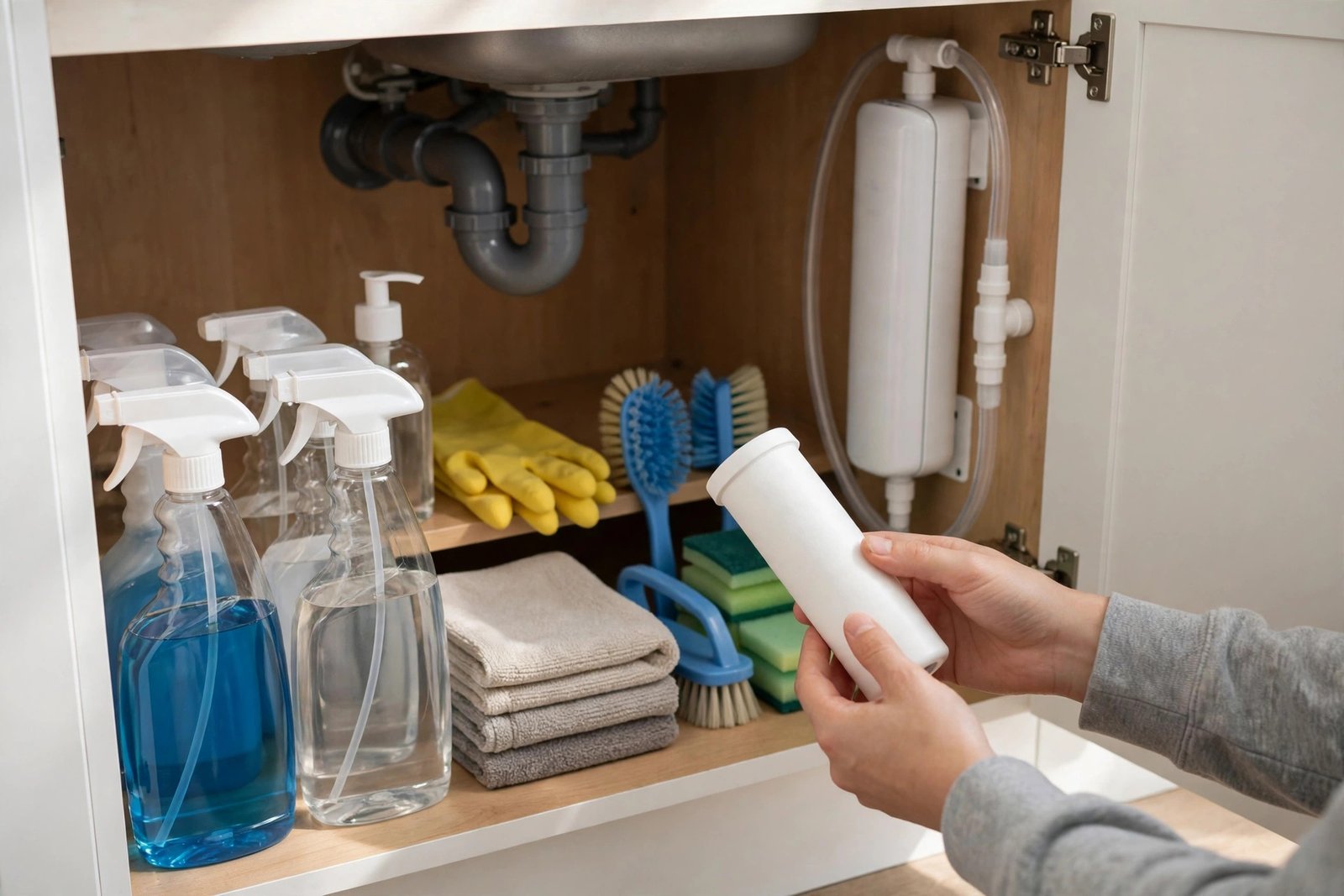
Most handy homeowners can handle a tankless install, but if your plumbing is old or cramped, a plumber visit is well spent. I would rather see one clean install than a slow drip fought for a month.
Waterdrop G2 up close
The G2 leans on simplicity. Its 7-stage path, its 1:1 ratio, and its twist-and-pull filters all point to the same idea: a straightforward system you can live with. I like twist-and-pull designs for one simple reason. When filter day comes, you do not want a toolbox, a wrestling match, and a puddle. You want a quick swap, a wipe-down, and a glass of water to confirm everything is back to normal. That is the kind of small convenience that matters more than it sounds like it should.
Its flow of about 0.28 GPM is modest: fine for a glass, slower for a huge stock pot. That is normal for this class. If you need fast, high-volume filling all day, step up to a higher-output class like the ones in my Waterdrop G3P600 vs G3P800 comparison.

Check the Waterdrop G2 on Amazon
SimPure T1-400 up close
The T1-400 leans on efficiency and its built-in pump. The 1.5:1 ratio is genuinely better than the G2 on waste, and the pump helps it stay consistent when pressure is not ideal. If you drink a lot of filtered water, or if you just hate the idea of sending extra water down the drain, those two facts carry real weight.
Watch out for the variant trap. Because the T1-400UV exists, listings sometimes blur the two models together. Check the exact model name and the spec section for UV before you buy. If you want UV, buy the UV variant on purpose. If you do not need it, the plain T1-400 still gives you the efficiency and pump benefits.

Buying note: I am linking to a search page on purpose here, not a single product page. SimPure sells the plain T1-400 and the T1-400UV as separate variants, and I do not want you landing on the wrong one. Use the search results to confirm the exact variant name before you buy.
Filter cost per year: the quiet budget line
Filter cost-per-year box (qualitative)
Waterdrop G2: Twist-and-pull cartridges keep swaps quick, which helps you actually do them on time. Skipped filter changes are where water quality and taste quietly slip, so ease matters as much as cartridge cost.
SimPure T1-400: Budget for regular cartridge replacements across its filter set, and check the replacement interval for your exact variant. A more efficient ratio saves water, but it does not remove the need for on-time filter changes.
The rule for both: Think in yearly terms. Add up every filter you will replace in a year, plus any membrane on its longer cycle. Heavy use shortens intervals, light use stretches them, and a system with filters you dread changing can cost you more in skipped maintenance than one you actually maintain.
Who should NOT buy each system
Who should NOT buy the Waterdrop G2
Skip the G2 if you go through a lot of filtered water every day and waste really bothers you, because the 1:1 ratio will send more water to drain than the T1-400 over the same year. Skip it too if you need UV for your water source, since the G2 has none, and skip it if you need very fast filling for big pots and bottles all day long. Its modest flow is fine for glasses and cooking in normal amounts, but it is not built to be a high-volume workhorse.
Who should NOT buy the SimPure T1-400
Skip the plain T1-400 if you specifically want UV and you are about to click buy without checking the variant, because the plain model will not give you UV. Skip it if you have no power access under the sink and no simple way to sort that out, since its built-in pump needs power. And skip it if your cabinet is extremely tight in the direction this slim tower needs, because a tankless label does not guarantee a fit in every cabinet. Measure first, buy second, every single time.
My verdict: a clear pick per household type
If I had to pick for a small household on city water, with a normal cabinet and a normal appetite for filtered water, I would lean toward the Waterdrop G2. Its twist-and-pull filters, its simple layout, and its honest budget positioning make it easy to live with, and the 1:1 ratio is a fair trade at this tier when your total water use is modest. It is the “set it up, change filters without drama, enjoy better-tasting water” choice.
If I had to pick for a bigger household, a heavy filtered-water user, or a home with lower water pressure, I would lean toward the SimPure T1-400. The 1.5:1 ratio saves real water over a year of heavy use, and the built-in pump helps keep things steady. Just buy the right variant on purpose, and confirm the fit and power situation before it arrives.
Still torn? Ask what will annoy you more: extra water down the drain, or wrestling with filters? The system you will actually maintain is the system that will actually serve you.
A quick check you can do at home: TDS
Once a system is in, a handheld TDS meter gives you a total dissolved solids reading, a useful rough signal over time. Be clear on its limit: it measures total dissolved solids only. It does not detect individual contaminants, and it cannot tell you a specific substance is present or absent. Treat it as a maintenance helper, not a lab test. My guide to TDS levels explained walks through the numbers in plain language.

Check the HM Digital TDS-EZ on Amazon
The Frizzlife PD600 review is another useful data point in the same budget-to-midrange conversation.
FAQ
Can two systems share 400 GPD and still be different?
Yes. GPD describes daily capacity under rated conditions, not waste, flow at your tap, or filter life. The two share a capacity class, but waste ratios, pumps, filter designs, and layouts pull them apart in daily use.
Is UV worth it at the budget tier?
For most city-water homes, no. A multi-stage RO system already handles the reasons most city-water buyers shop for RO. UV is worth a serious look on well water or where microbial risk is a real concern. If that is you, compare the T1-400UV variant directly.
Will either system fit a small cabinet?
Both are tankless, which helps, but neither fits every cabinet automatically. Measure height, width, and depth, leave hand room for filter changes, and check drain, feed, and power positions.
Which one is easier for filter changes?
The G2 has the clearer ease story, thanks to its twist-and-pull filters. The T1-400 uses cartridge-style changes, with exact steps depending on your variant, so read its manual and check swap clearance. Ease decides if filters get changed on time.
Are these good for renters?
They can be, with two conditions: landlord approval before altering plumbing or drilling, and a system you can install and remove cleanly, with power sorted in advance. With no under-sink outlet, power may matter more than the waste ratio.
Should I worry about the drain ratio if I barely drink tap water?
Not much. Light users will see only a small difference between 1:1 and 1.5:1. Heavy users and big families will feel the gap more. Match the system to your real usage.
As an Amazon Associate, Clearove may earn from qualifying purchases made through links on this page, at no extra cost to you. Links in this article are clean Amazon links with no tracking tag added, because no Clearove tracking ID is on record for this package.