
As an Amazon Associate I earn from qualifying purchases.
Prices change frequently — check the live Amazon page for the current price.
Here’s something nobody tells you when you buy a reverse osmosis system: the system is the cheap part. The filters are the subscription you just signed up for. The good news? On the iSpring RCC7 — America’s best-selling under-sink RO — that subscription is one of the cheapest in the business, if you buy the right packs and change them on schedule.
This guide covers every stage’s replacement interval, the real annual cost math, the exact packs to buy, and how to do the swap yourself in about 20 minutes.
The complete RCC7 replacement schedule
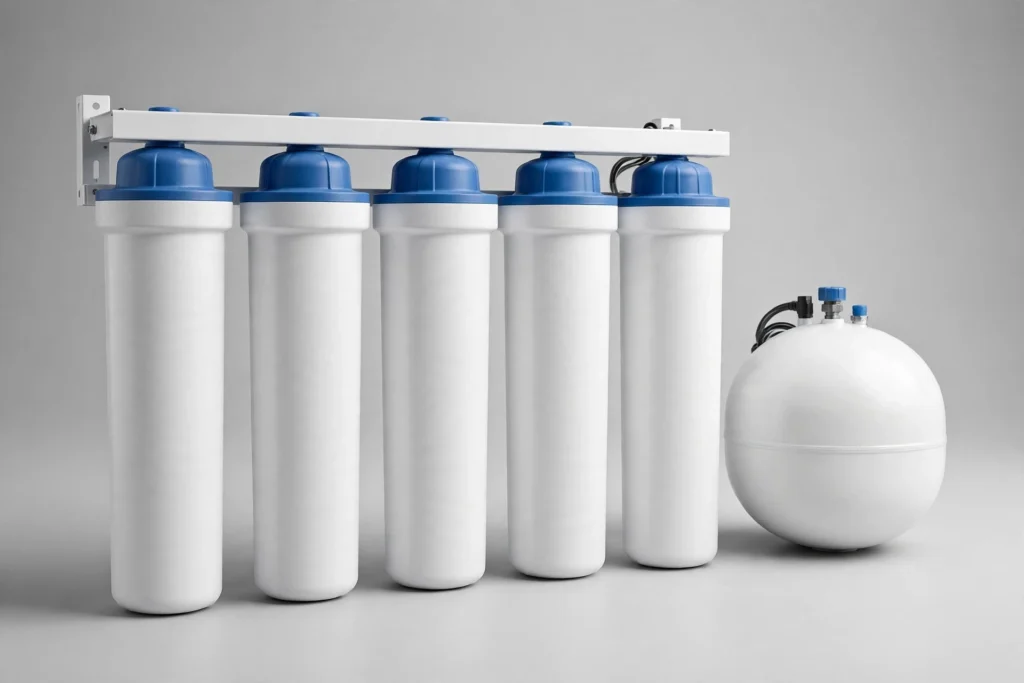
| Stage | Filter | Replace every | What happens if you don’t |
|---|---|---|---|
| 1 | 5-micron sediment (PP) | 6–12 months | Clogged pre-filters starve the membrane |
| 2 | Granular activated carbon (GAC) | 6–12 months | Chlorine reaches and damages the RO membrane |
| 3 | Carbon block (CTO) | 6–12 months | Taste/odor return; membrane life shortens |
| 4 | 75 GPD RO membrane | 24–36 months | TDS creeps up; rejection rate falls |
| 5 | Post inline carbon (FT15) | 12 months | Flat taste from the tank |
The 6–12 month range on pre-filters isn’t vague marketing — it genuinely depends on your water. City water with moderate sediment: 12 months is fine. Well water or old pipes: 6. When in doubt, change at 6 months for the first year and adjust based on what the old filters look like.
RCC7AK owners: you have a 6th stage (alkaline remineralization filter) — replace it every 6–12 months or ~1,500 gallons, whichever comes first.
Annual filter cost: the real math
Year 1–2 (no membrane needed): ~$40–45/year
The iSpring F7-GAC 1-year pack contains 7 filters — 2 sediment, 2 GAC, 2 CTO, and 1 post-carbon — which is exactly one year of scheduled changes. It typically sells for around $37–45 on Amazon.
Year 3 (membrane year): add ~$30–40
The 75 GPD RO membrane needs replacing every 2–3 years. Budget roughly $35 for the membrane in the year you change it, which amortizes to about $12–15/year.
Realistic long-term average: about $50–60/year. That’s it. Compare that to $400+/year on bottled water for a family, or ~$165/year for a tankless system’s filters, and the RCC7’s running cost is genuinely tiny.
Which replacement packs to buy
- Best value (standard RCC7): the F7-GAC 1-year pack — 7 filters, one purchase, done for the year. This is what most owners buy on repeat.
- Need the membrane too? Look for iSpring’s 2-year (F15-75) or 3-year supply packs, which bundle the membrane with the annual filters.
- RCC7AK owners: the F7-GAC pack covers stages 1–3 and 5; add the FA15 alkaline cartridge separately for stage 6.
A note on third-party compatible filters: they exist, they’re cheaper, and some are fine — but quality varies wildly, and a bad carbon block can let chlorine through to your membrane (a $35 mistake that costs you a membrane). If you go third-party, stick to NSF-tested filters from established brands. For most people, the genuine iSpring packs are cheap enough that the savings aren’t worth the gamble.
How to replace RCC7 filters yourself (20 minutes, no plumber)
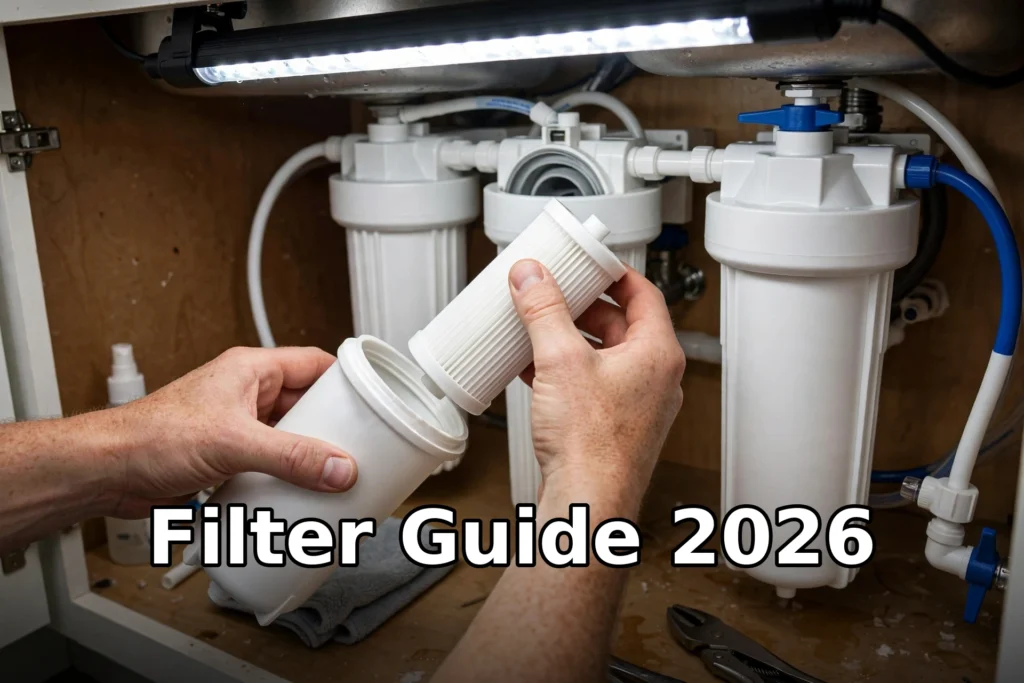
- Shut off the feed water (the small valve on the cold-water line) and the tank valve. Open the RO faucet to depressurize — let it run dry.
- Have towels ready. The housings hold water. This is the entire “difficulty” of the job.
- Unscrew the three vertical housings (stages 1–3) with the included wrench, lefty-loosey. Dump the old cartridges, rinse the housings.
- Drop in the new cartridges in order: sediment → GAC → carbon block. A thin smear of food-grade silicone grease on the O-rings keeps the seal happy (don’t use petroleum jelly).
- Swap the inline post-carbon filter (stage 5, the horizontal one on top) — note the flow arrow direction before removing the old one.
- Membrane (every 2–3 years): it’s inside the horizontal membrane housing — unscrew the cap, pull the old membrane with pliers, push the new one in firmly.
- Turn everything back on, check for drips for 10 minutes, then flush the system: let the tank fill and drain it completely 1–2 times before drinking. New carbon filters shed fine dust — the first tank or two may look slightly gray. That’s normal.
Total cost of tools: $0. Everything comes in the box.
5 signs your filters need changing now
- Water tastes “off” — the earliest warning. If it tastes like it did before the RO, the carbon stages are spent.
- TDS reading climbs — if you have a cheap TDS meter (worth owning), a reading that’s doubled from your baseline means the membrane is tired.
- Slow flow from the faucet — clogged pre-filters or a fouled membrane.
- It’s been 12+ months and you can’t remember the last change. Just do it.
- Visible gunk — iSpring’s first-stage housing is transparent. If the sediment filter looks brown, it’s done.
RCC7 vs RCC7AK: filter differences
The plain RCC7 and the alkaline RCC7AK share stages 1–5, so this entire guide applies to both — with one addition for AK owners:
| RCC7 (5-stage) | RCC7AK (6-stage) | |
|---|---|---|
| Annual pack | F7-GAC (7 filters) | F7-GAC + FA15 alkaline cartridge |
| Extra stage | — | Stage 6: alkaline remineralization (FA15) |
| Extra cost | — | ~$15–20/year (replace every 6–12 months) |
The FA15 alkaline cartridge twists inline after the post-carbon filter and takes about two minutes to swap during your annual change. If you bought the RCC7AK for the mineral taste, don’t skip it — an exhausted alkaline filter just becomes a very expensive paperweight.
Buying tips: don’t overpay for the annual pack
- Subscribe & Save on Amazon knocks 5% off the F7-GAC pack and — more importantly — reminds you every 12 months. Set it and forget it.
- Buy the membrane separately, on schedule. Don’t buy it “just in case” and let it sit in a closet for two years; membranes have a shelf life.
- Avoid the giant bulk packs (25-packs of sediment filters etc.) unless you run multiple systems. Filters stored for years in a garage degrade, and you save pennies per filter.
- Keep one spare set of pre-filters (one sediment + one carbon block) under the sink. When the flow slows on a Sunday evening, you’ll thank yourself.
What if you have hard water or very high TDS?
The RCC7 handles up to 750 ppm TDS, which covers the vast majority of US city water. But two situations need extra attention:
Very hard water (15+ gpg): hardness doesn’t damage the membrane the way chlorine does, but heavy scaling shortens its life. If your water leaves thick white crust on everything, consider a water softener before the RO — the softener handles hardness, the RO handles everything else. (They’re complementary, not competitors.)
Low water pressure (under 45 psi): RO membranes need pressure to work. If your home runs under 45 psi, the standard RCC7 will produce water slowly and waste more to drain. iSpring’s RCC1UP-AK is the same system with a built-in booster pump — same filters, same schedule in this guide, just with the pressure problem solved.
When to call iSpring support instead of guessing
iSpring’s US-based support (Atlanta, GA) is one of the brand’s genuine advantages — real humans who know the systems. Call them when: your TDS stays high right after a membrane change (could be a seating issue or a bad membrane), you have a leak you can’t trace, or your water chemistry is unusual (iron, sulfur smell, very high TDS). Don’t just keep buying filters hoping the problem goes away — a 10-minute call usually diagnoses it.
Frequently asked questions
How often should I replace iSpring RCC7 filters?
Pre-filters (stages 1–3): every 6–12 months. Post-carbon (stage 5): every 12 months. RO membrane (stage 4): every 2–3 years. Alkaline filter (RCC7AK stage 6): every 6–12 months.
How much do iSpring replacement filters cost per year?
About $40–45/year for the F7-GAC annual pack, plus ~$12–15/year amortized for the membrane — roughly $50–60/year total. One of the lowest running costs in the RO category.
What are the signs my RO filters need replacing?
Off taste, rising TDS readings, slow faucet flow, visibly dirty sediment filter, or simply 12+ months since the last change.
Can I replace iSpring filters myself?
Yes — it’s a 20-minute DIY job with no special tools. Shut off the water, swap the cartridges in order, check for leaks, flush the tank. The manual walks you through it.
How long does the iSpring RO membrane last?
2–3 years on typical city water. Heavy sediment or high TDS shortens it; changing pre-filters on schedule is what protects it.
Are third-party iSpring-compatible filters OK to use?
They fit and they’re cheaper, but quality is inconsistent — a subpar carbon block can let chlorine damage your membrane. If you go third-party, choose NSF-tested filters. Most owners stick with genuine iSpring packs since they’re already inexpensive.
Own the system? iSpring RCC7 on Amazon · Need the annual pack? F7-GAC 1-year filter pack
Related: iSpring vs APEC: Which Under-Sink RO Is Better? · 5 Best Tankless RO Systems 2026