

As an Amazon Associate, Clearove earns from qualifying purchases made through links on this page, at no extra cost to you.
Short answer: yes — a reverse osmosis system is one of the best home tools you can buy for chromium-6, and the U.S. Environmental Protection Agency (EPA) names reverse osmosis as the most effective home treatment option for it. Published sources typically put RO removal of chromium-6 at around 85–95%, with some studies reporting up to 99%. That is a strong result, but it is not a promise of complete removal forever. Your membrane has to be in good shape, your system has to be maintained, and the only way to know your own number is a proper lab test. This guide walks through what chromium-6 is, why the rules around it are so confusing, and how to deal with it without wasting money on gadgets that cannot help.
Chromium-6 vs. chromium-3: same element, very different story
Here is the mix-up that trips up almost everyone, so let us get it straight first. Chromium shows up in water in two main forms, and they behave nothing alike. Chromium-3, also called trivalent chromium, is the common, mostly harmless form. In tiny amounts it is even considered an essential nutrient, and it shows up naturally in foods like broccoli and whole grains. Chromium-6, or hexavalent chromium, is the toxic form. It is classified as a known human carcinogen when inhaled, and health agencies treat it as a serious concern in drinking water too, with long-term exposure linked to cancer risk in animal and human studies.
The practical point matters more than the chemistry lesson: a “total chromium” result does not tell you your chromium-6 level. Your water could pass a total chromium test and still carry chromium-6, or it could contain mostly harmless chromium-3. If a report or a product only talks about “chromium” without saying which form, it has not answered your question yet. You need a result that names hexavalent chromium specifically.
Where does chromium-6 in drinking water come from?
Chromium-6 reaches water from two directions: human activity and nature itself. On the industrial side, it has been used in chrome plating, stainless steel production, leather tanning, textile dyes, and wood preservatives. Waste from those operations, along with older industrial sites and landfills, can leach into groundwater. The most famous case is Hinkley, California, where Pacific Gas and Electric’s compressor station contaminated local groundwater with chromium-6 over decades — the story behind the Erin Brockovich case. That was an extreme case, not a typical one, but it put chromium-6 on the map for a lot of American households.
Nature plays a role too. Chromium occurs naturally in rocks and soil, and under certain groundwater conditions it can oxidize into the hexavalent form on its own. That means chromium-6 is not only a problem near factories. Some wells and municipal supplies draw from aquifers where it appears with no industrial source in sight. If you are on a private well, that point deserves extra attention, since nobody is testing your water for you unless you arrange it. Our guide to the best reverse osmosis system for well water covers the extra steps well owners should think about.
The regulation gap: 100 ppb, 0.02 ppb, and no federal chromium-6 limit
This is the part that genuinely confuses people, and honestly, it confused me the first time I dug into it. The numbers sound like they contradict each other, so here they are side by side.
| Standard | Number | What it covers |
|---|---|---|
| EPA federal limit (MCL) | 100 parts per billion (ppb) | Total chromium, set in 1991, based on skin effects — not cancer |
| California public health goal | 0.02 ppb | Chromium-6 alone, a health goal, not an enforceable limit |
| California chromium-6 MCL | 10 ppb, struck down in court in 2017 | Was the only state chromium-6 limit; a new regulation is pending |
Read that again slowly, because the gap is enormous. The federal limit covers total chromium, not chromium-6 specifically, and it dates from 1991, when regulators based it on skin irritation effects rather than cancer risk. California’s own scientists later set a public health goal for chromium-6 alone at 0.02 ppb — five thousand times lower than the federal total-chromium figure. California did adopt a 10 ppb chromium-6 limit in 2014, but a court struck it down in 2017, and a replacement regulation is still pending. The bottom line: right now there is no federal limit written specifically for chromium-6. A supply can comply with the federal total-chromium rule while still delivering chromium-6 at levels health researchers would rather not see — which is why many families do not wait for regulators.
How reverse osmosis handles chromium-6 — and where it stops
A reverse osmosis membrane works like an extremely fine sieve at the molecular level. Water is pushed through a semipermeable membrane, and dissolved contaminants — including chromium-6 ions — mostly stay behind and get flushed away with the wastewater. That is why the EPA ranks RO as the most effective home option, and why published removal figures land in that 85–95% range, with some studies reaching up to 99%. Ion exchange is the other recognized home alternative, and it can work well, but it needs careful setup and resin maintenance, which is why RO tends to be the simpler choice for most kitchens.
Now the honest limits, because no filter deserves blind trust. First, RO treats water at one tap, not your whole house — your kitchen tap gets filtered water, but your bathroom taps and shower do not, unless you install a whole-home system. Second, removal drops as the membrane ages or fouls, and low pressure or skipped filter changes eat into performance. Third, RO makes wastewater; a modern tankless design keeps that ratio far better than old tank systems, but it never hits zero waste. And fourth, no honest source can promise complete removal forever. The right mindset is not “install and forget” — it is “install, maintain, and verify with a lab test now and then.”
How to test your water properly
If you take one action from this article, make it this one: get a lab test that names hexavalent chromium. Here is how to do it right.
First, check your water supplier’s Consumer Confidence Report if you are on city water. It is published every year, and it lists total chromium. Treat it as background, not an answer — remember, total chromium is not chromium-6. Second, order a certified lab test and read the panel before you buy: it must list “hexavalent chromium” or “chromium VI” as its own line item. The laboratory method you want to see is EPA Method 218.6, which measures the hexavalent form specifically. If a kit only promises “chromium” or “heavy metals” in general, ask the lab directly whether it reports hexavalent chromium separately. If it cannot say yes, pick a different lab.
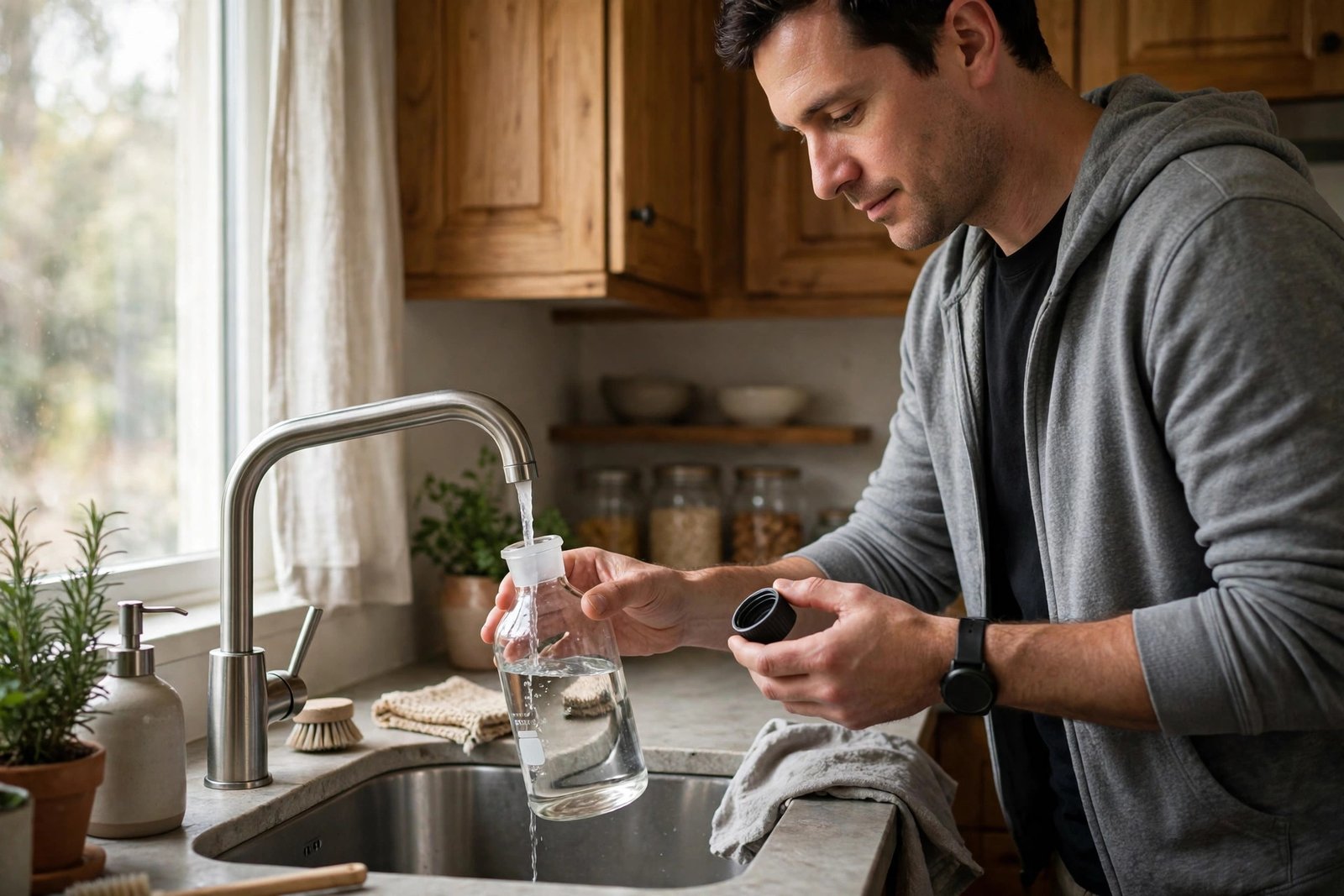
Collect the sample exactly as instructed — usually first-draw water from your kitchen tap, in the bottle the lab sends you — and mail it back promptly. Compare the results to the numbers in the table above, not just to the federal total-chromium limit. If you already run an RO system, test the filtered water too; that before-and-after pair is the only real proof of what your system is doing in your home. Our guide to TDS levels explained will help you read your other numbers without overreacting to any single one.
What does not work: pitchers, boiling, and TDS meters
Let us save you some money, because this is where a lot of households get tripped up. Standard carbon pitcher filters mostly do not address chromium-6. Their carbon is great at improving taste and cutting chlorine, but a basic pitcher cartridge is not designed to pull dissolved hexavalent chromium out of water, and its short contact time works against it. A few specialty cartridges claim heavy-metal reduction — if you go that route, read the fine print for chromium-6 specifically and look for independent certification, not just a marketing claim.
Boiling does not help either. Chromium-6 is a dissolved mineral contaminant, not a germ, so heat does not destroy it. In fact, boiling water down concentrates dissolved minerals as steam escapes, which moves you in the wrong direction. And then there is the TDS meter trap. A TDS meter measures total dissolved solids — the overall mineral load — and it is genuinely handy for watching whether your RO membrane is still doing its job, because a rising TDS reading on filtered water hints the membrane is wearing out. But a TDS meter does not detect chromium-6, and it never will. A low TDS reading can sit right next to a chromium-6 problem, and a high reading says nothing about which minerals are in there. Use the meter for what it is good at; do not lean on it for this question.
HM Digital TDS-EZ: a simple, pocket-sized meter for tracking your RO system’s general performance over time. One clear warning, though: this meter does NOT detect chromium-6. It tells you about total dissolved solids only. Keep that distinction front and center, and it is a useful little tool. Treat it as a chromium-6 detector, and it will mislead you.
Check the HM Digital TDS-EZ on Amazon
Bottled water deserves a quick word too. Some bottled waters are purified by reverse osmosis at the plant, and some are just spring water with whatever the spring contains. The bottle rarely tells you its chromium-6 level, so bottled water is a guess, not a verified fix. A home RO system plus a lab test gives you an answer you can actually check.

Frequently asked questions
What is the difference between chromium-6 and chromium-3?
Chromium-3 is the common, mostly harmless form, and in tiny amounts it acts as an essential nutrient. Chromium-6 is the toxic, carcinogenic form. They are not interchangeable, and a test that reports only “total chromium” cannot tell you how much of each you have.
How can I tell if my water has chromium-6?
Only a laboratory test that reports hexavalent chromium separately can confirm it — look for EPA Method 218.6 on the panel. Your supplier’s annual report covers total chromium only, and no home strip or handheld meter can identify chromium-6 on its own.
Is bottled water safer than tap water for chromium-6?
Not necessarily. Some bottled water is RO-purified, but many brands are spring water, and bottles do not typically disclose chromium-6 levels. You are trading a known question for an unknown answer, usually at a steep markup over time.
Do pitcher filters remove chromium-6?
Standard carbon pitchers mostly do not. Their cartridges target taste, odor, and chlorine, not dissolved hexavalent chromium. Specialty cartridges may claim otherwise — verify chromium-6 specifically in the certification, and do not assume a “heavy metals” label covers it.
Why do California and federal rules disagree so much?
The federal rule sets 100 ppb for total chromium and dates from 1991, based on skin effects. California’s health goal for chromium-6 alone is 0.02 ppb, and its 10 ppb chromium-6 limit was struck down in court in 2017, with a replacement still pending. Until a chromium-6-specific federal limit exists, the two frameworks simply measure different things.
Does RO remove other contaminants too?
Yes — RO is a broad-spectrum approach. It also reduces fluoride, PFAS, lead, nitrates, and many other dissolved contaminants, though removal rates vary by substance and system condition. If those concern you as well, our guides on whether reverse osmosis removes fluoride and RO and PFAS go into the details.
Your next step: test first, then filter with confidence
Here is the order I would follow in my own home. Start with the lab test, because guessing is how people either overspend or under-protect. A certified mail-in kit that reports hexavalent chromium gives you a real baseline for your tap, and it gives you something to compare against after you install a filter.
Certified lab water test: look for a panel that lists hexavalent chromium (EPA Method 218.6) as its own result. One caution that belongs here: the test strips sometimes shown with these kits cannot confirm chromium-6 on their own — the lab analysis is the part that counts.
Once you know your number, a full RO system is the step that actually moves it. The Waterdrop G3P600 is the tankless system I would point chromium-6 readers toward first: up to 600 gallons per day, an 8-stage filtration process, and a tankless design that saves the under-sink space a tank system eats up, with a 2:1 pure-to-drain ratio. Two honesty notes: it has no UV stage, and it is not NSF-certified as a complete system, so judge it on its RO performance and your own lab results, not on a badge it does not carry. Change the filters on schedule and retest down the line — that combination turns a purchase into a verified result.
Waterdrop G3P600 — Tankless RO System
600 GPD output, 8-stage filtration, tankless under-sink design, 2:1 pure-to-drain ratio. No UV stage; not NSF-certified as a system. Best for households that want a high-flow RO setup and are willing to verify results with a lab test.