
“Forever chemicals” went from an obscure chemistry term to a dinner-table topic in just a few years — and if you’re wondering whether your water filter actually does anything about them, you’re asking the right question. Here’s the short version: yes, reverse osmosis removes PFAS — up to 99% of them — and it’s the most reliable home method available. But the details matter, so let’s get them right.

What PFAS are (in plain English)
PFAS (per- and polyfluoroalkyl substances) are a family of thousands of man-made chemicals used since the 1940s in nonstick cookware, waterproof fabrics, food packaging, and firefighting foam. They’re called “forever chemicals” because they barely break down — not in the environment, and not in your body. They’ve been found in the blood of nearly all Americans tested.
In 2023, the U.S. Geological Survey estimated that about 45% of the nation’s tap water contains at least one PFAS compound. That’s the number that turned a niche issue into a national one.
What the EPA rule actually says
In April 2024, the EPA finalized the first-ever legally enforceable drinking water standards for PFAS under the National Primary Drinking Water Regulation:
- PFOA and PFOS: 4.0 parts per trillion (ppt) each — that’s 4 drops in an Olympic swimming pool, essentially “as close to zero as labs can measure”
- PFHxS, PFNA, and GenX chemicals (HFPO-DA): 10 ppt each
- Public water systems must monitor, notify the public, and comply by 2027–2029
What this means for you: your utility is now required to test for and reduce PFAS. But enforcement takes years, and if you’re on a private well, nobody is testing your water but you. A home filter is the fastest way to take control now.
Does reverse osmosis remove PFAS? The evidence
Yes — and it’s not close. RO membranes filter down to ~0.0001 microns; PFAS molecules are far larger than the membrane’s pores, so they’re physically blocked along with lead, fluoride, nitrates, and dissolved solids.
What the manufacturers and certifiers actually claim:
- Waterdrop’s G3 series is third-party (SGS) tested to reduce PFAS, and lists it explicitly in its filtration claims.
- AquaTru is IAPMO-certified to NSF standards specifically for PFOA and PFOS removal — one of the few countertop systems with that certification on paper.
- APEC lists PFAS (“PFAs”) among the impurities its ROES-series membranes remove.
- iSpring’s comparison materials list PFAS/TDS/lead removal across the RCC7 family.
The honest caveat: “reduces up to 99%” depends on your incoming water, membrane condition, and pressure. No home system removes literally 100% of everything forever — membranes age, which is why filter schedules exist (see our filter replacement guide).
What about other filter types?
This is where people waste money, so let’s be blunt:
- Standard fridge filters and pitcher filters (basic carbon): reduce some PFAS, inconsistently. Better than nothing, not a solution. Some are now certified to NSF/ANSI 53 for PFOA/PFOS specifically — check the certification, not the marketing.
- Whole-house carbon systems: can reduce PFAS at the point of entry but need massive carbon beds and frequent media changes to stay effective. Expensive to run properly.
- Water softeners: do not remove PFAS. Different job entirely.
- Boiling water: does not remove PFAS — it can’t break them down, and evaporating water actually concentrates what’s left. This myth needs to die.
- Reverse osmosis: the most reliable, most certified, most cost-effective option for drinking water.
If PFAS is your concern, an RO system with NSF/ANSI 58 certification (or a specific PFOA/PFOS claim) is the answer — not a fancier pitcher.
Which systems are certified for PFAS removal?
Look for these on the listing before you buy:
- NSF/ANSI 58 — the RO-specific standard; systems certified to it (Waterdrop G3P600/G3P800, iSpring RCC7AK) have verified TDS/contaminant reduction.
- NSF/ANSI 53 — health-effects standard; the Waterdrop G3P800 carries it, and some filters are certified specifically for PFOA/PFOS under 53.
- Explicit manufacturer PFAS claims backed by third-party lab testing (SGS, IAPMO, WQA) — marketing words without a lab name are worthless.
Our picks if PFAS is your main worry:
- Best under-sink tankless: Waterdrop G3P800 — NSF/ANSI 53 + 58 certified, SGS-tested PFAS reduction, 3:1 efficiency.
- Best value under-sink: iSpring RCC7AK — NSF/ANSI 58 whole-system certified, under $60/year in filters.
- Best with no plumbing: AquaTru Classic — IAPMO-certified specifically for PFOA/PFOS. See our 5 best tankless RO systems.
How to test your tap water for PFAS
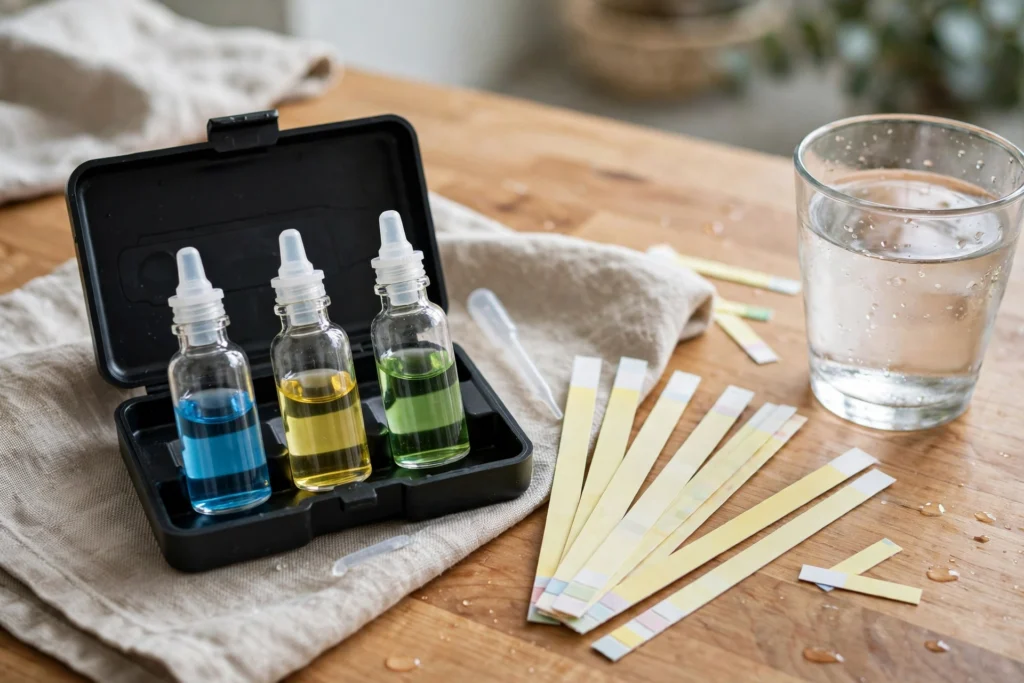
You have three options, cheapest first:
- Check your utility’s report. Since the EPA rule, public water systems must publish PFAS monitoring data — search “[your city] water quality report PFAS” or check the EPA’s PFAS data tools.
- At-home water test kit. A basic TDS meter ($15–25) tells you total dissolved solids but not PFAS specifically. For PFAS you need a lab.
- Certified lab test. The only way to know your actual PFAS levels. Look for a state-certified lab offering EPA Method 533 or 537.1 testing — typically $150–400. Worth it if you’re on a well or your utility’s numbers worry you.
If your test comes back with detectable PFOA/PFOS above 4 ppt, an RO system is the fastest fix you control directly.
How to read your utility’s water quality report
Every public water system in the US must publish an annual Consumer Confidence Report (also called a water quality report). Since the PFAS rule, these now include PFAS monitoring data. Here’s how to read the relevant lines:
- Find the PFAS section — search the PDF for “PFOA” or “PFOS”. Results are in ppt (parts per trillion).
- Compare to 4.0 ppt. Anything at or above the MCL means your utility is legally required to act — but remember, compliance deadlines stretch to 2027–2029, so “we’re working on it” is a valid current status.
- Check the sampling date. A 2023 result doesn’t tell you about 2026. Ask for the latest quarterly data if the report is stale.
- “Non-detect” isn’t zero — it means below the lab’s detection limit, which is usually at or near the MCL anyway. Good news, with an asterisk.
On a private well? There is no report. You’re the utility. Test every 1–2 years, or immediately if neighbors find PFAS — contamination plumes don’t respect property lines.
Point-of-use vs whole-house for PFAS
A common question: should you filter all the water entering your home, or just your drinking water?
Point-of-use RO (under-sink or countertop) is the right answer for almost everyone. PFAS exposure that matters is overwhelmingly through ingestion — drinking and cooking. Skin absorption from showering is minimal by comparison (PFAS don’t pass through skin easily), so filtering every gallon that hits your water heater is expensive overkill.
Whole-house PFAS treatment (large carbon or ion-exchange systems, $3,000–8,000+ installed) makes sense only in specific cases: extremely high well-water contamination, or a household that wants the shower/bath angle covered too. Even then, most experts still recommend a point-of-use RO for drinking water as the primary barrier.
Start with the kitchen tap. It’s where 95% of the benefit lives at 10% of the cost.
Frequently asked questions
Does reverse osmosis remove PFAS from drinking water?
Yes. RO membranes remove up to 99% of PFAS including PFOA and PFOS. It’s the most reliable home filtration method for forever chemicals, backed by NSF/ANSI 58 certifications and third-party lab testing from multiple manufacturers.
What is the EPA limit for PFAS in drinking water?
4.0 parts per trillion for PFOA and PFOS individually, 10 ppt for PFHxS, PFNA, and GenX chemicals, finalized April 2024. Public water systems must comply by 2027–2029.
Do refrigerator filters remove PFAS?
Some do, partially — a few are certified to NSF/ANSI 53 for PFOA/PFOS. But standard fridge and pitcher carbon filters are inconsistent against the full PFAS family. RO is far more reliable.
Does boiling water remove PFAS?
No. PFAS are heat-stable “forever chemicals” — boiling doesn’t break them down, and evaporating water concentrates them. Boiling is not a PFAS strategy.
Which home water filters are certified for PFAS removal?
Look for NSF/ANSI 58 (RO systems like Waterdrop G3 series, iSpring RCC7AK), NSF/ANSI 53 with a specific PFOA/PFOS claim, or IAPMO certification naming PFOS/PFOA (AquaTru). Always check the certification, not the ad copy.
How do I test my tap water for PFAS?
Check your utility’s published PFAS data first (now required by the EPA rule). For your own numbers — especially on well water — use a state-certified lab running EPA Method 533 or 537.1 (typically $150–400).
Related: 5 Best Tankless RO Systems 2026 · Waterdrop G3P600 vs G3P800 · iSpring RCC7 Filter Guide