

Disclosure: This article contains affiliate links. If you buy through a link on this page, Clearove may earn a small commission at no extra cost to you.
The short answer: yes, mostly — and the details matter
Does reverse osmosis remove microplastics? For the microplastics most people worry about, yes: a working reverse osmosis (RO) system should remove the overwhelming majority of them. Published research on RO filtration has reported removal above 99% for microplastic particles in the tested size ranges. Be clear about what that figure is: it comes from published work, not from a test I ran in my own kitchen, and it does not mean a home system removes literally 100% of everything, forever.
That honest version is still good news. RO is one of the strongest home options here, because its membrane pores are far smaller than the particles it must stop. The weak points are worn membranes, poor seals, old filters, and plastic parts downstream of the membrane. Keep those in good shape and performance can drop with no obvious warning if you let them slide.
Why the pore size makes such a difference
A typical RO membrane pore is around 0.0001 micron. A micron is one-millionth of a metre, so we are talking about an opening roughly ten thousand times smaller than a single micron.
Microplastics, by contrast, are commonly defined as plastic particles from about 1 micron up to 5 millimetres across. That range covers fibres from clothing, fragments from broken-down packaging, and tiny beads and pellets. Even the smallest particles in that standard definition are still about ten thousand times wider than an RO pore. That size gap is why size exclusion works so well: most microplastic particles simply cannot fit through.
Picture a kitchen strainer: pasta stays behind because it is bigger than the holes. RO works the same way, at a scale that is hard to picture, with water pushed through under pressure while larger particles are held back.
There is a catch. Below microplastics sit nanoplastics, particles smaller than 1 micron. Some are still much larger than an RO pore and will be rejected too. A very small share, at the tiniest end, gets closer to the pore size, and rejection becomes less certain. That is why no honest writer should promise total removal of every nanoplastic particle.

What RO catches, and what can still slip through
What RO should catch well
Microplastic fibres, fragments, and beads in the usual 1 micron to 5 millimetre range should be rejected at a very high rate by a healthy RO membrane, in line with the above-99% figures reported in published research. RO also cuts total dissolved solids sharply, which is why filtered water often tastes cleaner. Keep that TDS drop in its own box, though: it tells you about dissolved minerals and salts, not about plastic particles. I will come back to that point, because it trips up a lot of buyers.
For the PFAS angle, see our guide on RO and PFAS.
What can slip through, or sneak back in
First, nanoplastics at the smallest end of the scale, as described above. Second, a damaged or aged membrane. A tear, a bad seal, or a membrane run well past its rated life can let water bypass the barrier. That bypass may be small, but it is real, and it is why filter-change dates are not just a sales trick.
Third, contamination after the membrane. Water can pick up particles again from a storage tank, a post-filter, plastic tubing, or a faucet fitting downstream. That does not mean the RO system failed; the last few inches of the journey matter too.
Fourth, installation errors. A mis-seated membrane, a cracked housing, or a drain line plumbed wrong can quietly reduce performance. If a new system tastes off, leaks, or shows a TDS reading that never drops after install, get it checked rather than assuming it is fine.
How RO compares with other common options
Carbon pitchers are the most common starting point, and they are fine for taste, chlorine, and some chemicals. For microplastics, they are a weak tool. A loose carbon filter has much larger pathways than an RO membrane, and water passes through quickly. Some pitchers may catch larger particles, but they were not designed as a microplastics barrier, and you should not buy one for that purpose alone.
Ultrafiltration (UF) sits between a pitcher and RO. UF membranes have pores around 0.01 micron in many systems, which is still smaller than most microplastics. UF can do a solid job on particles and bacteria, and it wastes less water than RO. For microplastics in the standard range, UF is a credible option. RO still wins on the finest particles and on dissolved contaminants, because its pores are far tighter.
Distillation is the other strong performer. Boiling water and condensing the steam leaves most particles and dissolved solids behind, so distilled water should be very low in microplastics. The trade-offs are speed, energy use, and taste: distillers are slow and use power. Boiling alone, without the distillation step, is a different story. Boiling kills germs, but it does not remove plastic particles. So no, boiling your tap water does not solve microplastics.
Gravity and fridge filters vary too much to rate as a group, so check the actual pore size or certification for the model you own. For full systems, see our tankless RO guide, and for a different contaminant, our guide on whether RO removes fluoride.

The pattern is simple: the tighter and better-sealed the barrier, the better the result. RO and distillation sit at the strong end, UF is close behind, and pitchers sit at the weak end for this job.
Certifications: what NSF numbers actually mean
NSF/ANSI 58 is the standard for reverse osmosis systems. It covers things like TDS reduction and structural integrity. An NSF/ANSI 58 listing tells you the system was tested as an RO system and met the standard for what it claims. It is a good sign. It is not, by itself, a microplastics guarantee.
NSF/ANSI 401 covers emerging contaminants, and its scope includes microplastic particles within a defined size range, tested under set conditions. A filter with a genuine NSF/ANSI 401 listing for microplastics is a stronger, more specific claim. The honest problem is supply: very few consumer filters carry that specific listing, and many products that talk about microplastics in their marketing do not carry it at all. That does not make them useless. It does mean you should check the actual listing, rather than accepting a marketing line.
When you shop, look for the standard number, the exact contaminant named, and the test conditions. “Certified” with no number is not a claim you can check.
How to actually check your own water
Here are the two honesty statements, plainly, before anything else.
No home test kit detects microplastics. There is no strip, drop test, or handheld gadget you can buy for your kitchen counter that will tell you how many microplastic particles are in your glass.
TDS meters do NOT detect microplastics. A TDS meter measures dissolved solids, things dissolved in the water like minerals and salts. A TDS reading says nothing about plastic particles. A low TDS reading after RO is a useful sign that the membrane is working on dissolved solids. It is not proof about microplastics.
So what can you do? The only real path for a homeowner is a certified lab test. A lab can filter a sample and examine particles under controlled methods, reporting what it found within its detection limits. When you order, check that the lab states its particle size range and method, and ask what its detection limit is. A result of “none detected” only means something if you know how small the lab could see.
For most households, a sensible approach is this: test your tap water once for a baseline, then test the filtered water after a new RO system has settled in, using the same lab and method if you can. If the cost puts you off, buy on the membrane science and certifications above, and skip gadgets that promise what they cannot deliver.
Bottled water is not automatically safer here. Published studies have reported microplastics in bottled water too, and results vary a lot by brand, study, and method. Switching to bottled water is not a reliable fix.
Maintenance that keeps rejection high
Change pre-filters on schedule. They protect the membrane from sediment and chlorine damage, and a clogged pre-filter can starve the membrane or let chlorine through. Change the post-filter on schedule too, since it is the last step before your glass. Replace the membrane at the maker’s rated interval, or sooner if output drops sharply, taste changes, or TDS readings climb and stay high after a flush.
Sanitise when the maker tells you to, flush a new membrane as directed, and check tubing and fittings for wear now and then.
A TDS meter does have a proper role here: general water checks. Use it to watch for big changes in dissolved solids over time, which can hint that a membrane is ageing. Just remember the limit, every time you use it: TDS meters do NOT detect microplastics.

HM Digital TDS-EZ — for general water checks only
Use this for a quick check of total dissolved solids, so you can spot a big change in your RO output over time. It is explicitly NOT a microplastics test, and it cannot tell you anything about plastic particles in your water.
Frequently asked questions
Do water filter pitchers remove microplastics?
Not reliably. Most pitchers use loose carbon and were designed for taste and chlorine, not as a fine particle barrier. Do not rely on a pitcher for microplastics protection.
Does boiling water remove microplastics?
No. Boiling kills germs, but it does not remove plastic particles. Only distillation, where steam is collected and condensed, removes them by leaving them behind.
Does a TDS meter show microplastics?
No. A TDS meter measures dissolved solids, not particles. TDS meters do NOT detect microplastics, and no home test kit detects microplastics either. If you want a real answer, use a certified lab test that states its size range and detection limit.
Is bottled water safer than RO water for microplastics?
Not reliably. Published studies have reported microplastics in bottled water, and the bottle itself is plastic. A well-maintained RO system is generally the stronger and more consistent choice at home.
Do I need an NSF/ANSI 401 filter?
It helps as a specific, checkable claim, but very few consumer filters carry that listing for microplastics. A sound RO system with NSF/ANSI 58 listing, a membrane in good condition, and filters changed on time is already a strong setup.
How often should I change an RO membrane?
Follow the maker’s interval for your model, and change it sooner if output falls, taste shifts, or TDS climbs and stays high. Pre-filters and post-filters need changing far more often, and skipping them shortens membrane life.
The bottom line for your home
RO is one of the best home tools for microplastics, because its pores are far smaller than the particles in question, and published research reports removal above 99% for microplastics in tested ranges. That result depends on a healthy membrane, good seals, and clean parts after the membrane, and nanoplastics at the tiniest end remain the hardest case.
If you are choosing a system, weigh the membrane science first, then the certifications, then the maintenance you will actually keep up with. A system you maintain beats a fancier system you neglect. If a seller promises 100% removal of everything forever, walk away.
Readers who follow home and work topics may also like our sister sites, JobyRoz and Earnrove, for practical guides beyond water filtration.
Check your water, then choose a system that holds up
If you want facts about your own tap water, start with a lab test. It is the only method that can actually look for microplastics, and it gives you a baseline you can compare later.
Use the search results to find a certified lab water test that states its particle size range and detection method. Read the listing carefully before you order, since labs differ in what they test for and how small they can see.
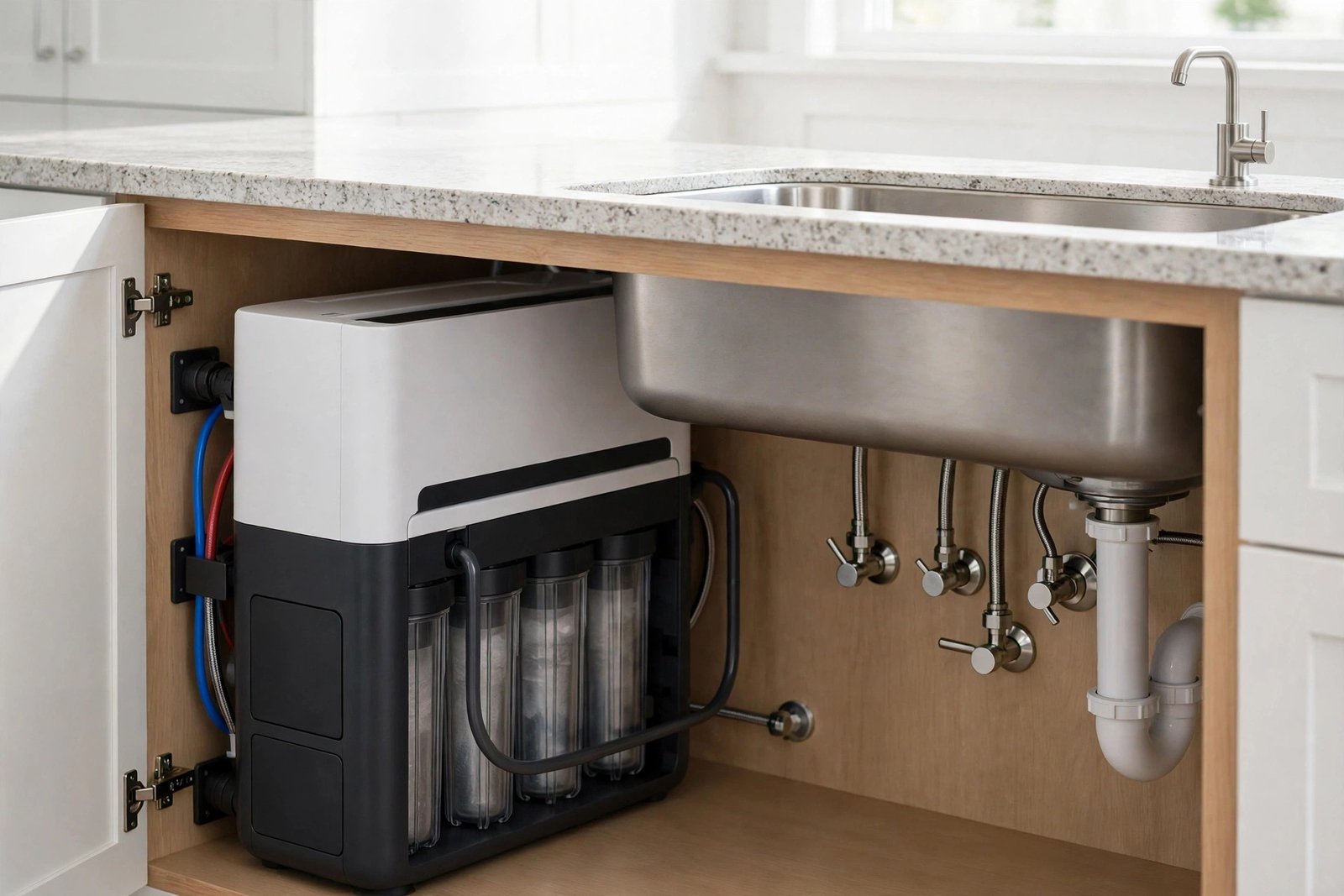
Waterdrop G3P600 — a tankless RO system worth a close look
A tankless design is worth considering because it removes the storage tank from the chain, so filtered water spends less time sitting in a tank before it reaches your glass. Check the current listing for its certifications and filter-change schedule, and match them against the points in this guide before you buy.