
As an Amazon Associate I earn from qualifying purchases.
If you’re shopping for an under-sink reverse osmosis system, you’ve already seen the name: iSpring RCC7. It’s been the internet’s default answer to “which RO system should I buy?” for over a decade. And honestly? That default status is earned — but it’s not the right pick for everyone in 2026, especially with tankless systems getting cheaper every year.
Here’s the short version: the iSpring RCC7 is a 5-stage, 75 GPD under-sink RO system with a storage tank, a solid NSF/ANSI 58 certification, and filter costs that stay low year after year. It’s the pick for homeowners on municipal water who want great drinking water without a $600+ appliance. It’s not the pick if you hate waiting on a tank to refill, if your water pressure is weak, or if you want minerals added back into your water.
This is the plain-English review I wish existed when I started researching RO systems — specs from the actual Amazon listing, honest yearly cost math, who should skip it, and how it stacks up against the new tankless crowd.
What the iSpring RCC7 Actually Is
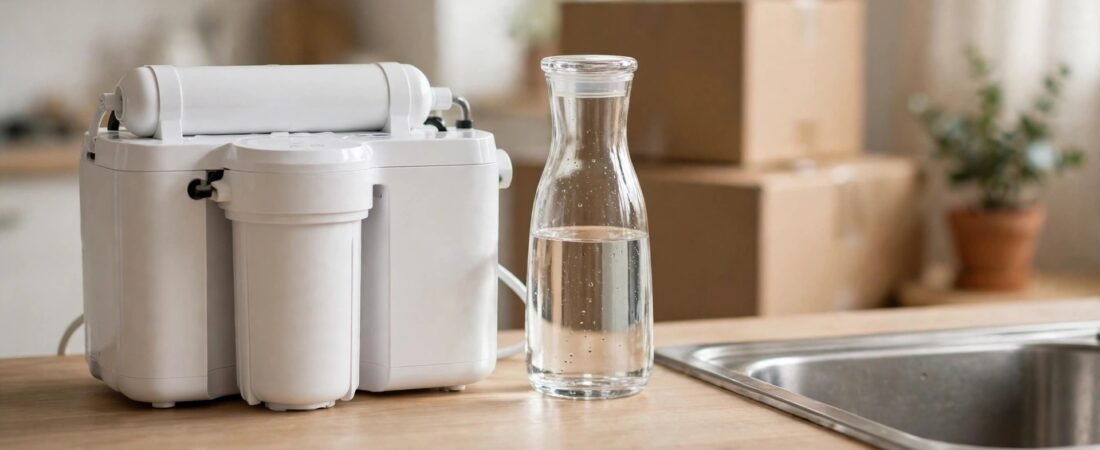
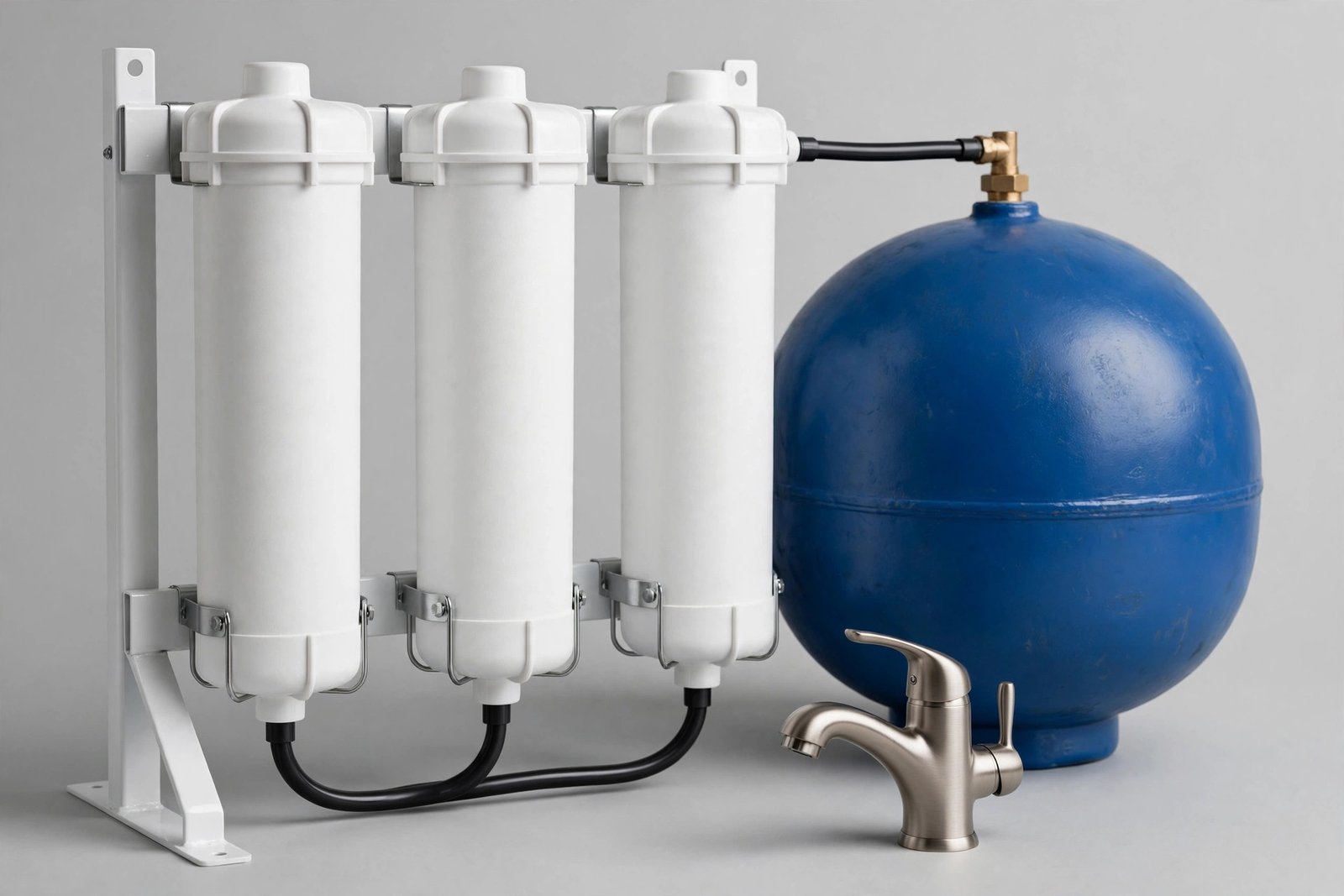
The RCC7 is the classic American under-sink RO formula: three pre-filter housings, an RO membrane, a polishing filter, and a pressurized storage tank that lives under your kitchen sink. A dedicated brushed-nickel faucet goes on your countertop, and you get bottled-quality water on demand — well, on tank-demand.
The five stages work like this:
- PP sediment filter (1st stage) — catches rust, sand, and particles down to 5 microns. The sacrificial lamb that protects everything downstream.
- GAC carbon filter (2nd stage) — granular activated carbon that absorbs chlorine, tastes, and odors.
- CTO carbon block (3rd stage) — a tighter carbon block that finishes off chlorine and organics before the membrane.
- RO membrane (4th stage) — the 75 GPD heart of the system, rejecting dissolved solids down to 0.0001 microns.
- Post-carbon filter (5th stage) — a final polish between the tank and your faucet so the water tastes fresh.
No electricity, no moving parts, no pump noise. It runs entirely on your home’s water pressure, which is why the feed-water pressure spec matters (more on that below).
iSpring RCC7 Specs (From the Official Amazon Listing)
No invented numbers here — every line below comes straight from the RCC7’s Amazon product page:
| Spec | Value |
|---|---|
| Brand / Model | iSpring RCC7 |
| Stages | 5 (sediment → GAC → carbon block → RO membrane → post-carbon) |
| Membrane capacity | 75 gallons per day (GPD) |
| Feed water pressure | 45–70 psi |
| Operating temperature | 40–100 °F |
| Max feed TDS | 750 ppm |
| Certification | NSF/ANSI 58 certified |
| Power | None — water-pressure driven |
| Faucet | Lead-free solid-brass faucet, brushed-nickel finish, included |
| Warranty | 1-year manufacturer warranty + lifetime technical support (USA-based, Alpharetta, GA) |
| Dimensions (system) | Approx. 15 × 8 × 18 inches |
Two things in that table deserve a closer look. First, the 45–70 psi requirement: if your house runs at 40 psi, the membrane underperforms and waste water climbs. That’s an edge case, but check your pressure before you buy. Second, NSF/ANSI 58 certification actually means something here — it’s the standard for reverse osmosis systems, and plenty of cheap Amazon RO units skip it entirely.
The Real Cost: Filter Cost-Per-Year (Honest Math)
This is the part most reviews hand-wave past, and it’s the part that actually decides whether an RO system is cheap to own. Here’s the RCC7’s schedule, straight from iSpring’s own manual:
- Stages 1–3 (sediment + GAC + carbon block): every 6 months — 2 changes per year
- Stage 5 (post-carbon): every 12 months
- Stage 4 (RO membrane): every 2–3 years
iSpring sells a 1-year filter pack (model F7-GAC) with 7 cartridges — two each of the pre-filters plus the post-carbon filter. That pack covers stages 1, 2, 3, and 5 for a full year. Important detail: the 1-year pack does not include the RO membrane — the membrane only needs replacing every 2–3 years, so you buy that separately on its own cycle (the 2-year F15-75 and 3-year F22-75 packs do include it).
💰 Cost-per-year box: Realistic all-in filter spend for an RCC7 on normal municipal water lands around $60–100 per year (third-party reviewer rofilterlab’s figure, and it lines up with the math: one 1-year prefilter pack + a membrane amortized over ~2.5 years). Hard water or heavy chlorine? You’ll change pre-filters sooner, so budget the top of that range. That works out to a few cents per gallon of drinking water — far below bottled water, and one of the lowest ownership costs in RO.
For the full replacement calendar with exact intervals and costs, see our iSpring RCC7 filter replacement schedule & cost guide.Real-World Ownership Notes

Installation is a real DIY project — a satisfying one. You’ll tap into the cold-water line, mount the drain saddle, and drill (or claim an existing hole) for the faucet. Most handy homeowners finish in an afternoon with basic tools; iSpring’s manual and videos are genuinely good. One non-negotiable tip from the listing itself: measure your under-sink space first. Five housings plus a tank eat a surprising amount of cabinet real estate.
The tank is the best and worst thing about it. Best: when you open the faucet, water flows immediately and quickly — no waiting for a membrane to produce it in real time. Worst: once the tank is empty, you’re waiting for it to refill at the membrane’s pace. For a family filling a few glasses, a coffee pot, and a cooking pot through the day, this is a non-issue. For back-to-back gallon jugs, it’s noticeable.
It’s silent. No pump, no electricity, no moving parts — the listing’s “quiet and low maintenance” claim checks out against how the thing is built.
Waste water — let’s be honest. Every conventional tank RO sends water down the drain; that’s how the membrane stays clean. Here’s where I’ll be straight with you: iSpring does not publish a wastewater ratio for the RCC7. If you see a blog quoting an exact number, they’re guessing. Third-party comparison tables commonly cite roughly 3:1 for this class of system — treat that as third-party, not official. If waste bothers you, route the drain line to a bucket and water your plants with it; plenty of owners do exactly that. And if waste ratio is a dealbreaker, skip ahead to the tankless section — modern tankless systems waste meaningfully less.
iSpring RCC7 vs Tankless: The 2026 Decision Frame
This is the real fork in the road for 2026 buyers. The RCC7 is the old guard (tank); Waterdrop, Frizzlife, and iSpring’s own RO500 are the new guard (tankless). Here’s how to choose in about thirty seconds:
Buy the RCC7 if: you want the lowest ownership cost, you have under-sink space to spare, you don’t want another appliance plugged in, and “a few seconds of full flow from the tank” sounds fine. It’s also simply the more proven design — millions of these are under American sinks.
Buy tankless if: your cabinet is cramped, you hate the idea of stored water, you want faster continuous flow for big pots, or waste-water ratio genuinely matters to you. The trade-off is real money: tankless systems cost more upfront and their proprietary cartridges cost more per year.
For our full breakdown of the tankless side, see the 5 best tankless reverse osmosis systems of 2026.
Who Should NOT Buy the iSpring RCC7
I’d rather talk you out of the wrong purchase than take the easy affiliate sale. Skip the RCC7 if:
- You want instant, unlimited flow. The tank refills at membrane speed. If that sentence annoyed you, go tankless instead.
- You want minerals left in (or added back to) your water. Standard RO strips minerals along with contaminants. You want the RCC7AK — the alkaline variant with a remineralization stage. We compared it head-to-head against APEC’s alkaline system here: iSpring RCC7AK vs APEC ROES-PH75.
- Your water pressure is low (under ~45 psi). Without enough pressure the membrane starves. You’d need a booster pump — at which point a tankless system with a built-in pump may be the cleaner answer.
- You’re a renter who can’t drill. The dedicated faucet needs a hole in your sink or countertop. Countertop RO exists for exactly your situation — no plumbing, no landlord conversations.
What About the RCC7AK?
Quick note since it keeps coming up: the iSpring RCC7AK is the same 5-stage system plus a 6th alkaline remineralization stage that adds minerals back and raises pH. If RO water tastes “flat” to you, or you believe in alkaline water, that’s your model. If you just want clean water at the lowest price, the plain RCC7 is the better value. Full comparison: iSpring vs APEC — which under-sink RO is better in 2026?
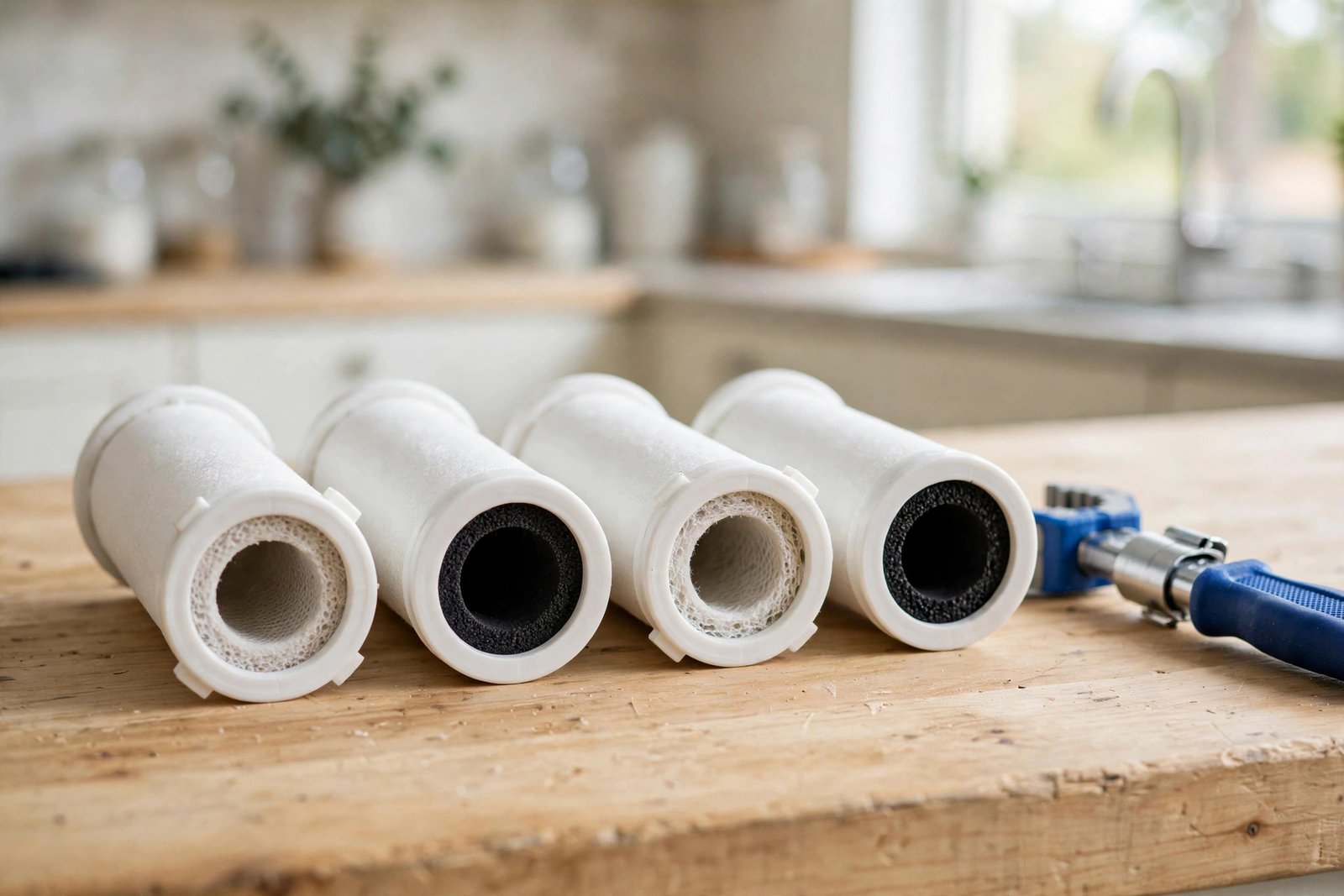
iSpring F7-GAC 1-Year Replacement Filter Pack
The smart buy alongside the system: 7 cartridges (2× sediment, 2× GAC, 2× carbon block, 1× post-carbon) that cover every filter change for a full year on the RCC7. No membrane included — by design, since it lasts 2–3 years.
FAQ
What’s the difference between the iSpring RCC7 and RCC7AK?
The RCC7 is the classic 5-stage RO system. The RCC7AK adds a 6th stage — an alkaline remineralization filter that puts minerals back and raises the water’s pH. Same housings, same 75 GPD membrane, same maintenance rhythm; the AK just costs more and suits people who want mineralized, less “flat” water. See our RCC7AK vs APEC ROES-PH75 comparison for the alkaline deep-dive.
How often do I need to change the RCC7’s filters?
Pre-filters (stages 1–3) every 6 months, the post-carbon filter (stage 5) every 12 months, and the RO membrane every 2–3 years. iSpring’s F7-GAC 1-year pack bundles a full year of everything except the membrane. Our complete iSpring filter guide has the full calendar.
Does the iSpring RCC7 remove fluoride and PFAS?
Yes — reverse osmosis is one of the most effective residential methods for reducing fluoride, and it’s EPA-recognized for PFAS reduction too. If PFAS is your specific worry, our RO and PFAS guide goes deeper on what the EPA rule means for homeowners.
Is 75 GPD enough for a family?
For drinking and cooking, comfortably. That rating means the membrane can produce up to 75 gallons in 24 hours — far more than a typical family drinks — and the storage tank handles burst demand (filling a pot, back-to-back glasses) instantly. You’d only feel the limit if you routinely drain the tank faster than it refills, like filling multiple gallon jugs in a row.
What warranty and support does iSpring offer?
A 1-year manufacturer warranty plus lifetime technical support from iSpring’s US team in Alpharetta, Georgia. In the RO world, responsive domestic support is genuinely worth something — iSpring is consistently rated among the best for it.
Verdict: Still the Default Pick for a Reason
The iSpring RCC7 isn’t exciting, and that’s the point. It’s a 75 GPD, NSF/ANSI 58 certified, 5-stage RO system with a tank, a real warranty, American support, and roughly $60–100 a year in filter costs. No subscription cartridges, no app, no electricity. In 2026, it’s still the smartest under-sink RO for homeowners on municipal water who want clean drinking water at the lowest long-term cost.
Buy it if the classic formula fits your kitchen and your water pressure. Buy tankless if you want the modern conveniences and are willing to pay the premium. But if “proven, cheap to run, and dead simple” is what you’re after — the classic still wins.