As an Amazon Associate I earn from qualifying purchases.
If you’ve started shopping for home water treatment, you’ve probably run into a confusing fork in the road: water softener on one side, reverse osmosis system on the other, and a salesperson somewhere telling you that you absolutely need both. Are they the same thing? Do they solve the same problem? And which one does your home actually need?
Here’s the short version: they solve different problems, and for a lot of households, they genuinely work best as a team. But you don’t want to buy either one based on a guess. The smart move is a five-minute water test first — and by the end of this guide, you’ll know exactly what to test and what the results mean.
What a water softener actually does (plain English)
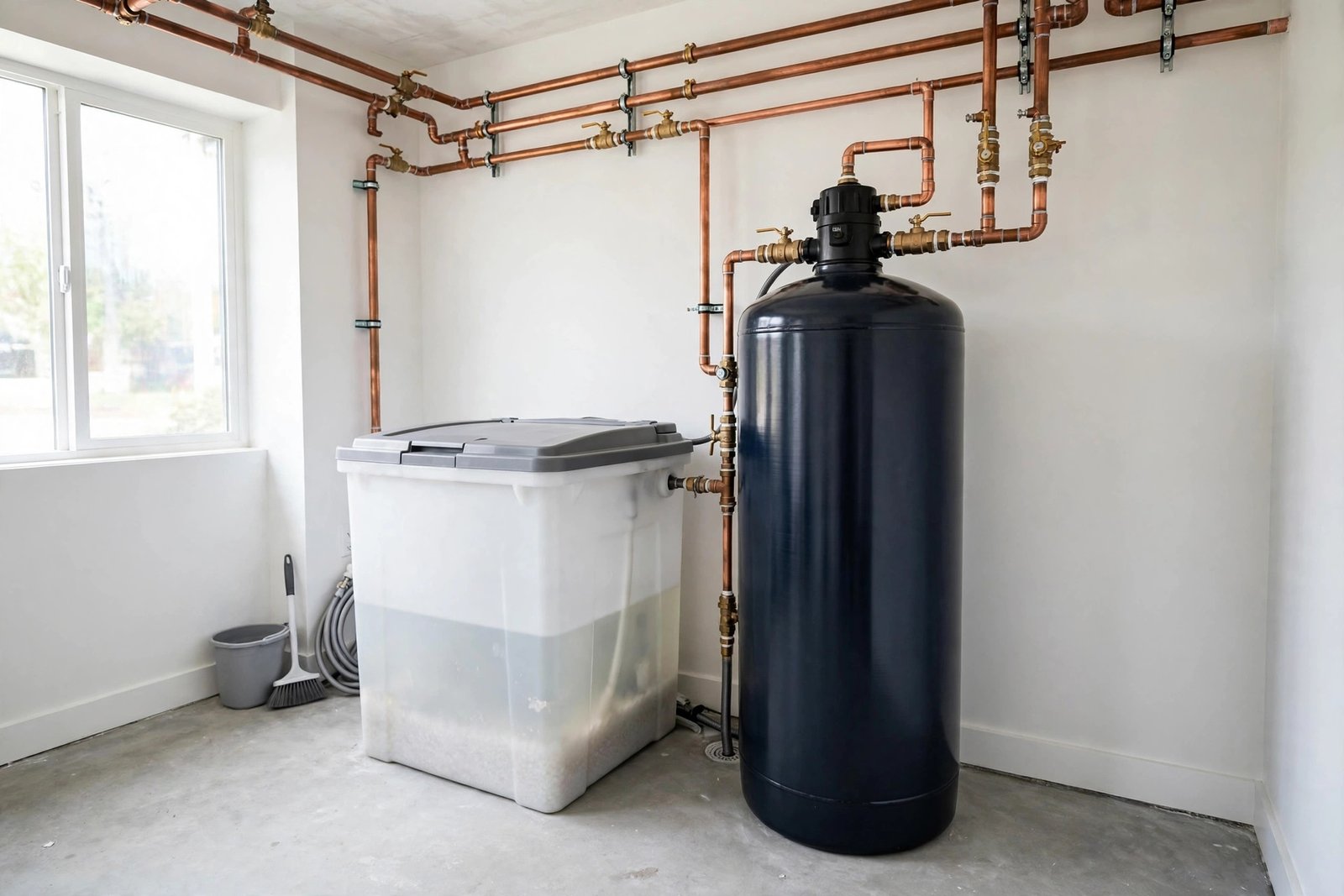
A water softener is a whole-house system — it treats every drop of water that enters your home, from the showerhead to the washing machine. Its one job is removing hardness minerals: calcium and magnesium, the culprits behind limescale crust on faucets, spots on glassware, stiff laundry, dry skin, and scale building up inside your water heater and pipes.
It does this through a process called ion exchange. Inside the tank, resin beads grab the calcium and magnesium ions and swap them for sodium ions (some systems use potassium instead). The hardness is gone — but note what happened: one dissolved mineral was simply traded for another. Nothing was filtered out.
This leads to the most common misunderstanding about softeners: a water softener does not reduce total dissolved solids (TDS), and it does not make water safer or better-tasting. It addresses hardness and scale — period. If your complaint is bad taste, chlorine, lead, fluoride, or anything contaminant-related, a softener won’t fix it.
What a reverse osmosis system actually does (plain English)
A reverse osmosis (RO) system does the opposite kind of job. Instead of treating the whole house, it usually sits under your kitchen sink and treats drinking and cooking water only. It forces water through a semi-permeable membrane with pores so tiny that they reject the vast majority of dissolved solids — metals, fluoride, nitrates, sodium, and most other dissolved contaminants — sending them out as waste water while clean water goes to your dedicated faucet.
Here’s the detail that matters for this comparison: an RO system removes the sodium that a water softener adds. So the two systems don’t just coexist — they actively complement each other. The softener trades hardness for sodium at the whole-house level; the RO unit strips that sodium (plus everything else dissolved) back out at the tap where you actually drink.
Want a closer look at how RO stacks up against the big-name systems? Our iSpring vs APEC comparison breaks down two of the most popular under-sink RO units side by side.
RO vs water softener: side-by-side comparison
| Water Softener | Reverse Osmosis | |
|---|---|---|
| Problem it solves | Hardness: calcium and magnesium (scale, spots, dry skin) | Dissolved solids and contaminants in drinking water (taste, lead, fluoride, sodium, nitrates) |
| How it works | Ion exchange — swaps hardness minerals for sodium (or potassium) | Semi-permeable membrane rejects dissolved solids, sends them to drain |
| Coverage | Whole house — every faucet, shower, appliance | One point of use — usually the kitchen sink only |
| Reduces TDS? | No — TDS is essentially unchanged (one dissolved mineral traded for another) | Yes — dramatically reduces dissolved solids |
| Improves taste? | No | Yes — this is one of its biggest strengths |
| Adds sodium? | Yes, in modest amounts (the ion-exchange swap) | Removes sodium — including the sodium a softener adds |
| Typical cost band* | $1,200–$2,500 installed (some dealer estimates range $600–$4,000 for the unit) | $300–$1,000 installed for under-sink (whole-house RO configurations run far higher) |
| Ongoing costs | Salt refills every 4–6 weeks; electricity minimal; regeneration water use | Filter replacements + membrane every few years (see our iSpring filter replacement guide) |
*Cost bands are ranges compiled from dealer estimates and vary widely by brand, home size, water conditions, and local labor. Treat them as ballpark figures, not quotes.
Do you need one, the other, or both? The decision framework
Stop guessing. The answer depends on what’s actually in your water — and a cheap test strip tells you in about a minute. Here’s the workflow I’d recommend before you spend a dollar on either system:
Step 1: Test your water’s hardness
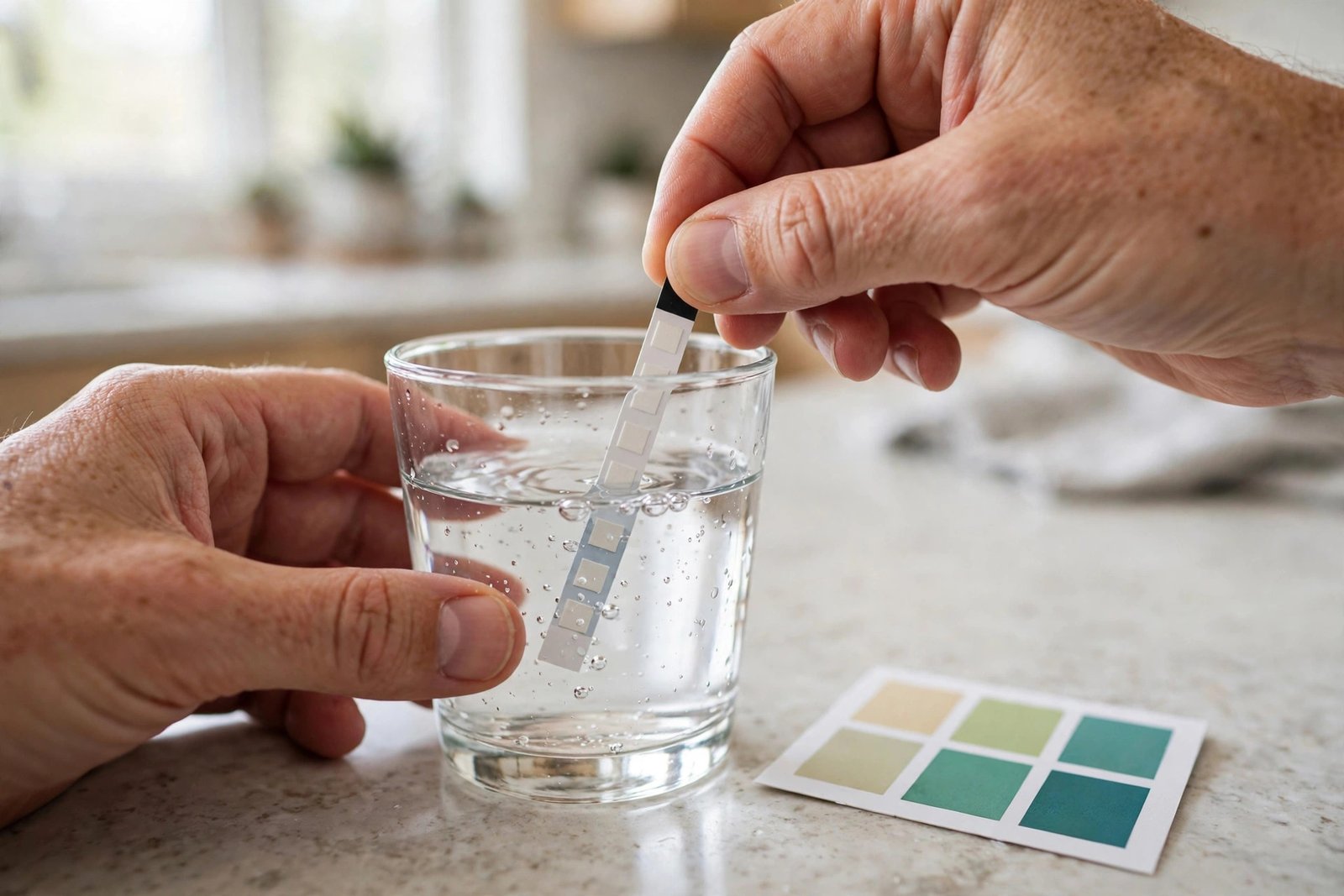
Grab a hardness test strip, dip it in a glass of tap water, and compare the color to the chart. The Varify Water Hardness Test Kit is a solid pick for this — 150 strips, reads hardness in both ppm and grains per gallon, and it’s made exactly for this job (checking softener needs, well water, dishwashers). It’s a few dollars, and it answers the single most important question on this page.
Step 2: Read the results
- Soft water (below ~3 grains per gallon / ~50 ppm): You almost certainly do not need a softener. Your scale problems, if any, are coming from something else. An RO system alone — for clean, good-tasting drinking water — may be all you need.
- Moderately hard water (3–7 gpg / 50–120 ppm): The gray zone. Mild spotting and some scale buildup over time. A softener is a “nice to have” here; many people manage with just an RO at the sink. If your water heater is dying young or your glassware looks permanently cloudy, lean toward the softener.
- Hard or very hard water (above 7 gpg / 120 ppm): A softener earns its keep. This is where scale destroys water heaters, clogs fixtures, and makes soap nearly useless. And critically: very hard water is also the scenario where a softener protects an RO system — hardness and iron foul and scale RO membranes, shortening membrane life. Putting the softener before the RO unit (softener first, RO after) extends the membrane’s life and keeps the whole setup running longer.
Step 3: Ask yourself what bothers you
Two different complaints, two different fixes. Spots, scale, crusty fixtures, dry itchy skin after showers, laundry that feels stiff — that’s a hardness problem, and only a softener (or a whole-house filter aimed at hardness) fixes it. Bad taste, chlorine smell, worry about lead or other contaminants, or a TDS reading that makes you wince — that’s a drinking-water problem, and that’s RO territory. Plenty of hard-water households have both complaints. That’s when you genuinely need both systems, working in sequence.
The “both” setup, in the right order
If you land on both, install them in this order: softener first (whole house), RO after (under the kitchen sink). The softener takes hardness — and the iron and manganese that often ride along — out of the water before it ever reaches the RO membrane. The RO unit then gets easier water to work with, the membrane lasts longer, and your drinking faucet delivers softened-then-purified water with the softener’s added sodium stripped back out. It’s the one-two punch the systems were designed for.
Well water folks should read our best tankless RO systems guide too — tankless RO units handle the point-of-use side with less fuss, and they’re worth considering if counter space under your sink is tight.
The honest box: what a water softener really costs to run
Dealers love quoting the sticker price and moving on. The running costs deserve honesty, because they’re the part that surprises people a year in:
- Salt refills: plan on topping up the brine tank every 4–6 weeks. Bags of softener salt are cheap individually, but it’s a recurring chore and a recurring cost for the life of the system.
- Regeneration water: the system periodically flushes the resin beads with brine and sends the rinse water to drain. That adds to your water bill, modestly but constantly.
- Brine discharge: regeneration produces salt-laden brine wastewater. In some areas — particularly parts of California — brine discharge is an environmental concern with local restrictions. Worth checking your local rules before you buy.
- No drinking-water payoff: worth repeating — softened water won’t taste better and isn’t purified. If drinking-water quality is the goal, the softener alone doesn’t get you there. That’s RO’s job.
For drinking water: the RO upgrade box
If your test strips say your hardness is fine — or you’ve already handled hardness and now want the drinking-water half of the equation — an under-sink RO system is the natural next step. The iSpring RCC7AK is one of the most widely owned 6-stage RO systems in the US: reverse osmosis plus an alkaline remineralization stage, with an enormous installed base behind it. It sits under your kitchen sink and does the one thing a softener can’t — give you clean, low-TDS, great-tasting water at the tap, sodium and all stripped out.
Frequently asked questions
Should I install the RO system before or after the water softener?
After — always softener first, RO second. Hardness and iron scale and foul RO membranes, so letting the softener do its job first protects the membrane and extends its life. The RO unit then also removes the sodium the softener added.
Does using a water softener improve the efficiency of an RO system?
Yes, in hard-water homes. By removing hardness minerals (and much of the iron and manganese) before water reaches the membrane, the softener reduces scaling and fouling — the main things that shorten membrane life. In soft-water homes, there’s no such benefit because there’s little hardness to remove.
Do I need both a water softener and reverse osmosis?
Only if you have both problems: hard water (scale, spots, dry skin) and drinking-water concerns (taste, TDS, contaminants like lead or fluoride). Test your hardness first — soft-water households usually need only the RO unit, while very hard-water households often genuinely benefit from both, installed in sequence.
Will a water softener fix the taste of my drinking water?
No. A softener addresses hardness and scale — it doesn’t reduce TDS or remove the things that affect taste. If taste is the complaint, an RO system (or at minimum a good carbon filter) is the fix.
Is softened water safe to drink?
For most healthy people, yes — the sodium added by ion exchange is modest. But if you’re on a sodium-restricted diet, or you simply don’t like the idea, an RO system removes that sodium at the drinking tap. That’s one of the strongest arguments for pairing the two.
Will an RO system work without a water softener?
Yes — but in very hard water the membrane will scale and clog faster, meaning more frequent (and pricier) membrane replacements. In soft to moderately hard water, an RO unit runs fine on its own.
Does RO remove the sodium a softener adds?
Yes. RO membranes reject dissolved sodium along with the other dissolved solids, so the water at your RO faucet comes out with the softener’s added sodium removed. It’s the cleanest answer to the softener’s one real drinking-water downside.
The bottom line
A water softener and a reverse osmosis system aren’t rivals — they’re specialists. The softener guards your whole house against hardness and scale. The RO unit guards your glass against dissolved solids and bad taste. Test your water first (it’s a five-minute job with a hardness test kit), fix hardness if the test says you have it, and add RO whenever you want drinking water you actually look forward to. In that order, neither dollar is wasted.