As an Amazon Associate I earn from qualifying purchases.
A glass of water in about five seconds. No tank eating half your under-sink cabinet. A little screen on the faucet that tells you your water’s TDS in real time. That is the pitch Waterdrop makes for the G3P800 — and it is a strong one.
But here’s what affiliate pages won’t say: this is a premium system with premium ongoing costs. Before you spend hundreds, you deserve the full picture — real specs, real filter math, installation reality, and the cases where something cheaper is smarter.
I’ve dug through Waterdrop’s own documentation, the Amazon listing, and a stack of hands-on reviews — including a lab-tested three-year ownership review from QualityWaterLab and month-long installs from PopSci and BobVila. Here’s the honest breakdown.
Waterdrop G3P800: The Short Version
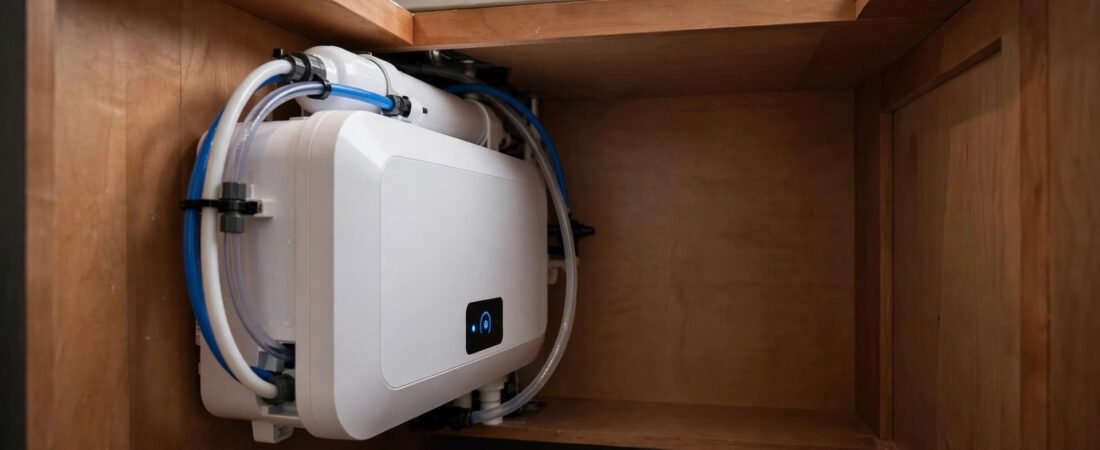
The G3P800 is Waterdrop’s flagship tankless under-sink reverse osmosis system. It produces up to 800 gallons per day — that’s roughly 0.63 gallons per minute — through 10 filtration stages packed into three twist-in cartridges, plus an LED UV sterilizer built into the water line. The whole thing is slim enough to leave most of your cabinet usable, and the smart faucet shows your TDS reading and filter life every time you fill a glass.
It’s IAPMO-certified against NSF/ANSI 58 for TDS reduction, NSF/ANSI 42 and 53 for chlorine, taste, and odor, and NSF/ANSI 372 for lead-free materials. That’s legitimate third-party certification, not a self-awarded badge. Third-party labs (including SGS) have tested it for PFAS, fluoride, lead, and heavy metals with strong reduction numbers.
Who is it for? Busy households that want the fastest, most convenient RO water they can get without a storage tank — and who are comfortable paying a premium for that convenience, plus ~$160–$170 a year in filters.

Waterdrop G3P800 — 800 GPD Tankless RO System
Best for: families and heavy water users who want fast, tank-free RO water with smart monitoring.
Full Specs (from Waterdrop & the Amazon listing)
| Specification | Waterdrop G3P800 |
|---|---|
| Flow rate | 800 GPD (~0.63 GPM) — a cup in about 5 seconds |
| Filtration | 10 stages across 3 twist-in cartridges + LED UV sterilizer |
| Pure-to-drain ratio | 3:1 (3 cups filtered per 1 cup wastewater) |
| Certifications | IAPMO-certified: NSF/ANSI 58 (TDS), 42 & 53 (chlorine/taste/odor), 372 (lead-free materials) |
| Smart faucet | Yes — real-time TDS display + filter-life indicator |
| UV sterilization | Yes, LED UV, rated 50-year lamp life |
| Filter life | CF 6 months / CB 12 months / RO membrane 24 months |
| Dimensions | 18.11″ × 5.67″ × 17.72″ — ultra-slim tankless body |
| Power | Required — corded electric (booster pump + UV + display) |
| Warranty | 1 year manufacturer/seller combination |
| Remineralization | Not built in — optional mineral cartridge add-on |
A note on that 3:1 ratio, because reviewers argue about it: Waterdrop’s rated spec is 3:1 pure-to-drain. In real-world testing, some reviewers measured closer to 1:1 during actual dispensing plus automatic self-cleaning flushes. The honest version: it’s far more efficient than old tank systems (which can waste 3–4 gallons per gallon), but don’t take 3:1 as a literal daily promise.
What the 10 Stages Actually Do
Ten stages sounds like marketing. In practice, it’s three physical cartridges doing layered work: a composite pre-filter (sediment + carbon) that catches particles and chlorine, the RO membrane itself (0.0001-micron pores — the real workhorse), and a carbon post-filter that polishes taste and odor. The LED UV stage adds microorganism protection in the water line.
Does the stage count matter? Not as much as the certification behind it. What matters is the NSF/ANSI 58 certification and the independent lab testing for PFAS and heavy metals. Plenty of systems claim “10 stages” with nothing backing it. This one has paperwork.
One gap to know: there’s no built-in remineralization. RO strips nearly everything out, so the water comes out slightly acidic (roughly pH 6–7) and can taste a little flat. Waterdrop sells an optional mineral filter if you want that spring-water taste back. PopSci’s reviewer noted the same thing. If mineral taste is a dealbreaker for you, an alkaline system like the iSpring RCC7AK vs APEC face-off we covered might suit you better.

Performance: Flow, Noise, and Real-World Behavior
The 800 GPD rating is the headline, and it delivers. Reviewers consistently report near-instant flow — no standing around waiting for a glass like you do with a 50 GPD tank system recovering between draws. For a family that cooks, makes coffee, and fills bottles all day, this is genuinely life-changing.
The TDS display is more useful than it sounds. Long-term owners report readings in the single digits to low double digits — QualityWaterLab’s faucet sample measured 28 ppm after three years of ownership with fresh filters. The pump runs around 65 dB when dispensing (normal conversation level), though the automatic self-cleaning cycle bothers some owners, and light sleepers with a bedroom next to the kitchen have complained.
One real limitation: it needs power. The booster pump, UV lamp, and smart display all run on electricity, so you’ll need an outlet under the sink. During a power outage, you get no filtered water. Old-school tank systems don’t care about your electrical panel.
Installation: What DIY Really Looks Like
Waterdrop says ~30 minutes; hands-on reviewers say closer to 60–90 minutes for a first-timer, and I’d believe them. The process is genuinely DIY-friendly — push-to-connect fittings, color-coded tubing, and an included water-line cutter. BobVila’s reviewer got it done with zero leaks on the first try.
The hard parts, honestly: you need a hole in your sink or countertop for the smart faucet (if you don’t have a spare knock-out, that’s drilling through stainless steel or stone), and you need to drill a small hole in the drain pipe for the wastewater line. Neither is rocket science, but if the idea of drilling into your countertop makes you sweat, budget for a plumber or a handyman. There’s also a 30-minute initial flush before the water is ready — the faucet display tells you when it’s done.
Filter Costs Per Year: The Number Nobody Leads With
This is the section that matters most for the “worth it” question. Here’s the real math, based on Waterdrop’s own replacement schedule and third-party cost estimates:
💰 G3P800 filter cost-per-year box
- CF composite pre-filter: every 6 months
- CB carbon block filter: every 12 months
- RO membrane: every 24 months
- Estimated annual cost: ~$160–$170/year (QualityWaterLab ~$170; affordablewatersystems ~$160)
- Twist-in design: no tools, no plumber, seconds per swap
- UV lamp: 50-year rated life — effectively never a replacement cost
Heads-up: filter life depends on your water. Hard or high-sediment water burns through the CF stage faster than the rated 6 months. If your TDS is very high, get your water tested first — and if you want to see how replacement math works on a classic tank system for comparison, our iSpring filter replacement cost guide breaks that one down to the dollar.
Five-year math: roughly $800–$850 in filters alone — hence “premium.” A family spending $1,000+/year on bottled water still comes out far ahead; a single person filling two glasses a day won’t, and that’s the G3P600’s territory.
G3P800 vs G3P600: Should You Pay More?
This is the question everyone actually has. The G3P600 is the same family — tankless, smart faucet, NSF-certified — at 600 GPD, 8 stages, no UV, and a 2:1 pure-to-drain ratio. We compared them head-to-head in our Waterdrop G3P600 vs G3P800 breakdown, but the short version:
- Get the G3P800 if: you have a large household, high daily water use, or you want UV sterilization and the fastest flow available.
- Save your money with the G3P600 if: you’re 1–3 people, on city water you trust, and don’t care about UV. It does ~90% of the job for meaningfully less money.
The G3P800’s edge is speed and the UV stage. The G3P600’s edge is value. Neither is “better” in the abstract — it depends on your household.
Prefer the budget tankless option?
The Waterdrop G3P600 is the same tankless design at 600 GPD with an 8-stage system and smart faucet — usually priced well below the G3P800.
For the full tankless landscape — including the Frizzlife PD600, which undercuts both Waterdrops — see our best tankless RO systems roundup.
Who Should NOT Buy the Waterdrop G3P800
Honesty section. This system is not for everyone, and the reviews agree:
- No outlet under the sink and no way to add one. The pump and UV need power. No power, no water. A classic tank system (iSpring RCC7, APEC ROES-50) runs on water pressure alone.
- You’re on well water with iron or sediment. The G3P800 is designed for municipal water. Well water needs pre-treatment first — check our best RO for well water guide before buying anything.
- You want mineral/alkaline water out of the box. There’s no remineralization built in. The optional add-on helps, but alkaline tank systems do it natively.
- You’re a light drinker on a budget. The upfront cost plus ~$160+/year in filters is a lot for someone who fills two glasses a day. A G3P600, a Frizzlife PD600, or even a good countertop system would serve you fine.
- You rent and can’t drill. You need a faucet hole and a drain connection. Landlord says no? Look at countertop RO instead.
- Power outages are frequent where you live. Every outage = no filtered water until the power’s back.
The Verdict: Is the G3P800 Worth It in 2026?
For the right household — a busy family on city water, with an outlet under the sink, that burns through filtered water daily — yes. The speed is real, the certifications are real, the TDS faucet is genuinely useful, and the tankless design gives you your cabinet back. It’s the most convenient under-sink RO experience you can buy right now.
But “worth it” has a price tag attached: a premium upfront cost plus roughly $160–$170 a year in filters, forever. If your household is small, your water is already decent, or the budget is tight, the G3P600 gives you nearly the same water for less — and a classic tank system like the iSpring RCC7 does the filtration job for a fraction of the price if you can live with a tank and slower flow.
The G3P800 isn’t the best RO system for everyone. It’s the best RO system for people who want the fastest, smartest, most convenient one — and know exactly what that costs. If that’s you, it’s an excellent buy.
Frequently Asked Questions
How long do Waterdrop G3P800 filters last?
The CF composite pre-filter lasts about 6 months, the CB carbon block about 12 months, and the RO membrane about 24 months. The UV LED lamp is rated for a 50-year service life. Real-world life depends on your water quality — hard or high-sediment water shortens the pre-filter’s life.
Does the G3P800 need professional installation?
No, it’s designed for DIY — most people finish in 60–90 minutes with the included fittings and cutter. The tricky parts are drilling a hole for the smart faucet (if you don’t have a spare) and connecting the drain line. If either makes you nervous, a handyman can do it cheaply.
What is the actual pure-to-drain ratio?
Waterdrop rates it at 3:1 pure-to-drain. Independent reviewers have measured closer to 1:1 during actual dispensing, plus water used in automatic self-cleaning flushes. Either way, it’s far more efficient than traditional tank systems.
Is the G3P800 noisy?
The pump runs around 65 dB when dispensing — roughly normal conversation level. The bigger complaint from owners is the automatic self-cleaning cycle, which some find noticeable. If your kitchen shares a wall with a bedroom, it’s worth knowing.
Does the G3P800 remove PFAS and fluoride?
Yes — third-party lab testing (SGS) shows strong reduction of PFAS compounds, fluoride, lead, and heavy metals, and the system is IAPMO-certified against NSF/ANSI 58 for TDS reduction.
Does the G3P800 make water alkaline or add minerals?
Not by itself. RO strips minerals out, so the water is slightly acidic with a neutral-to-flat taste. Waterdrop sells an optional remineralization filter if you want minerals and a higher pH.
Can I use the G3P800 with well water?
Not directly — it’s designed for municipal water. Well water with iron, sulfur, or heavy sediment needs pre-treatment first, or you’ll burn through filters fast. See our well-water RO guide before deciding.