
Every reverse osmosis system on the market promises the same thing: pure water. The iSpring RCC7AK promises something extra – pure water that doesn’t taste like it came out of a science lab. That 6th stage, the alkaline remineralization filter, is the whole reason this model exists. Instead of drinking water with every mineral stripped out, you get water with a little calcium and magnesium put back in, and a pH that sits slightly alkaline instead of slightly acidic.
I’ve spent the last few days digging through the official specs, the certification documents, and what owners actually report about living with this system. Here’s the honest picture – what it does well, where it falls short, and who should spend their money elsewhere.
What the iSpring RCC7AK Actually Is
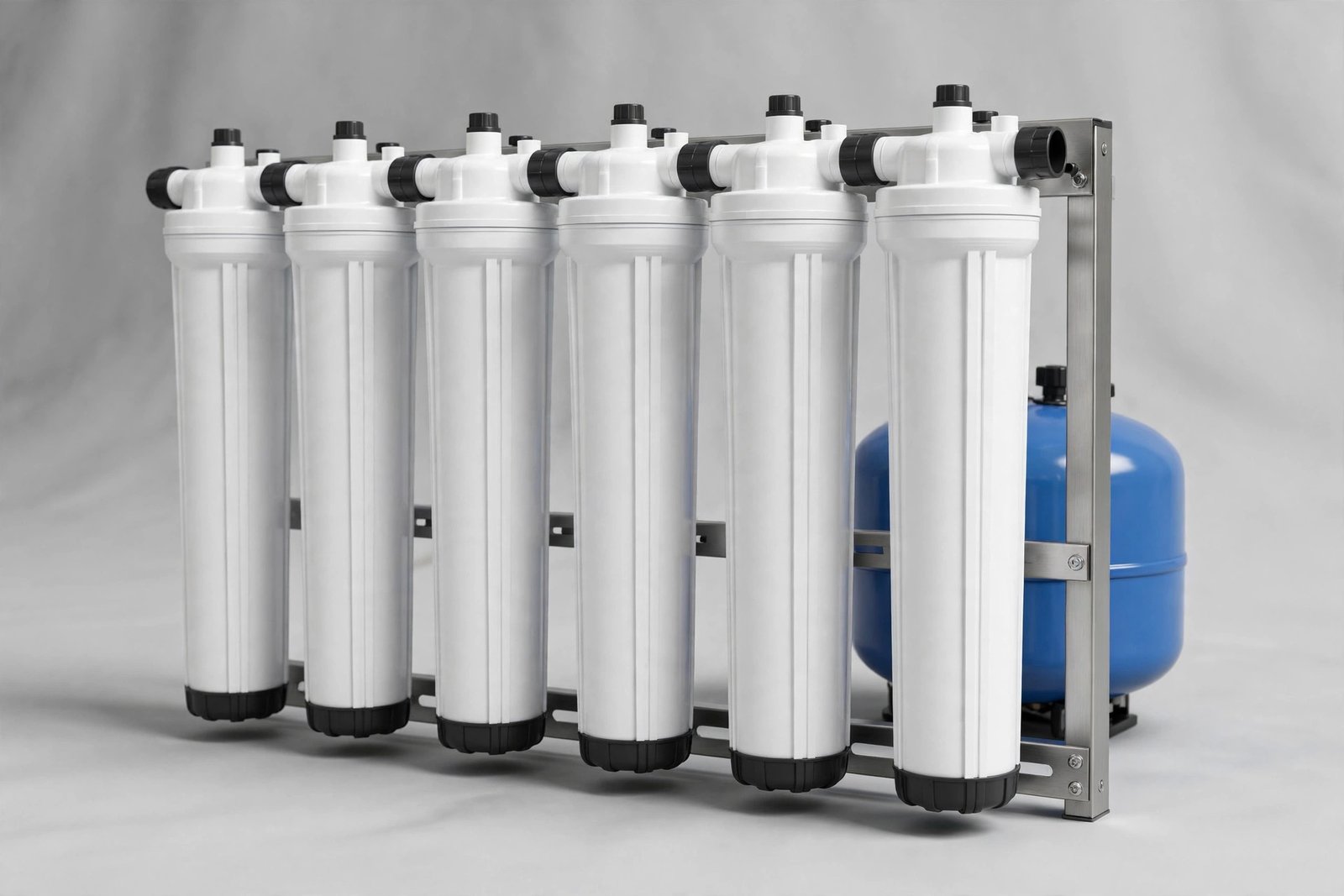
The RCC7AK is iSpring’s alkaline version of their famous RCC7. Same chassis, same 75-gallon-per-day membrane, same NSF/ANSI 58 certification – plus one extra cartridge bolted on the end that re-mineralizes the water. If the RCC7 is the plain black coffee of under-sink RO systems, the RCC7AK is the same coffee with cream.
The six stages, in order:
- Sediment pre-filter – catches rust, sand, and larger particles so the finer filters downstream don’t clog early.
- Granular activated carbon (GAC) – takes on chlorine, taste, and odor.
- Carbon block (CTO) – a second carbon pass that grabs what the GAC missed.
- RO membrane (75 GPD) – the heart of the system. Forces water through a membrane fine enough to reject up to 99% of over 1,000 contaminants, including lead (iSpring claims up to 98% for lead), fluoride, arsenic, asbestos, and PFAS.
- Post-carbon polish – a final taste pass after the storage tank.
- Alkaline remineralization (AK) – all-natural mineral stones that dissolve small amounts of calcium and magnesium back into the water and nudge the pH into the slightly alkaline range.
Why does that 6th stage matter? A standard 5-stage RO system strips so much from the water that the result comes out slightly acidic – iSpring’s own support pages put typical RO output at pH 7.0 or below. Some people notice it as a “flat” taste. The AK stage restores just enough mineral content to give the water a more natural, bottled-water taste. It won’t turn your tap into designer alkaline water with a pH of 9.5 (no under-sink filter does that), but it fixes the flatness.
iSpring RCC7AK Specs (Official)
| Spec | Detail |
|---|---|
| Stages | 6 (sediment, GAC, carbon block, RO membrane, post-carbon, alkaline remineralization) |
| Daily capacity | 75 gallons per day |
| Certification | NSF/ANSI 58 certified |
| Alkaline stage | All-natural mineral stones (calcium/magnesium remineralization) |
| Pure-to-drain ratio | Up to 1:2 with the storage tank (varies with pressure and water conditions) |
| Faucet | Patented top-mount design, European-style |
| First-stage housing | Transparent – you can see the sediment filter’s condition without opening it |
| Power needed | None (runs on water pressure) |
| Filter changes | Pre/post filters every 6 months (iSpring F6K75 replacement kit) |
| Warranty | 1-year manufacturer limited warranty + lifetime US-based technical support |
RCC7AK vs RCC7 vs APEC ROES-PH75: The Alkaline Showdown
The RCC7AK doesn’t exist in a vacuum. Its two closest rivals are its own sibling (the RCC7) and APEC’s alkaline model (the ROES-PH75). We compared the RCC7AK against the ROES-PH75 head-to-head in our iSpring RCC7AK vs APEC ROES-PH75 comparison – this table is the quick version.
| iSpring RCC7AK | iSpring RCC7 | APEC ROES-PH75 | |
|---|---|---|---|
| Stages | 6 | 5 | 6 |
| Daily capacity | 75 GPD | 75 GPD | 75 GPD |
| Alkaline remineralization | Yes – natural mineral stones | No (post-carbon polish only) | Yes – calcium carbonate cartridge |
| Certification | NSF/ANSI 58 | NSF/ANSI 58 | WQA certified (Amazon listing claims NSF 58 & 372) |
| Power required | No | No | No |
| Notable extra | Transparent 1st-stage housing | Brushed-nickel designer faucet | Extra pre-filter set included in the box |
The honest take: the RCC7AK and the ROES-PH75 are solving the same problem two different ways. iSpring uses mineral stones; APEC uses a calcium carbonate cartridge. Both are 75 GPD, both carry real third-party certification, neither needs electricity. If you want our full breakdown of the taste and maintenance differences, read the full comparison. And if you don’t care about alkaline at all, our iSpring RCC7 review covers the classic 5-stage version.
What It Costs to Run: The Filter Math
Filter cost per year (honest estimate)
- Pre/post + alkaline filters: every 6 months via the iSpring F6K75 replacement kit – listed around $95 on iSpring’s site at time of writing, so roughly $190/year if you buy direct. Check the current price before you budget, since it moves.
- RO membrane: lasts longer than the pre-filters; iSpring doesn’t publish a fixed membrane life on the official page, so treat third-party “2-3 year” claims as rough guidance, not gospel.
- Your time: each filter swap is a 20-30 minute DIY job. No tools beyond what’s in the box.
Bottom line: plan on roughly $190 a year in filters at today’s prices. That’s the real cost of the alkaline feature – the RCC7’s 5-stage kits run a bit cheaper because there’s no AK cartridge to replace. Our iSpring filter replacement guide walks through the schedule in detail.
Pros and Cons
What I like:
- NSF/ANSI 58 certification – real third-party testing, not marketing copy
- The alkaline stage genuinely improves taste over standard RO water
- 75 GPD is plenty for a family – no waiting on the tank to refill
- Transparent first-stage housing means you can see when the sediment filter is getting dirty
- Lifetime US-based technical support – iSpring’s support reputation is one of the best in this price class
- No electricity needed; installs under a standard kitchen sink
What I don’t like:
- Replacement filters cost more than the 5-stage RCC7’s – the alkaline cartridge adds to every 6-month kit
- Pure-to-drain ratio of up to 1:2 is good for a tank system but can’t touch tankless systems’ efficiency
- It still needs a storage tank, so it eats a chunk of under-sink space
- No smart features – no TDS readout, no filter-life reminders on the unit itself
Who Should NOT Buy the iSpring RCC7AK
This section matters more than the pros list. Skip the RCC7AK if:
- You don’t care about alkaline water. Then you’re paying extra every 6 months for a filter stage you don’t value. Buy the standard RCC7 instead and pocket the difference.
- You’re on well water. iSpring’s own support documentation says the RCC7 line is designed for municipal tap water. Well water needs pre-treatment first – check our well-water RO guide before buying anything.
- You want maximum water efficiency. Up to 1:2 pure-to-drain is fine, but a tankless system wastes far less. Our drain-ratio explainer breaks down the real numbers.
- Your under-sink cabinet is tiny. Six canisters plus a tank need real estate. Measure first.
Also worth knowing: if you’re working from home these days and drinking twice the tap water you used to, a system like this pays for itself in skipped bottled-water runs pretty fast.
FAQ
Is the iSpring RCC7AK worth it?
If you want alkaline-tasting RO water without buying a separate remineralization cartridge, yes – it’s one of the cheapest ways to get it, usually selling for around $200 at time of writing (check the current price; it moves). If alkaline doesn’t matter to you, the standard RCC7 gives you the same filtration for less.
Does the RCC7AK remove fluoride?
Yes. Fluoride is one of the contaminants iSpring lists for the RCC7 line, and the system is NSF/ANSI 58 certified. For the full picture on fluoride and RO, see our fluoride removal guide.
How often do you replace the RCC7AK filters?
Every 6 months for the pre-filters, post-carbon, and alkaline cartridge – iSpring sells these together as the F6K75 kit. The RO membrane lasts longer. Set a phone reminder; a clogged pre-filter is what kills membranes early.
What’s the difference between the RCC7AK and the RCC7?
One stage. The RCC7 is a 5-stage system; the RCC7AK adds a 6th alkaline remineralization stage with natural mineral stones. Same 75 GPD capacity, same NSF/ANSI 58 certification, same warranty. That’s the entire difference – and the entire price difference, both upfront and in filter costs.
The Verdict
The iSpring RCC7AK is the alkaline RO system I’d point most people toward. It’s certified, it’s from a brand with genuinely good US-based support, and it costs about what a nice dinner out costs a family of four – around $200 at time of writing. The alkaline stage isn’t magic, but it does fix the one real complaint people have about RO water: that flat, empty taste.
Just go in with open eyes about the running costs. Roughly $190 a year in filters at today’s prices is the price of the alkaline feature, and if that bothers you, the 5-stage RCC7 is sitting right there. But if you’ve been reading about whether RO water is safe to drink every day and the mineral question is what’s holding you back – this is the system that answers it.
As an Amazon Associate, Clearove may earn from qualifying purchases – at no extra cost to you. Prices and availability change; the price on Amazon at checkout is what counts.