

As an Amazon Associate, Clearove earns from qualifying purchases made through links on this page, at no extra cost to you.
Picking between a classic tanked RO system and a modern tankless one feels a lot harder than it should. Both promise the same thing at the end of the day — clean, great-tasting water straight from your kitchen tap — but they get there in completely different ways. One stores purified water in a tank under your sink and has been doing it reliably for years. The other makes water on demand, fast, and skips the tank entirely.
That is exactly the choice between the APEC ROES-50 and the Waterdrop G3P600. I have spent a good while digging into both systems — their specs, their filter setups, what owners actually live with day to day — and the honest answer is that neither one is “the best” for everyone. The right pick depends on your kitchen, your household size, and how much you care about speed versus simplicity.
Here is the full breakdown, side by side.
APEC ROES-50 vs Waterdrop G3P600 at a Glance
| Feature | APEC ROES-50 | Waterdrop G3P600 |
|---|---|---|
| System type | Tanked (classic under-sink RO) | Tankless (on-demand RO) |
| Daily output | 50 gallons per day (GPD) | 600 gallons per day (GPD) |
| Filtration stages | 5 stages | 8 stages |
| Pure-to-drain ratio | About 3:1 drain-to-pure (conventional) | 2:1 pure-to-drain |
| Power needed | No — runs on water pressure alone | Yes — needs an under-sink power outlet |
| Smart faucet / TDS display | No — standard RO faucet | Yes — smart faucet shows TDS readings |
| UV sterilization | No | No |
| Certification | WQA Gold Seal certified | Not NSF-certified as a complete system |
| Best for | Simplicity, reliability, no-power setups | Speed, big households, small cabinets |
One thing worth clearing up right away: you will see some roundup articles describe the G3P600 with NSF-related claims. Treat those with care. The G3P600 is not NSF-certified as a complete system, and repeating a component-level claim as if it were whole-system certification would be misleading. Similarly, the ROES-50 carries the WQA Gold Seal — a respected industry certification — but it is not NSF-certified, and I am not going to call it that.
How Each System Works Day to Day
The APEC ROES-50: slow and steady, always ready
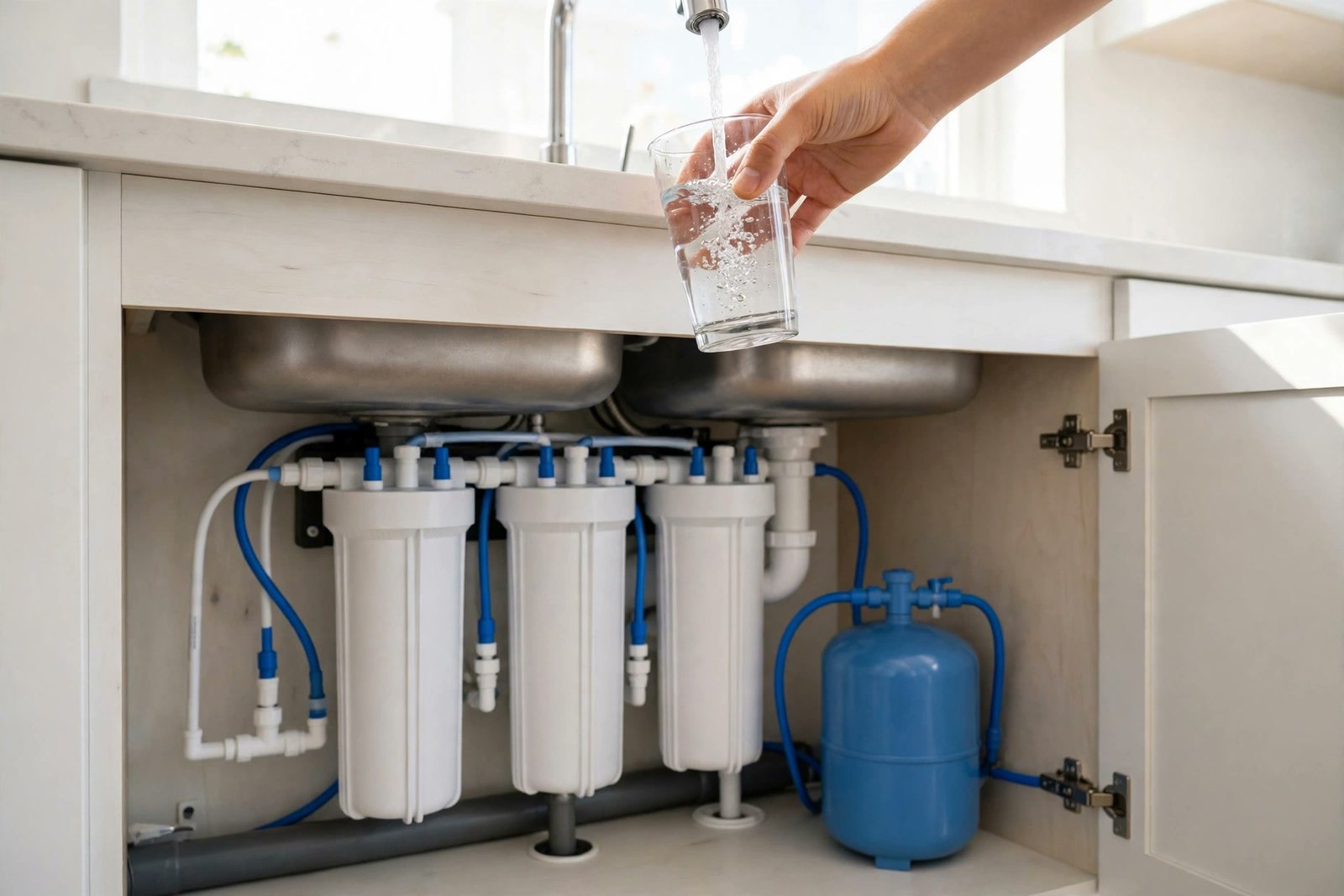
The ROES-50 is the old-school way of doing RO, and old-school here is a compliment. Tap water passes through five stages — sediment and carbon pre-filters, the reverse osmosis membrane itself, and a final polishing carbon filter — and the purified water collects in a pressurized storage tank under your sink. When you open the faucet, water flows out of that tank right away.
Because the tank does the waiting for you, the modest 50 GPD output rarely feels slow in real life. A family of three or four doing normal drinking and cooking will almost never drain the tank faster than it refills. The trade-off is that the tank takes up real cabinet space, and the water you drink has been sitting in that tank since the last refill cycle.

The Waterdrop G3P600: fast water, no tank, no waiting
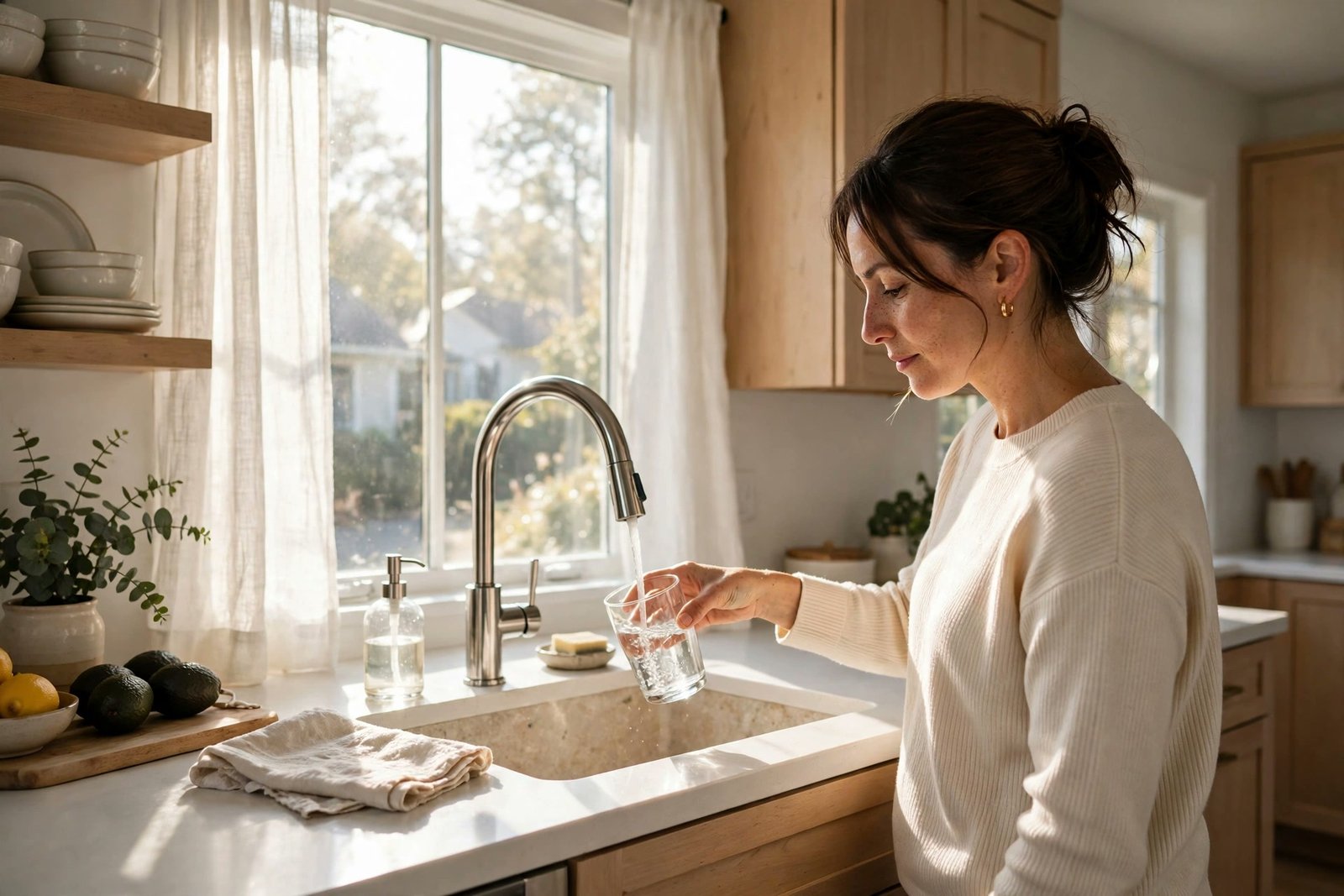
The G3P600 flips the whole idea around. There is no tank at all. When you open its smart faucet, the system filters water on the spot through eight stages and sends it straight to your glass at a genuinely fast flow rate. With 600 GPD of capacity, filling a big pot for pasta or a whole pitcher barely takes any longer than filling a single glass.
That speed is the headline reason people switch to tankless. The second reason is space: without a tank, the compact unit leaves most of your under-sink cabinet free for everything else down there. The third is freshness — since water is filtered at the moment you ask for it, nothing sits stored under your sink between uses.
The smart faucet is a nice touch too: it shows a TDS reading at a glance. If you want to understand what those numbers actually mean, our guide to TDS levels explained walks through it in plain language.

Water Quality and Contaminant Coverage
Both systems use reverse osmosis membranes, so both do the heavy lifting you would expect from RO: reducing dissolved solids, chlorine taste and odor, lead, fluoride, arsenic, nitrates, and a wide range of other common tap-water contaminants. If your main worry is the general quality of your municipal water, either system will be a big step up from an ordinary pitcher filter.
The differences sit in the details. The G3P600’s eight stages add extra polishing layers — including additional carbon and scale-inhibitor stages — which Waterdrop positions for taste and for protecting the membrane in harder water. The ROES-50’s five stages are a simpler, proven chain that has earned its WQA Gold Seal through the industry’s own certification program.
One honest caveat for both: no RO system makes your water “perfect,” and neither of these two includes UV sterilization. If your water comes from a private well with bacterial concerns, that is a different conversation — start with our guide to the best RO system for well water and get your water professionally tested before you buy anything.
Installation, Space, and Power
This is where the two systems genuinely pull apart, and it is often the deciding factor.
The ROES-50 needs no electricity at all. It runs entirely on your home’s water pressure, which means you can install it in any kitchen with a standard under-sink setup and never think about an outlet. The catch is space: the tank plus five filter housings eat a serious chunk of your cabinet. Measure before you order, and be realistic about what else needs to live under there.
The G3P600 needs the opposite trade. It frees up your cabinet — the single compact unit tucks neatly to one side — but it must have a power outlet under the sink. Plenty of modern kitchens have one (often the same outlet feeding the garbage disposal), but older kitchens sometimes do not. If you would need an electrician to add one, factor that into your decision honestly. Installation is straightforward on both for anyone comfortable with basic under-sink plumbing.
And if you are still weighing the whole tankless category rather than just this one model, our roundup of the best tankless RO systems puts the G3P600 in context with its rivals.
Filter Cost Per Year: What to Actually Expect
Sticker price is only part of what an RO system costs you. Filters are the ongoing bill, and the two systems bill you differently.
With the ROES-50, you are looking at a simple, predictable rhythm: pre-filters and post-filters get swapped on a regular cycle through the year, and the membrane itself lasts far longer — typically several years under normal municipal water. Because the design is standard and the filter sizes are common, replacement sets are widely available and the yearly upkeep stays modest for a full RO system. Nothing here will surprise you.
With the G3P600, filter changes are genuinely easier — twist-out cartridges, no tools, done in minutes — but the cartridges are proprietary and the system asks you to swap its stages on a shorter, staggered schedule. Expect to replace filters more often across the year, and expect each cartridge to cost more than a standard-size RO filter, because you are paying for the compact, twist-in design. Over several years, the G3P600’s running costs will usually run higher than the ROES-50’s, even though the day-to-day experience is more convenient. That convenience-for-cost trade is real, and it is worth weighing before you buy.
Either way, one small purchase pays for itself in peace of mind: a handheld TDS meter lets you check your filtered water any time and know when your filters are actually due.

A quick honesty note on that meter: it measures total dissolved solids only. It tells you how much stuff is dissolved in the water, not which stuff. It cannot detect individual contaminants like lead or PFAS on its own. Use it as a general filter-health check, not as a safety test — for specific contaminants, you need a proper lab test.
Who Should NOT Buy Each System
Do not buy the APEC ROES-50 if…
You have a big household that burns through water all day — think six or more people, constant cooking, and pitchers refilled on rotation. A 50 GPD system with a tank can keep up with normal family use, but it is not built for heavy, back-to-back demand, and you will notice the tank running low at the worst moments. Skip it too if your under-sink cabinet is already cramped; the tank needs real room, and squeezing it in next to a disposal and a tangle of pipes is a recipe for frustration. And if you hate the idea of stored water on principle and want every glass filtered fresh, the tanked design will never feel right to you.
Do not buy the Waterdrop G3P600 if…
You do not have a power outlet under your sink and do not want to add one. This system simply will not run without electricity, and that is a deal-breaker, not a detail. Skip it as well if you want the lowest possible long-term filter costs — the proprietary cartridges will cost you more over the years than standard-size filters. And if you live somewhere with frequent power outages, remember that a tankless electric system gives you nothing during an outage, while a tanked system keeps serving from its stored supply until the tank empties.
The Verdict: Which One Fits Your Home?
Here is how I would call it, household by household:
Pick the APEC ROES-50 if you want the simplest, most proven setup: a smaller household, a kitchen with no spare outlet, a preference for low running costs, or a “set it and forget it” attitude toward maintenance. It is the system I would point a first-time RO buyer toward, because there is almost nothing to go wrong with it. If you are comparing it with its sibling brand rival first, our iSpring vs APEC comparison is a good next read.
Pick the Waterdrop G3P600 if you have a busier household, you fill big pots and pitchers often, your cabinet space is tight, and you have an outlet under the sink. The speed and the fresh-on-demand filtering are genuinely delightful in daily use, and the smart faucet’s TDS readout gives you a visible reason to trust every glass. If you are torn between this and its bigger sibling, check our Waterdrop G3P600 vs G3P800 comparison before deciding.
For most average families, I lean toward the ROES-50 for its simplicity and lower lifetime cost — but if your kitchen is short on space or your household drinks a lot of water, the G3P600’s speed and tankless design are worth every bit of the extra filter spend.
Frequently Asked Questions
Is tankless RO water fresher than tanked RO water?
Yes, in a practical sense. A tankless system filters water at the moment you open the faucet, so nothing sits stored. A tanked system stores purified water in a pressurized tank, so the water you drink was filtered earlier — sometimes hours earlier. Both are perfectly fine to drink; freshness is a preference, not a safety issue, for a well-maintained system.
Does the APEC ROES-50 need electricity?
No. The ROES-50 runs entirely on your home’s water pressure and needs no power outlet. That makes it a great fit for older kitchens and for anyone who wants their drinking water available during a power outage, at least until the tank empties.
Does the Waterdrop G3P600 need an outlet under the sink?
Yes. The G3P600 is an electric system and must be plugged in under your sink. Check for an available outlet before ordering — many kitchens have one for the garbage disposal, but if yours does not, you will need an electrician to add one.
How much cabinet space does each system need?
The ROES-50 needs room for five filter housings plus a storage tank, so it takes a large share of a standard cabinet. The G3P600 is a single compact unit with no tank, so it leaves most of your cabinet free. Measure your cabinet before you buy either one.
How do the two systems compare on wasted water?
The G3P600 is the more efficient of the two, with a 2:1 pure-to-drain ratio — two parts purified water for every one part sent to drain. The ROES-50 uses a conventional tanked design at roughly 3:1 drain-to-pure, meaning it sends more water to drain for each glass produced. If water waste matters a lot to you, that difference is worth real weight in your decision.
Is a classic tanked system more reliable than a modern tankless one?
Classic tanked systems have fewer parts that can fail — no electronics, no pump, no power dependency — and decades of proven service behind the design. Tankless systems add electronics and a pump, which is what buys you the speed and efficiency, but it also means there is more that could eventually need attention. Both designs are well-established today; reliability here is really about simplicity versus capability.