

As an Amazon Associate I earn from qualifying purchases.
You don’t need to own your home to drink truly clean water. If you rent — a lease that says “no modifications,” a kitchen the size of a closet, and a landlord who would faint if you drilled a hole in the countertop — a traditional under-sink RO system is simply not an option. The good news? You don’t need one.
Countertop reverse osmosis systems plug into a normal outlet, sit on your counter like a coffee maker, and produce genuinely purified water with zero plumbing changes, zero drilling, and zero awkward landlord conversations. When you move, you unplug it and take it with you. That’s the entire installation story.
This guide rounds up the best RO systems for apartments and renters in 2026 — every pick chosen for the things renters actually care about: no drilling, small footprint, easy to move, and honest running costs.
The short answer
Best RO system for apartments overall: the Bluevua RO100ROPOT. It’s fully countertop (no plumbing at all), stores filtered water in a glass carafe instead of plastic, wastes less water than most rivals at a 2:1 pure-to-drain ratio, and its filters run about a year before replacement. It is the most renter-shaped product on this list — plug it in, pour tap water in the top, drink clean water out of the carafe.
What makes an RO system “renter-friendly”?
Before the picks, here’s the checklist we used — and the one you should use for any model you’re eyeing:
- No installation, period. No drilling into the sink, no tapping the cold-water line, no drain saddle under the cabinet. True countertop units refill from a top tank.
- Small counter footprint. Apartment counters are precious. Anything wider than about 9 inches starts eating real workspace.
- Portable. You should be able to lift it, box it, and move it to your next place without a plumber.
- Sane water waste. Old RO systems flushed 3–4 gallons down the drain for every clean gallon. Modern countertop models run 2:1 to 4:1 — worth checking, because your water bill follows your lease’s sub-metering (more on drain ratios in our RO wastewater explainer).
- Reasonable filter costs. A cheap unit with expensive filters is the classic trap. We note the real filter math under every pick.
1. Bluevua RO100ROPOT — Best overall for renters
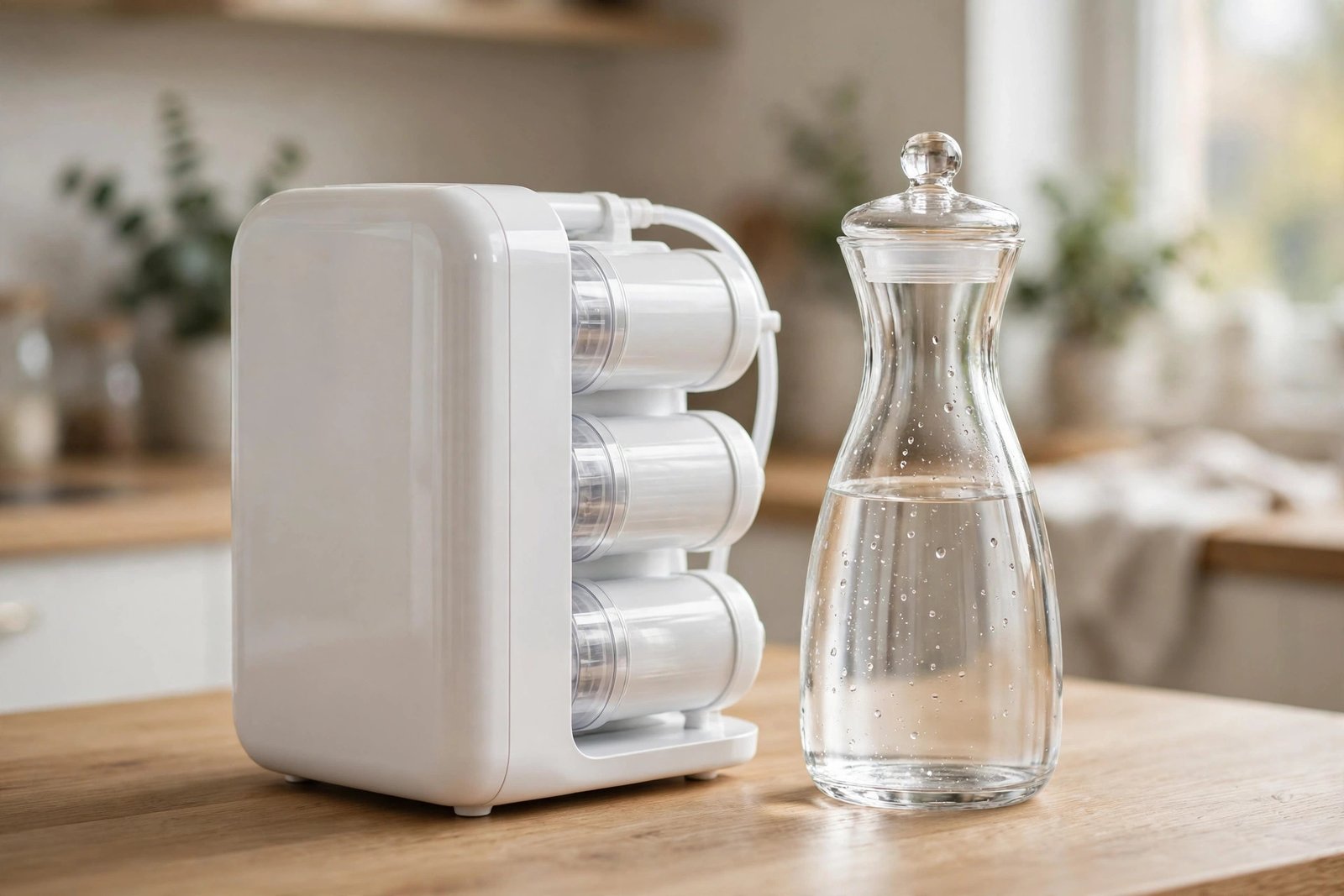
Who it’s for: Renters who want the closest thing to “just works.” You pour tap water into the top tank, press a button, and get RO-purified water in a high-borosilicate glass carafe — no plastic storage jug, no installation, no plumbing knowledge required.
The RO100ROPOT is built around the renter use case. It uses a 0.0001-micron RO membrane plus pre- and post-filters to reduce TDS, chlorine, fluoride, lead, arsenic, and PFAS compounds, and it’s SGS-tested and WQA certified (NSF/ANSI 372 lead-free). A power-saving standby mode kicks in when idle, and a filter-life monitor with a water-quality display tells you when cartridges actually need changing instead of guessing.
Honest downsides: It produces water at room temperature only — no hot or cold function. The carafe holds a modest amount, so a family of four will be refilling often. And while it’s compact for what it is, it’s still a countertop appliance; measure your cabinet clearance before buying.
Cost per year: This is where the RO100ROPOT quietly wins. Bluevua sells four individual replacement filters on Amazon — the pre/post filters list around $30 each and the RO membrane around $60, with pre/post filters rated for roughly a year. Most renter-level usage lands around $120–$150 per year in filters. Compare that to bottled water: a case of bottled water a week costs far more over a year than this system’s filter bill.
2. SimPure Y7T-A — Best water efficiency + better-tasting water
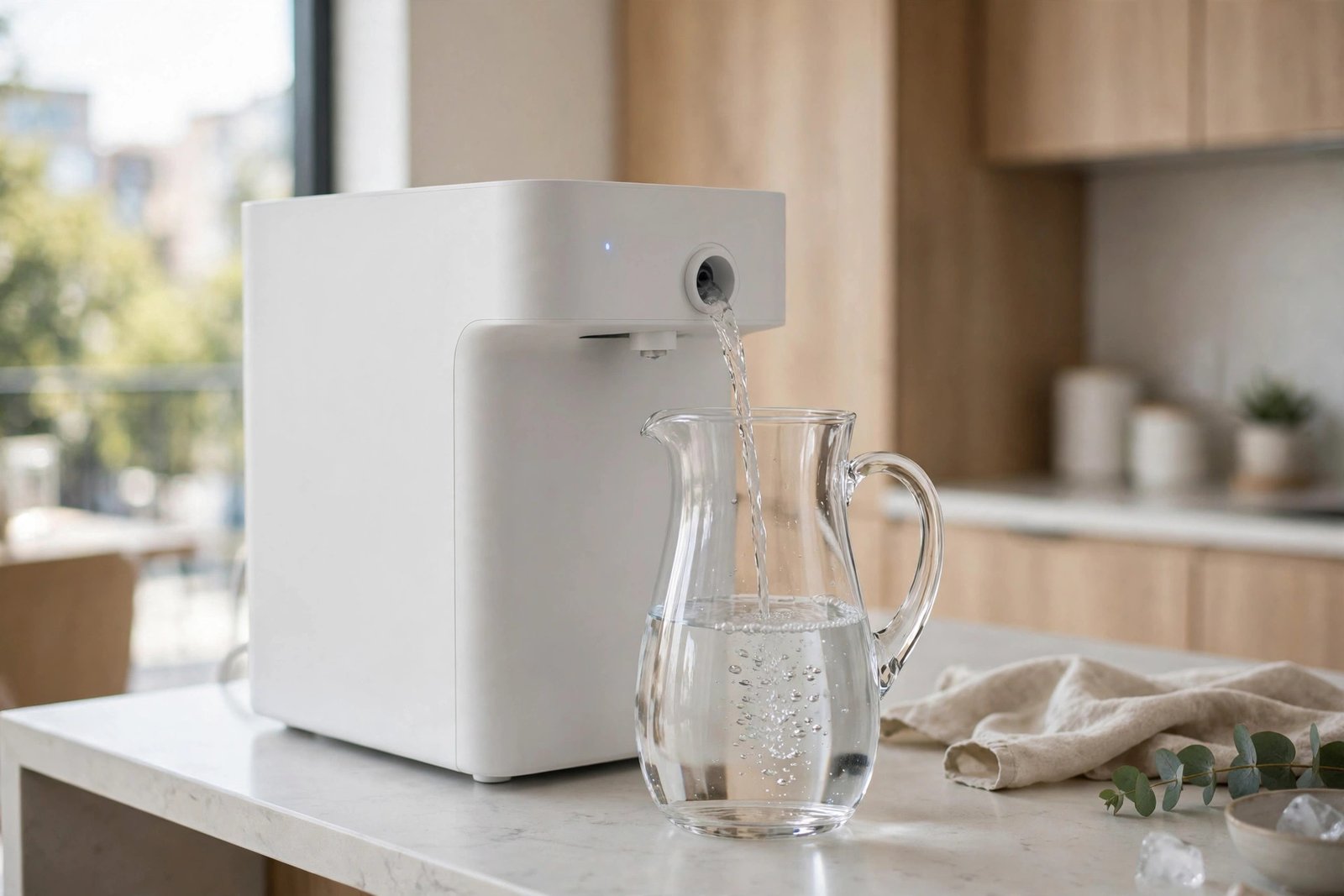
Who it’s for: Renters who hate the idea of wasting water, and anyone who finds pure RO water tastes a little flat. The Y7T-A is SimPure’s 2025 upgrade of their popular Y7 countertop line, and it adds an alkaline pH+ post-filter plus a mineral-enhancing glass pitcher — so the water that comes out has calcium, magnesium, and potassium restored and tastes noticeably less “empty” than standard RO output.
The numbers are genuinely strong: 5-stage filtration with 0.0001-micron RO, 100 GPD output, SGS-tested against NSF/ANSI 58, and a 4:1 pure-to-drain ratio — the best water efficiency on this list, meaning only one glass of reject water for every four glasses of pure water. That’s roughly 15× less wasteful than a traditional under-sink RO. It’s fully countertop with no installation, about 18 × 8 × 17 inches, and SimPure says it suits tap or well water up to 500 ppm TDS. If you’re cross-shopping against the AquaTru, our AquaTru vs SimPure countertop comparison breaks down how the two brands’ philosophies differ.
Honest downsides: Room-temperature water only — like every pick here, it won’t replace a kettle or an instant-hot dispenser. Filters need replacing roughly every 6 months, so it’s a bit more hands-on than the Bluevua. At about 12.5 lbs it’s light enough to move, but the 21-inch open-lid height needs roughly 22 inches of cabinet clearance.
Cost per year: Two filter change cycles a year. Check current cartridge prices on Amazon, but most owners land around $100–$140 per year — very reasonable for a system that saves this much water.
3. Waterdrop WD-K19-S — Best slim footprint for tiny kitchens
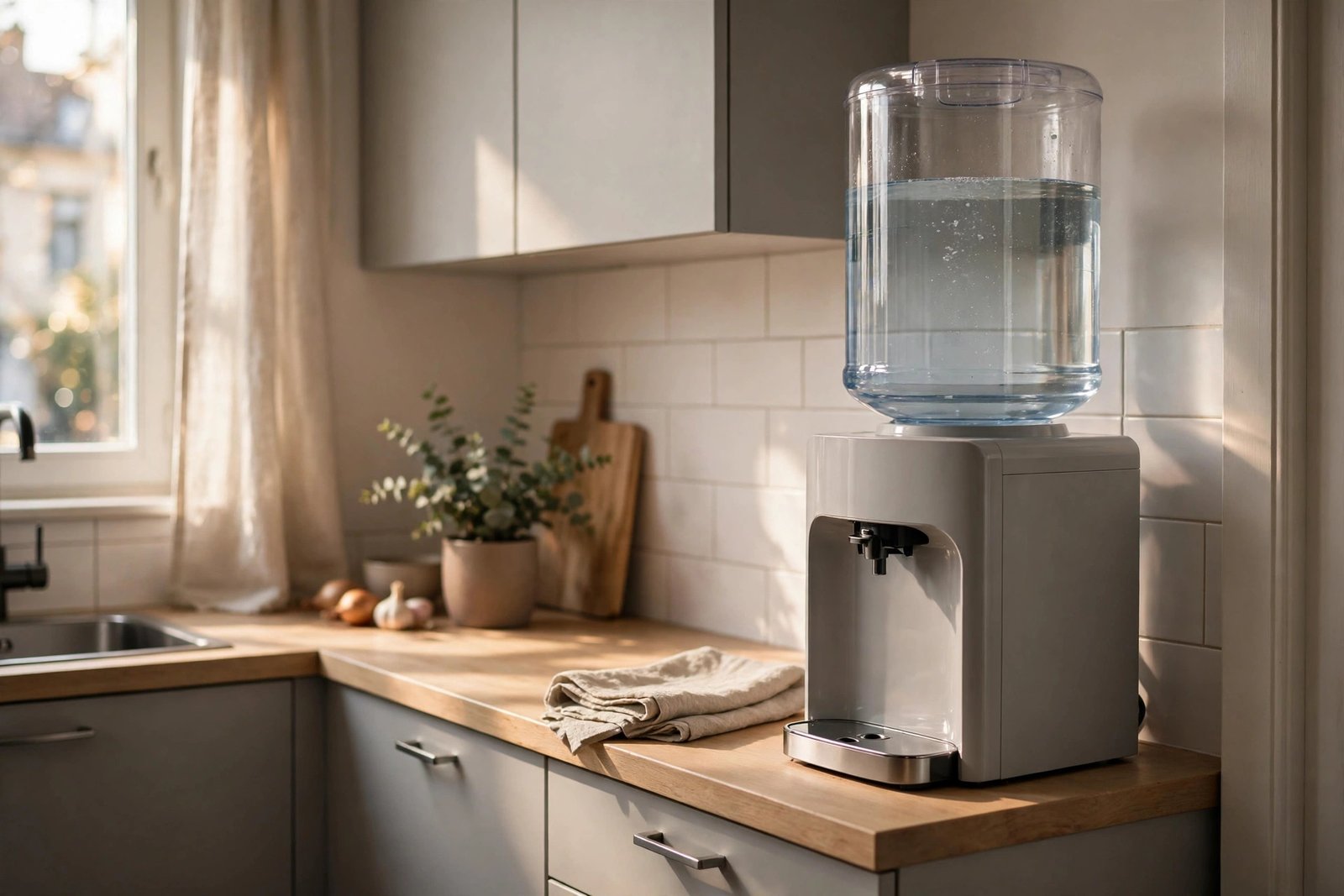
Who it’s for: Renters whose kitchen counter is roughly the size of a cutting board. The K19-S is only about 7.9 inches wide — one of the slimmest countertop RO dispensers Waterdrop makes — with a 170 oz (1.4-gallon) tank, so it tucks between the coffee maker and the wall without dominating the counter.
It’s a 4-stage RO system with a solid 3:1 pure-to-drain ratio, explicitly marketed for PFAS reduction, BPA-free, and zero installation. The whole filtration job is handled by a single composite cartridge you replace about once a year — the simplest maintenance routine of any pick here. It dispenses room-temperature water at the touch of a button, and the narrow profile genuinely makes a difference in galley kitchens and studio apartments.
Honest downsides: Room-temp water only, and with four stages (vs five or six on rivals) it’s a simpler filtration chain — still genuine reverse osmosis, but the spec sheet is leaner than the Bluevua’s or SimPure’s. The 75 GPD flow rate is slower than the others; filling a big pot takes patience.
Cost per year: One cartridge a year. Check the current price of the WD-K19RF replacement on Amazon, but a single annual cartridge is about as simple as filter math gets.
4. HM Digital TDS-EZ — The $15 starter move (test before you invest)
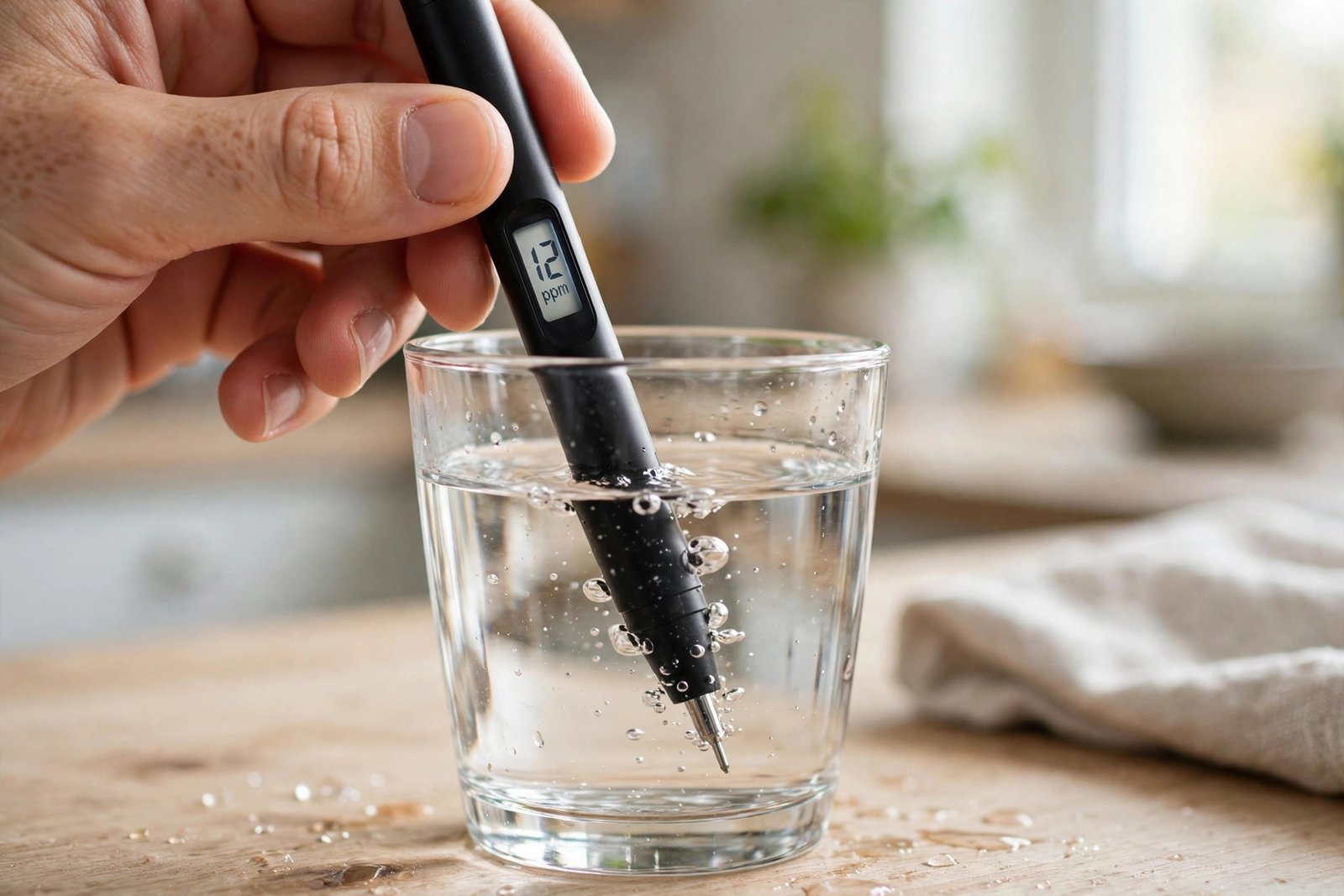
Who it’s for: Renters who aren’t sure they even have a problem worth solving. Before spending hundreds on a filtration system, spend about fifteen dollars to learn what your tap water actually contains.
A TDS (total dissolved solids) meter measures the mineral and salt content of your water in parts per million. It won’t tell you which contaminants are present — lead and calcium look the same to it — but it’s the fastest honest signal of whether your water is lightly mineralized or carrying a heavy dissolved load. Readings under ~50 ppm after filtration confirm your RO is doing its job; readings over 300–500 ppm on raw tap tell you filtration is worth it. The TDS-EZ reads 0–9990 ppm at 1 ppm resolution with ±3% accuracy, and it’s one of Amazon’s most-reviewed water testers (4.4 stars from roughly 7,600 reviews).
Honest downside: It’s a screening tool, not a lab. A low TDS reading doesn’t guarantee the absence of specific contaminants like lead or PFAS — for those you need a certified lab test or a mail-in kit. Think of it as the thermometer of water testing: useful, cheap, but not a diagnosis.
Side-by-side comparison
| Model | Stages | Pure-to-drain | Footprint | Filter rhythm | Best for |
|---|---|---|---|---|---|
| Bluevua RO100ROPOT | 5 | 2:1 | ~10 × 8 in | ~12 months | Overall renter pick — glass carafe, simplest ownership |
| SimPure Y7T-A | 5 | 4:1 | ~18 × 8 in | ~6 months | Water savers + better taste (alkaline remineralization) |
| Waterdrop WD-K19-S | 4 | 3:1 | ~14 × 8 in, 7.9 in wide | ~12 months | Tiny kitchens — slimmest profile, one cartridge a year |
| HM Digital TDS-EZ | — | — | Pocket pen | N/A | Cheap first step — test your tap before buying |
Footprint figures are approximate width × depth from manufacturer/Amazon spec sheets; check the live listing before ordering if counter space is tight.
Who should NOT buy a countertop RO (and when under-sink is better)
Honesty time: countertop RO is the right answer for renters, but not for everyone.
- If you own your home, an under-sink system is usually the better long-term buy. It hides under the cabinet, frees your counter completely, connects to a dedicated faucet, and typically produces water faster with lower per-gallon filter costs. Our best tankless RO roundup covers the top under-sink options.
- If you need hot or cold water on demand, these room-temperature units won’t satisfy you. Look at hot/cold countertop dispensers instead (our countertop RO comparison covers one).
- If your tap water TDS is already very low (under ~100 ppm from a good municipal supply), a simple carbon filter pitcher may be all you need — RO would be overkill.
- If you want whole-house filtration for showers and laundry, no countertop unit does that job.
Apartment & renter RO FAQs
Do I need my landlord’s permission for a countertop RO system?
Almost certainly not. Countertop RO systems don’t touch your plumbing — they plug into a wall outlet and you pour water in manually. Nothing is drilled, mounted, or altered, so most standard leases have nothing to say about them. That said, if your lease has unusual clauses about appliances or water damage liability, a 30-second skim of the lease (or a quick text to your landlord) costs nothing.
Do countertop RO systems waste a lot of water?
Far less than old under-sink systems did. The picks above run 2:1 to 4:1 pure-to-drain, versus 1:3 or 1:4 on legacy units. The reject water goes into an internal tank you empty into the sink — it doesn’t connect to your drain at all. See our drain-ratio explainer for the full math.
How much counter space does a countertop RO actually need?
Plan on roughly one square foot — about the footprint of a toaster oven. The Waterdrop K19-S is the slimmest pick at under 8 inches wide; the Bluevua is the most cube-like. Measure the gap between your counter and the upper cabinets too: some models need ~22 inches of vertical clearance when the lid is open.
Can I take it with me when I move?
Yes — that’s the whole point. Unplug it, drain the tanks, box it up. It’s one of the few home upgrades that follows you from apartment to apartment instead of staying behind as a gift to your landlord.
The bottom line
For most renters in 2026, the Bluevua RO100ROPOT is the pick: genuinely no-installation, a glass carafe instead of plastic, efficient 2:1 water use, and roughly a year between filter changes. If water waste bothers you, the SimPure Y7T-A stretches every gallon further at 4:1 and tastes better doing it. If your kitchen is tiny, the Waterdrop WD-K19-S disappears into a corner. And if you’re still on the fence, the HM Digital TDS-EZ costs less than a pizza and tells you whether your tap water even needs help.
Renting doesn’t mean settling for questionable tap water — it just means choosing a filter that respects the lease. One more useful read before you decide: does reverse osmosis actually remove fluoride? — the answer surprises a lot of first-time buyers.