
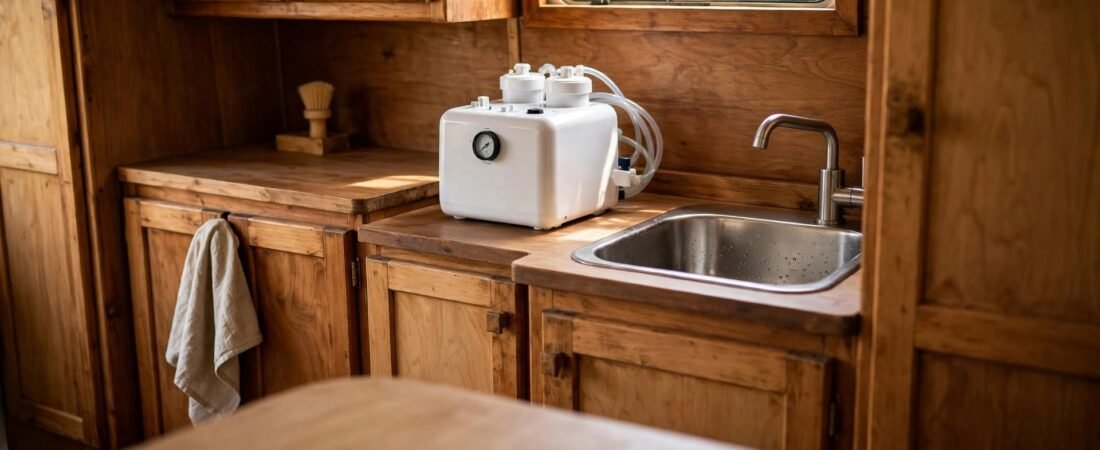
There’s a particular anxiety that comes with filling your RV’s fresh-water tank at a roadside spigot. It looks fine, but you’ve heard the stories — iron-stained campground wells, funky hookups, supply lines you’d rather not inspect. An inline filter smooths the taste, but for genuinely clean drinking water on the road, a compact RO system earns its spot on your counter.
The catch: most RO systems are built for full-size homes. RVs and small spaces need units that fit a tiny galley, sip power, and survive the road.
As an Amazon Associate, Clearove may earn from qualifying purchases — at no extra cost to you. Prices and availability change; the price on Amazon at checkout is what counts.
Honesty Box: Read This Before You Buy Anything
Three truths for RVers:
- Power: Four of the five picks plug into a wall outlet and need AC shore power (or an inverter). The APEC RO-CTOP-C is the exception — it runs on water pressure alone, no electricity at all.
- TDS limits: Every countertop unit here caps out at roughly 500 ppm total dissolved solids. The APEC is the only pick rated for high-TDS campground well water — up to 2,000 ppm. (We explain what TDS levels actually mean for your water in a separate guide.)
- Freeze damage: None of these units are freeze-proof. An RO membrane that freezes is a dead membrane. If you store your rig anywhere near freezing, read the winterization section below first.
Quick Comparison
| Pick | Type | Footprint | GPD | Power | Drain ratio |
|---|---|---|---|---|---|
| Waterdrop WD-C1S CoreRO | Countertop | 11.7″ × 8.3″ × 13.7″ | 75 | AC, 50W | 3:1 pure-to-drain |
| SimPure Y7P-BW UV | Countertop + UV | 18″ × 8″ × 16.1″ | 100 | AC | 4:1 pure-to-drain |
| APEC RO-CTOP-C | Countertop, faucet connect | 15.5″ × 6.5″ × 6.5″ | 90 @ 60 psi | None — water pressure only | 2:1 pure-to-drain |
| GlacierFresh RVRO01 | Portable, RV-specific | Ultra-portable w/ handle | N/A | USB-C 24V DC, 30W (power bank capable) | N/A |
| Waterdrop G2 | Tankless under-sink | 17.3″ × 5.9″ × 14″ | 400 | AC outlet under sink | 1:1 pure-to-drain |
1. Waterdrop WD-C1S CoreRO — Best Plug-and-Play Pick for Renters and RVers Who Hook Up
The WD-C1S is the “just add water” option. At 11.7″ × 8.3″ × 13.7″ and 14 lbs, it’s coffee-maker sized. Fill the 3.2L feed tank, plug it in, and you get 75 GPD with a 1L pure tank ready to pour. No plumbing, no drilling, no landlord negotiation — which is also why it sits near the top of our best countertop RO systems roundup.
It draws 50W on a 100–240V hookup, with a 3:1 pure-to-drain ratio. Certification nuance: it’s NSF/ANSI 372 Certified (Lead-Free) and SGS tested — 372 covers materials safety (lead-free construction), not contaminant-reduction performance. It’s not NSF 58.
Filter life runs about 12 months (the WD-C1RF replacement filter). Price band: around $250–300 at the time of writing — check the current price, since these listings move.
Pros: Truly plug-and-play; compact footprint; year-long filter life; decent drain efficiency.
Cons: Needs AC power; feed-tank cap ~500 ppm TDS; NSF 372 is materials-only certification.
2. SimPure Y7P-BW UV — Best for Questionable Campground Water (UV Angle)

If your travels take you to campgrounds where the water quality is a genuine unknown, the SimPure Y7P-BW earns its spot with a built-in UV sterilizer on top of RO. At 18″ × 8″ × 16.1″ and 14.8 lbs, it’s the largest countertop unit here — measure your galley first — but it delivers 100 GPD at 8.8 oz/min with a strong 4:1 pure-to-drain ratio.
Certification deserves care: it’s “tested and certified by SGS against NSF/ANSI 58 and EPA 537 standards.” An SGS lab tested it against those benchmarks — not the same as being NSF-listed.
Maintenance is hands-on: CF filter and RO membrane each last about 6 months, annual filter cost around $99.99–135. Price band is wide — roughly $180–370 at the time of writing. We covered this brand’s countertop lineup in our AquaTru vs SimPure comparison.
Pros: UV sterilization for sketchy water; best pure-to-drain ratio here (4:1); 100 GPD output.
Cons: Largest footprint; twice-yearly filter changes; electricity required; certification wording needs reading carefully.
3. APEC RO-CTOP-C — Best for Off-Grid and Boondocking (No Electricity Needed)
This is the one I’d point to first for serious boondockers. The APEC RO-CTOP-C is a portable countertop RO in an aluminum case (about 10–11 lbs, 15.5″ × 6.5″ × 6.5″) that hooks to your faucet with an adapter — and here’s the key: it needs zero electricity. It runs entirely on input water pressure. No shore power, no inverter, no generator running just to make drinking water.
Output scales with your water pressure: 90 GPD at 60 psi, 75 at 50 psi, 60 at 40 psi, and 45 at 30 psi, with a solid 2:1 pure-to-drain ratio. It’s also the only pick rated for high-TDS water — up to 2,000 ppm — the honest choice for campground well water that would choke the other units.
One disclosure: we couldn’t find a specific NSF listing for this model. APEC’s RO reputation is strong, but don’t buy this one expecting an NSF 58 stamp — none was found. The price band sits around $289.99 at the time of writing; check the current price before deciding.
Pros: Zero electricity — true off-grid capable; highest TDS tolerance (2,000 ppm); sturdy aluminum case; faucet adapter means no plumbing.
Cons: No NSF listing found for this model; output drops at low water pressure; no electric pump to boost weak pressure.
4. GlacierFresh RVRO01 (OSMOGO) — Best Purpose-Built for RV Life
This is the only unit here designed from scratch for RV use rather than adapted from a kitchen. The GlacierFresh RVRO01 — sold under the OSMOGO name — is ultra-portable with a built-in handle, a 4-stage system (3-in-1 composite: sediment/carbon pre-filter, RO membrane, carbon post-filter), and purifies about 12 fl oz per minute.
The power story makes it: USB-C at 24V DC, 30W — no AC needed. Plug it into a power bank and you’re filtering water off-grid. The Elite package ($269.99 at the time of writing) even includes a power bank; the Basic is $239.99. Per the brand’s claims, it removes bacteria, viruses, parasites, heavy metals, fluoride, chlorine, and PFAS — brand claims, not independently verified.
Certifications need careful reading: the brand lists “FCC-SDOC, FDA, CA65, NSF/ANSI Certified,” but we found no independent listing to confirm them — treat those as the brand’s own claims. Filter life is claimed at ~67,584 fl oz (roughly a 2-year lifespan, per the brand), with a 2-year warranty. Replacement filters run $69.99. Note: this one is sold on the official site, not on Amazon.
Pros: Built for RVs; power-bank compatible; genuinely portable; 2-year warranty.
Cons: Certification claims unverified independently; slower output (12 fl oz/min); must buy from the brand’s site.
5. Waterdrop G2 WD-G2-W — Best Tankless Pick for Tiny Kitchens
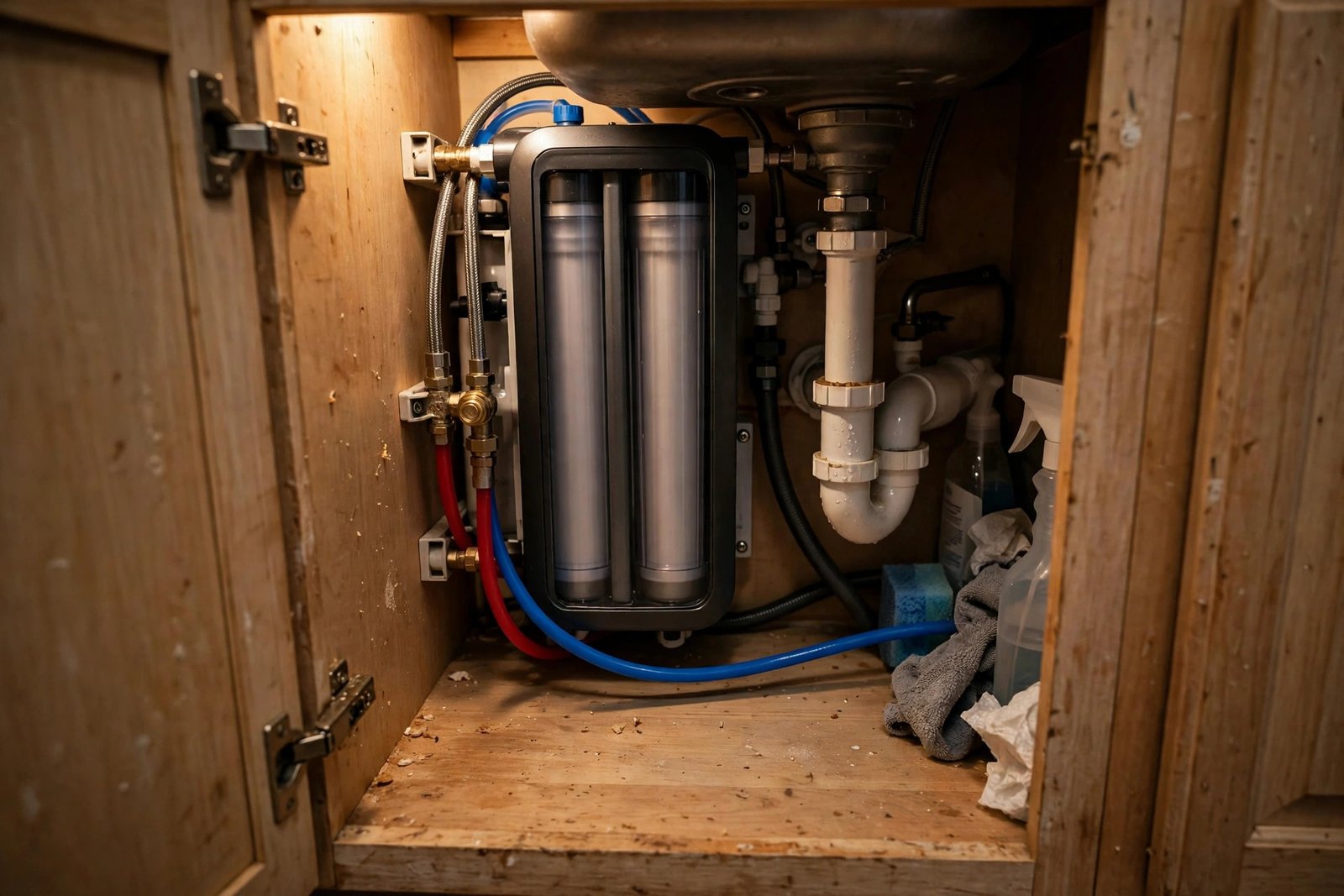
If your small space is a park model, a tiny house, or an RV with a real under-sink cabinet (and an outlet), the Waterdrop G2 gives you full-size RO performance without a tank eating half the cabinet. At 17.3″ × 5.9″ × 14″, it’s slim enough for cramped spaces, and 400 GPD with a cup filled in about 12 seconds means no waiting around.
The 1:1 pure-to-drain ratio is the best efficiency here. The honesty point for RVers: it requires an electrical outlet under the sink. Dealbreaker for a travel trailer with no such outlet; fine for a park model or stationary tiny home. Certification: NSF/ANSI 372 Certified (lead-free materials) and FCC Listed — 372 covers materials, not contaminant performance.
Filter economics: the CF pre-filter lasts about 12 months or 1,100 gallons, and the MRO RO membrane about 24 months or 2,200 gallons. The price band runs around $240–300 at the time of writing — check the current price.
Pros: 400 GPD, fills a cup in ~12 seconds; 1:1 drain ratio; tankless saves cabinet space; long membrane life.
Cons: Needs an under-sink outlet — limits RV use; 21–25 lbs; certification is materials-only.
Filter Costs Per Year vs. Bottled Water: The Honest Math
Bottled water runs roughly $1–2 per gallon in cases, and a two-person RV household easily drinks 300+ gallons a year — $300–600+ annually, plus the hauling and the plastic.
By comparison: the SimPure’s annual filter cost lands around $99.99–135. The GlacierFresh replacement filter is $69.99, and with the claimed ~2-year lifespan, that’s roughly $35 a year. The Waterdrop units need a yearly filter — exact replacement prices vary, so check the listing at purchase time.
Even at the high end, a compact RO pays for itself against bottled water within the first year or two.
Winterization: Don’t Skip This
Here’s what the product listings don’t emphasize enough: a frozen RO membrane is a ruined RO membrane.
None of these systems handle freezing. If your rig sits anywhere temps dip below freezing: drain all water from the unit and tanks before cold weather hits, run it dry, and store it somewhere heated — inside your home, not the RV.
Who Should NOT Buy a Compact RO for Their RV
Freeze-risk parkers: If your RV sits unheated through winter and you can’t bring the unit indoors, skip RO — a frozen membrane is money down the drain. Winterize first, buy second.
No-outlet rigs: If you boondock without an inverter, the plug-in countertop units and the G2 won’t work. The APEC (pressure-powered) or the GlacierFresh (USB-C power bank) are the workable options.
High-TDS well-water regulars: If your route runs through heavy well water above ~500 ppm TDS, the electric countertop units aren’t rated for it. The APEC’s 2,000 ppm rating is the only fit here.
If none of these picks fits, our apartments and renters RO roundup covers more no-drilling options for a stationary small space.
FAQ
Do I need an RO system for my RV, or is a basic inline filter enough?
A basic inline filter improves taste and removes chlorine and some sediment, but won’t meaningfully reduce dissolved solids, fluoride, PFAS, or heavy metals. Just want better taste at decent campgrounds? Inline is fine. Filling from unknown wells or want truly purified water? RO is the step up.
Do countertop RO systems need electricity to run?
Most do — they use an electric pump. The exception here is the APEC RO-CTOP-C, which runs entirely on faucet water pressure. The GlacierFresh RVRO01 uses low-voltage USB-C DC, which a power bank can supply.
Can you use a portable RO system off-grid / boondocking without shore power?
Yes, with the right pick. The APEC needs no power at all. The GlacierFresh runs off a USB-C power bank. The electric countertop units need shore power or an inverter.
How much water does an RO system waste?
Ratios here range from 1:1 on the Waterdrop G2 up to 4:1 pure-to-drain on the SimPure. On a limited fresh-water tank while boondocking, a better ratio matters a lot more than on full hookups.
What is the maximum TDS level a countertop RO can handle?
Most compact countertop units cap out around 500 ppm TDS. The APEC RO-CTOP-C is rated up to 2,000 ppm — the only pick here suited to heavy campground well water.
How do you winterize / store an RO system in an RV during freezing weather?
Drain every drop from the unit, tanks, and lines before freezing temperatures arrive, and store the unit somewhere heated — bring it inside your home, not the RV. A frozen membrane cracks and must be replaced.
How often do you change filters on a countertop RO system?
It varies: the Waterdrop WD-C1S runs about 12 months per filter; the SimPure Y7P-BW needs changes roughly every 6 months; the Waterdrop G2’s pre-filter lasts ~12 months with a ~24-month membrane; the GlacierFresh brand claims roughly a 2-year filter lifespan.
Does reverse osmosis remove fluoride, PFAS, lead, and chlorine?
RO membranes are highly effective at reducing all four — one of the technology’s main strengths. The GlacierFresh brand specifically claims removal of bacteria, viruses, parasites, heavy metals, fluoride, chlorine, and PFAS (brand claims, not independently verified).
Final Thoughts
The best RO for RV life isn’t the most powerful one — it’s the one that fits your actual setup. Shore-power campers who want plug-and-play simplicity: the Waterdrop WD-C1S. Off-grid boondockers: the APEC’s pressure-only design. Sketchy-water travelers: the SimPure’s UV stage. The GlacierFresh is the only one purpose-built for life on the road. And if your “small space” is a park model or tiny home with a cabinet and outlet, the tankless Waterdrop G2 is the workhorse pick.