

As an Amazon Associate, Clearove earns from qualifying purchases made through links on this page, at no extra cost to you.
Short answer: yes, for most common ones – with real limits
If you live near farmland, or you just want to know what is actually in your glass, this is a fair question to ask. A reverse osmosis system paired with carbon filters reduces most common pesticides and herbicides substantially. Industry sources, including AMPAC USA, cite typical rejection rates of 95 to 99 percent for many organic pesticides and herbicides. That is a strong result, and it is also not the whole story.
Removal varies by compound. It depends on the size of the molecule, its charge, how well it dissolves in water, the condition of your membrane, your water pressure, and if the system is certified for that specific contaminant. No home system removes 100 percent of everything, and any article that promises that is overselling it. My take: RO is one of the best tools a household has for this job, but you should buy it with clear eyes, test your water first, and keep up with filter changes.

How RO and carbon work together
A good RO system is not one filter doing all the work. It is a team, and each stage has a different job.
The carbon stages: adsorption
Carbon pre-filters and post-filters adsorb organic compounds. Think of activated carbon as a sponge with a huge internal surface area. Organic molecules stick to that surface as water passes through. This helps with taste, odor, chlorine, and a range of organic chemicals, including some pesticides. Carbon alone, though, has limits. Once its surface fills up, it stops adsorbing well. That is why exhausted carbon is a real problem, not a minor detail.
The RO membrane: rejection
The membrane is the main barrier. Water is pushed through a semi-permeable membrane at pressure, and most dissolved contaminants are held back and flushed away in the reject stream. Larger organic molecules, charged molecules, and many pesticide compounds are rejected well by an intact membrane. Smaller, uncharged organic molecules can slip through more easily. That split – membrane rejection doing the heavy lifting, carbon catching organics – is the honest way to describe the system.
For a related contaminant, see our guide on RO and PFAS, which explains membrane rejection in more detail.
What the numbers actually mean
Ranges like 95 to 99 percent sound precise, but they are typical ranges for many compounds under good conditions, not a guarantee for every chemical in your water. A compound at the small end of the scale, a tired membrane, or low pressure can all pull performance down. Treat published ranges as a guide to what a healthy, certified system can do, not as a lab result for your tap.
| Compound or group | What RO plus carbon typically does | Notes |
|---|---|---|
| Atrazine (herbicide) | Substantially reduced; industry sources cite typical 95 to 99 percent rejection for many organic pesticides and herbicides (AMPAC USA) | Common agricultural runoff herbicide; EPA drinking-water standard is 3 parts per billion (EPA) |
| Simazine (herbicide) | Substantially reduced in the same typical range (AMPAC USA) | Another common agricultural runoff herbicide; check your lab report for the exact compound |
| Many other organic pesticides and herbicides | Typically 95 to 99 percent rejection cited for many compounds (AMPAC USA) | Varies by compound: molecular size, charge, and solubility all matter |
| Small uncharged organic molecules | Lower and more variable rejection | These pass through membranes more easily; certification for a specific contaminant matters most here |
Atrazine and simazine: the two names to know
Atrazine and simazine show up a lot in farm-country water talk because they are widely used herbicides and they can reach groundwater and surface water through runoff. The U.S. Environmental Protection Agency sets the drinking-water standard for atrazine at 3 parts per billion. That number matters because parts per billion is a tiny amount – far below anything you can see, smell, or taste.
That scale is also why testing matters so much. You cannot judge pesticide levels by looking at your water. Clear water can still carry trace contaminants, and cloudy water can be cloudy for harmless reasons. Only a proper test tells you what is there.
If you want a practical testing walkthrough, read how to test tap water for lead and PFAS – the same lab-test-first logic applies to pesticides.
Why a carbon pitcher is not the same thing
I like carbon pitchers for what they are: cheap, simple, and good at improving taste and cutting chlorine. They are not a substitute for RO when pesticides are your concern.
A pitcher filter relies almost entirely on adsorption. It has a short contact time, a small amount of carbon, and no membrane barrier. It can adsorb some organics, but it cannot reject dissolved contaminants the way a membrane can, and its performance drops fast once the carbon is spent. If a pitcher claims broad pesticide removal, read the fine print closely and look for certification for specific contaminants. In most cases, a pitcher is a taste filter, not a pesticide solution.
The same logic shows up with other dissolved contaminants. Our guide on RO and sodium explains how membrane rejection differs from simple carbon filtration.
The limits you need to hear before you buy
This is the section most sales pages skip, so I will spell it out plainly.
- Small uncharged molecules pass more easily. Membrane rejection is strongest for larger and charged molecules. Small, uncharged organic molecules are the hardest to stop, and results for those compounds vary the most.
- A damaged or old membrane lowers performance. A torn, fouled, or overdue membrane does not reject like a healthy one. The same goes for low water pressure, which reduces rejection.
- Exhausted carbon stops helping. Carbon that has filled up no longer adsorbs organics well. Skipped filter changes quietly undo part of your protection.
- Well water is not federally regulated. If you are on a private well, no utility is testing your water for you. Testing is your job, and it is worth doing before you pick a system.
- A strip test cannot detect pesticides at regulatory levels. Test strips work at parts per million, not parts per billion. Pesticide standards sit at parts per billion. Only a certified lab test can measure pesticides at those levels. A strip that shows nothing tells you nothing about pesticides.
- A TDS meter cannot detect pesticides either. A TDS meter measures total dissolved solids, a rough general reading. It does not identify pesticides, and a low TDS reading is not proof your water is pesticide-free.
What to do, step by step
1. Test first, especially on well water
If you are on well water near farmland, start with a certified lab test that covers pesticides and herbicides, not just a home strip. A lab report gives you actual compounds and levels, so you can pick a system certified for what you actually have. If you are on city water, check your utility’s annual water-quality report first, then consider a lab test if you have a specific concern.
Well-water readers should also see the best RO system for well water for system features that matter on a private supply.
2. Choose a certified system with carbon stages
Look for NSF/ANSI 58 certification, and check the certification listing for the contaminants you care about. A system with both carbon pre-filters and a carbon post-filter, plus a healthy membrane, gives you both mechanisms: adsorption and rejection. Do not buy on a single percentage claim on a box. Buy on certification and on a filter-change schedule you will actually follow.
3. Replace filters on schedule
Put filter changes on your calendar the day you install the system. Pre-filters and carbon stages usually need changing far more often than the membrane, and skipping them shortens membrane life and cuts organic removal. Keep a simple log: date, filter, and any change in taste or pressure.
4. Retest after install
Once the system has run for a few weeks, retest with a lab test. That post-install result is the only honest proof your setup works for your water. If levels are still a concern, talk to a water-treatment professional about a system rated for that compound, rather than stacking more uncertified filters and hoping.
Filter changes and replacement parts are an ongoing household cost, so it helps to plan for them like any other home expense. I keep my own home costs in a simple monthly list, and Earnrove’s guides on planning everyday household spending cover the same practical approach for readers who want to budget for upkeep without surprises.
An affordable first step, then the full system
You do not have to buy a full RO system today to start getting answers. Start with testing, add a general water-quality check, and move to RO if your results point that way.
A general check, not a pesticide test

The HM Digital TDS-EZ meter is a low-cost way to track total dissolved solids in your water over time. To be crystal clear: it does NOT detect pesticides. It gives a general reading that can help you spot big changes and check that your RO system is producing low-TDS water. It is a useful household tool, but it is not a pesticide test, and it should never be used as one.
Get a real lab test

For pesticides, the right move is a certified lab water test. You collect a sample, mail it in, and get a lab report at parts-per-billion levels. Look for a test that lists the pesticides and herbicides you are concerned about, including atrazine, and check that the lab is certified in your state.
If you want full RO protection
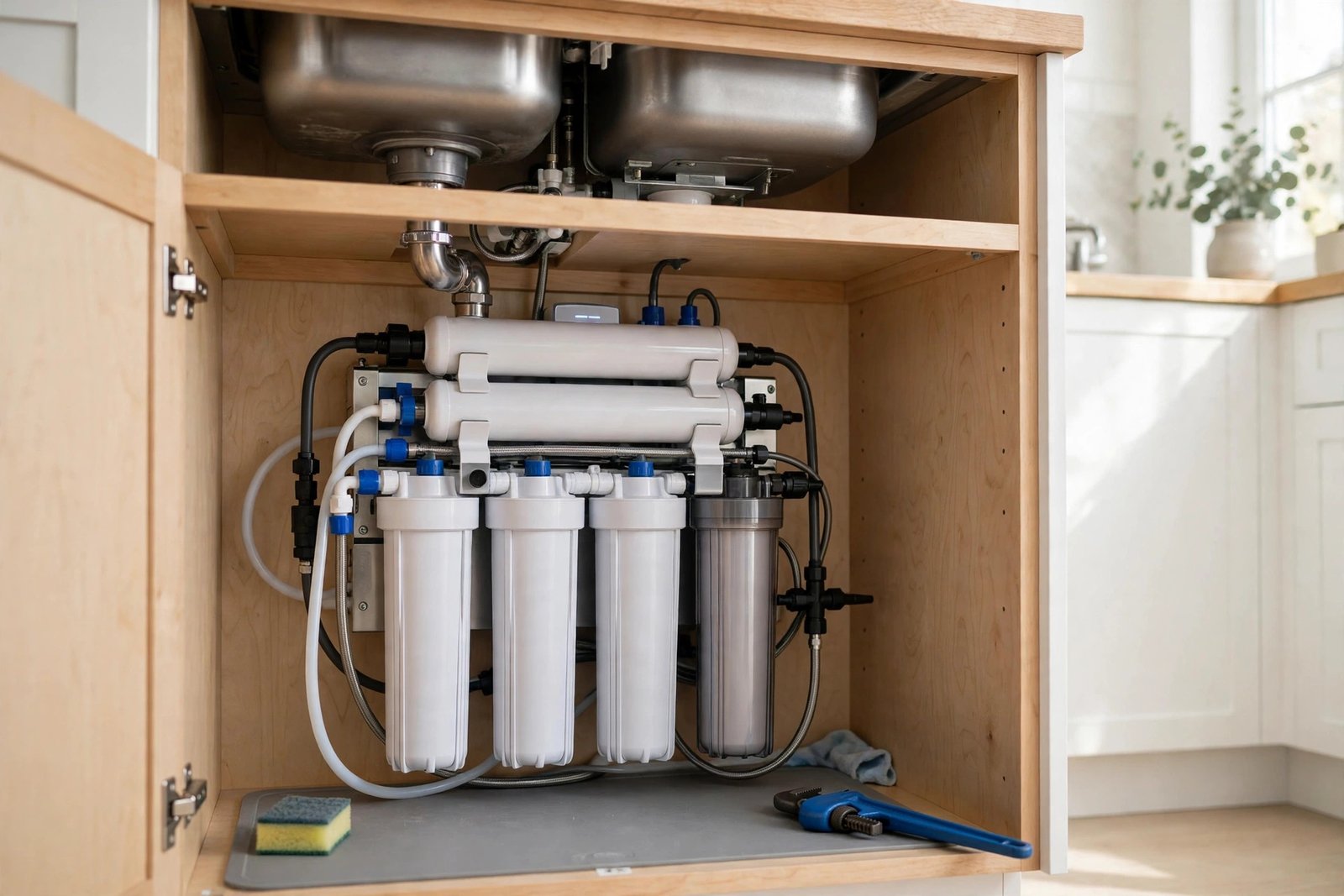
For readers who want RO protection at the tap, the iSpring RO500 is a tankless system rated at 500 gallons per day with a 2:1 drain ratio and NSF/ANSI 58 certification. Tankless designs save under-sink space, and the high daily output suits busy households. As with any system, confirm the certification listing covers your contaminants, and keep the filter schedule.
Frequently asked questions
Does RO remove atrazine?
RO plus carbon substantially reduces atrazine in most cases, with industry sources citing typical 95 to 99 percent rejection for many organic pesticides and herbicides (AMPAC USA). Results vary by membrane condition, pressure, and certification, so a lab test before and after install is the best way to confirm your setup. The EPA drinking-water standard for atrazine is 3 parts per billion (EPA).
Does a carbon pitcher remove pesticides?
Only partly, and not reliably enough to count on for pesticide protection. A pitcher adsorbs some organics, but it has no membrane barrier, a short contact time, and a small carbon bed that exhausts quickly. For pesticide concerns, a certified RO system with carbon stages is a much stronger choice.
Can I test for pesticides with strips?
No. Home strips cannot measure pesticides at regulatory levels, which sit at parts per billion. A strip that shows a clean result does not prove your water is pesticide-free. Only a certified lab test can measure pesticides at those low levels.
Is well water tested for pesticides?
Not by the federal government. Private well water is not federally regulated, so no agency tests it for you. If you are on a well near farmland, arrange your own certified lab test, and retest on a regular schedule or after nearby spraying, flooding, or a change in taste or odor.
Does RO remove 100 percent of pesticides?
No. No home system removes 100 percent of everything. RO plus carbon substantially reduces most common pesticides and herbicides, but small uncharged molecules, a tired membrane, low pressure, or exhausted carbon can all lower performance. Think of RO as strong, meaningful reduction – not total elimination – and verify it with lab testing.
So, does reverse osmosis remove pesticides and herbicides? For most common compounds, yes, substantially, when the system is certified, healthy, and maintained. Test first, pick a certified system with carbon stages, change filters on time, and retest after install. That sequence gives you real answers instead of a sales claim, and it is the approach I would take for my own home.