

Does reverse osmosis remove sodium? Yes — but here’s the part nobody tells you: sodium is the single hardest ion for a reverse osmosis membrane to reject. Every time a brand prints “removes 99% of sodium” on a box, they’re rounding up past reality. The science says real-world sodium rejection runs 90–95%, and there’s a reason the industry’s own certification test is built on table salt: NaCl is the membrane’s worst-case opponent. In this guide I’ll walk you through the science, do the actual household math (water softeners add more sodium than you’d think), and tell you honestly when sodium-in-water actually matters — and when it doesn’t.
As an Amazon Associate, Clearove may earn from qualifying purchases – at no extra cost to you. Prices and availability change; the price on Amazon at checkout is what counts.
The Short Answer
- Yes. The CDC lists sodium among the common chemical contaminants RO systems remove, and the Connecticut Department of Public Health names RO as effective against “inorganic contaminants such as: dissolved salts of sodium.”
- Real rejection: 90–95%. That’s the range for a healthy thin-film composite membrane — not the 99% you’ll see in marketing copy.
- NSF/ANSI 58 only requires ≥75% TDS reduction. Certification sets the floor at 75%, not 90%. Never let a salesman tell you otherwise.
- Your water softener is the sodium source for most American homes. Softeners swap hardness for sodium — about 7.5–8 mg/L per grain per gallon of hardness removed.
Why Sodium Is the Membrane’s Toughest Opponent
A reverse osmosis membrane works by forcing water through pores roughly 0.0001 microns wide — tight enough to block dissolved ions while letting water molecules through. Most ions never stand a chance. Calcium, magnesium, sulfate — all rejected at 96–99%+ because they’re large or carry a double charge that the membrane repels.
Sodium (Na⁺) is the awkward one. It’s monovalent — a single positive charge — and it’s small and mobile. It slips through more readily than anything else in your water. A brackish-water RO study put numbers on it: sodium rejection measured 96.5% while calcium was 98.8%. Sodium always trails.
And here’s the detail that proves the industry knows it: NSF/ANSI 58’s challenge test is built on 750 mg/L of sodium chloride. The certifiers deliberately test with table salt precisely because “sodium is monovalent… the ions are relatively small,” as Water Conditioning & Purification Online put it back in 2008 — making NaCl the conservative, hardest-to-pass test of a membrane’s ionic rejection. When a company says its system is NSF/ANSI 58 certified, what passed that bar was performance against sodium.
So the headline marketing number of “99% sodium removal” deserves a raised eyebrow. Lab data for well-maintained systems typically shows sodium rejection of 92–98%; field results in real homes cluster around 90–95%, and poorly maintained units with tired membranes can drop to 60–93%. If you’re quoting one number to a friend, 90–95% is the honest one.
Where Your Water’s Sodium Actually Comes From
For most American households, the biggest sodium source in tap water isn’t the water itself — it’s the water softener in the garage. Softeners remove calcium and magnesium hardness by exchanging them for sodium ions. Every grain per gallon (gpg) of hardness you strip out adds roughly 7.5–8 mg/L of sodium to the water.
Let’s run the math for real households:
| Water hardness (gpg) | Sodium added by softener | 2 L/day from that water |
|---|---|---|
| 5 gpg | ~40 mg/L | ~80 mg sodium |
| 10 gpg | ~80 mg/L | ~160 mg sodium |
| 15 gpg | ~120 mg/L | ~240 mg sodium |
| 20 gpg | ~160 mg/L | ~320 mg sodium |
To make that legible: one slice of white bread carries about 115–170 mg of sodium. So a household on 15-grain-per-gallon water drinks roughly the sodium of one-and-a-half bread slices a day, just in water. Put differently, 2 liters at 120 mg/L equals ~240 mg — about 10% of the general 2,300 mg/day guideline, but nearly half of a strict 500 mg/day sodium-restricted diet.
Context matters: most unsoftened American tap water is already low in sodium — a WQA survey found about 75% of 989 US water systems measured under 50 mg/L. If you don’t have a softener, your water probably isn’t a sodium story. On hard well water with a softener, you could easily be drinking 100–160+ mg/L.
The Regulation Contrast Nobody Explains: WHO vs EPA
This is where the sodium conversation gets weirdly reassuring — and it’s the part most articles skip.
The WHO’s 200 mg/L sodium guideline is about taste, not health. It was set at roughly the average taste threshold for sodium (as table salt) at room temperature. You can taste salty water at 200 mg/L; your body isn’t in danger at 200 mg/L.
That point got a major fresh confirmation in June 2025, when a systematic review published in Nutrients looked at drinking-water sodium standards across 197 countries. Of the 132 countries with sodium limits, 92% had adopted the WHO’s palatability-based 200 mg/L — only 12 countries cited health as the rationale. The takeaway: around the world, sodium-in-water limits are overwhelmingly about keeping water pleasant to drink.
The US EPA has no federal maximum contaminant level (MCL) for sodium at all. It issues advisories only: for a very-low-sodium diet of 500 mg/day, the EPA recommends drinking water not exceed 20 mg/L. Sensitive people can taste sodium between 30–60 mg/L. Suppliers must monitor and report sodium levels to public health officials, but there’s no enforceable ceiling. Canada and Australia take the same shape — a 200 mg/L aesthetic objective plus a 20 mg/L reporting threshold for sodium-restricted diets.
The Honesty Box: Your Diet Is the Real Story
Before you spend a dollar on anything, absorb this: more than 70% of the sodium Americans eat comes from processed, packaged, and restaurant food (UCLA Health), and the average American eats over 3,400 mg of sodium a day against the AHA’s recommendation of no more than 2,300 mg (moving toward 1,500). Drinking water typically accounts for less than 10% of total sodium intake.
So here’s the plain truth: if you’re thinking about buying an RO system only to reduce sodium, fix your plate first — it’ll move the needle far more. RO is a water-side fix, not the main lever.
Two more facts while we’re being honest:
- Boiling water does NOT remove sodium. It concentrates it — pure water evaporates, the sodium stays behind. Anyone boiling their way to low-sodium water is doing it backward.
- Carbon and sediment filters do NOT remove sodium. Your fridge filter and under-sink carbon block are excellent at chlorine and taste — they do essentially nothing to dissolved sodium. Only RO (or distillation) pulls ions out.
When Sodium in Water Genuinely Matters
None of the above means sodium-in-water never matters. It matters a lot for specific people:
- Sodium-restricted diets: if your doctor has you on a 500 mg/day sodium limit, water at 120 mg/L is nearly half your budget. This is the EPA’s 20 mg/L advisory use case.
- Kidney disease and high blood pressure: sodium restriction is standard guidance, and water-side sodium becomes a real line item.
- Infant formula: softened water is the classic trap — parents on hard well water with softeners can unknowingly mix formula with 100+ mg/L sodium water. Our best RO system for baby formula guide covers the safest setups.
If you’re on municipal water without a softener and no medical restriction, sodium is almost certainly not your problem. If you run a softener on hard water and fall into one of the groups above, RO at the drinking tap is the move — and under-sink RO units are documented to remove 95–99% of softener-added sodium from the water you actually drink.
How to Track Your Sodium: The TDS Meter Method
Here’s a frustration: there’s no home dip-strip that reads sodium specifically. A sodium-specific number needs a lab test. But you can absolutely track your sodium situation at home with a $15 tool — as long as you’re honest about what it measures.
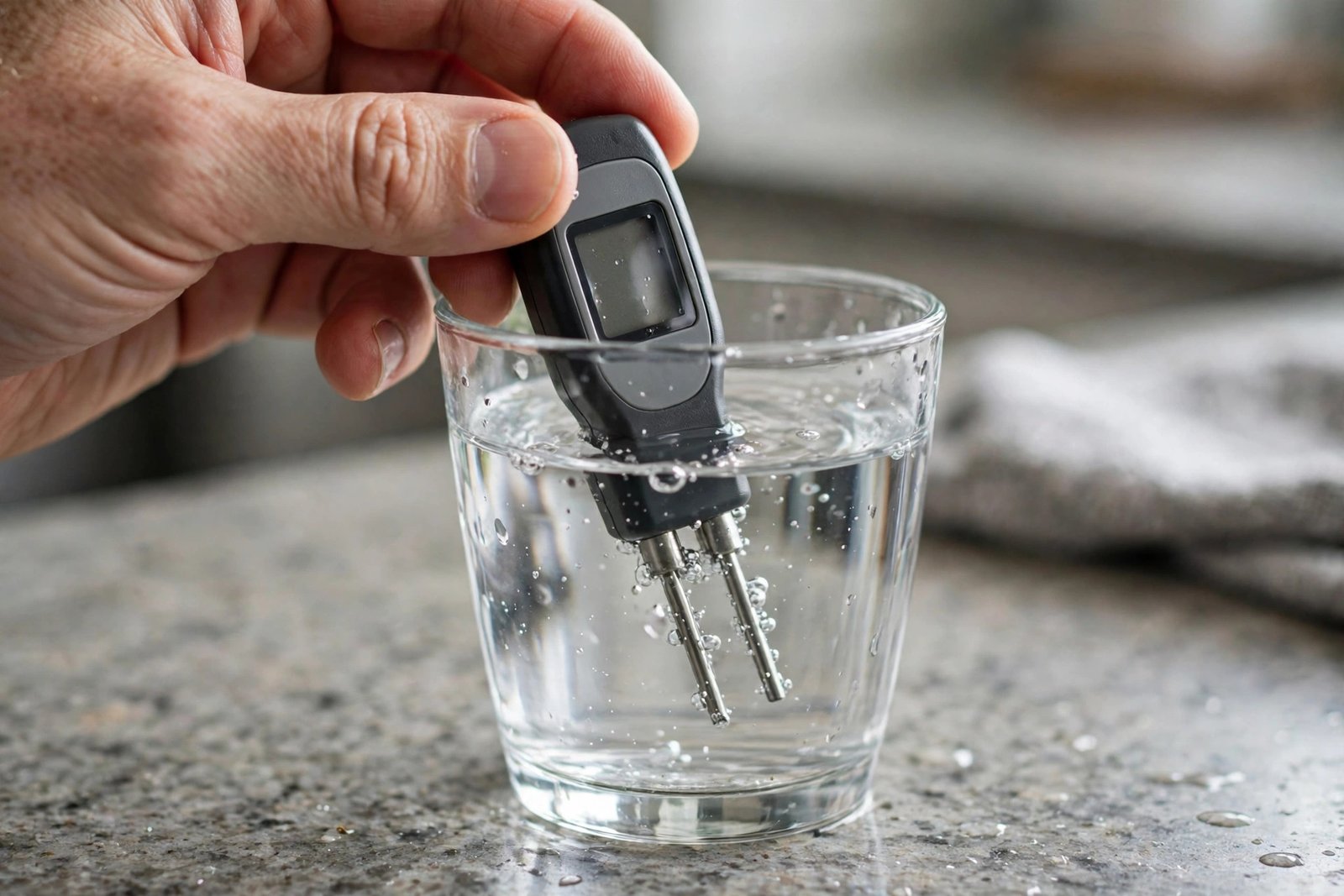
Meet the HM Digital TDS-EZ — one of the most-recommended handheld TDS meters in home water-testing circles, and the one I’d hand to anyone in this situation. It usually sells for around $15 at the time of writing — check the current price on Amazon.
The mandatory honesty: a TDS meter measures electrical conductivity and reports total dissolved solids. It cannot isolate sodium specifically. If your TDS reads 200 ppm, you don’t know how much is sodium versus calcium versus anything else. Anyone telling you a TDS meter gives you a sodium reading is overselling it.
So how do you actually use it? Three readings, same day:
- Raw tap water — your baseline.
- Softener output (a bathroom tap on softened water) — the jump from reading 1 is essentially your softener’s sodium addition. Watch it climb and you can see the bread-slices-per-day math from this article in your own home.
- RO output (kitchen RO faucet) — the drop from reading 2 is your RO system doing its job.
The practical rule of thumb from editorial testing guides: your membrane is still working if the RO reading is at least 80% lower than the feed water. When the post-RO reading starts creeping up, that’s your filter-change signal — catch it early and sodium rejection stays in the 90s. Our TDS levels explained guide digs deeper into what those numbers mean. And the meter is one of those rare sub-$20 tools that pays for itself in a month.
The Fix: Under-Sink RO at the Drinking Tap
If the three-reading test confirms your softener is loading your drinking water with sodium — or you’re in one of the groups above — the standard answer is refreshingly simple: put a small under-sink RO unit on the kitchen tap and let the softener handle the rest of the house. Softened water protects your plumbing, water heater, and dishwasher; the RO gives you low-sodium drinking and cooking water. The two systems don’t compete — they divide the labor.
For the drinking-tap job specifically, here are the Clearove-tested directions to explore:
- iSpring RCC7 review — the classic 75 GPD 5-stage tank unit, NSF/ANSI 58 certified, and the workhorse pick for softened homes on a budget.
- Best tankless RO systems — if under-sink space is tight and you want on-demand water with a high-GPD membrane.
- RO vs water softener — the full pairing guide for how these two systems sit together in one house.
- Is RO water safe to drink every day? — because yes, this question comes up, and the answer covers the mineral question too.
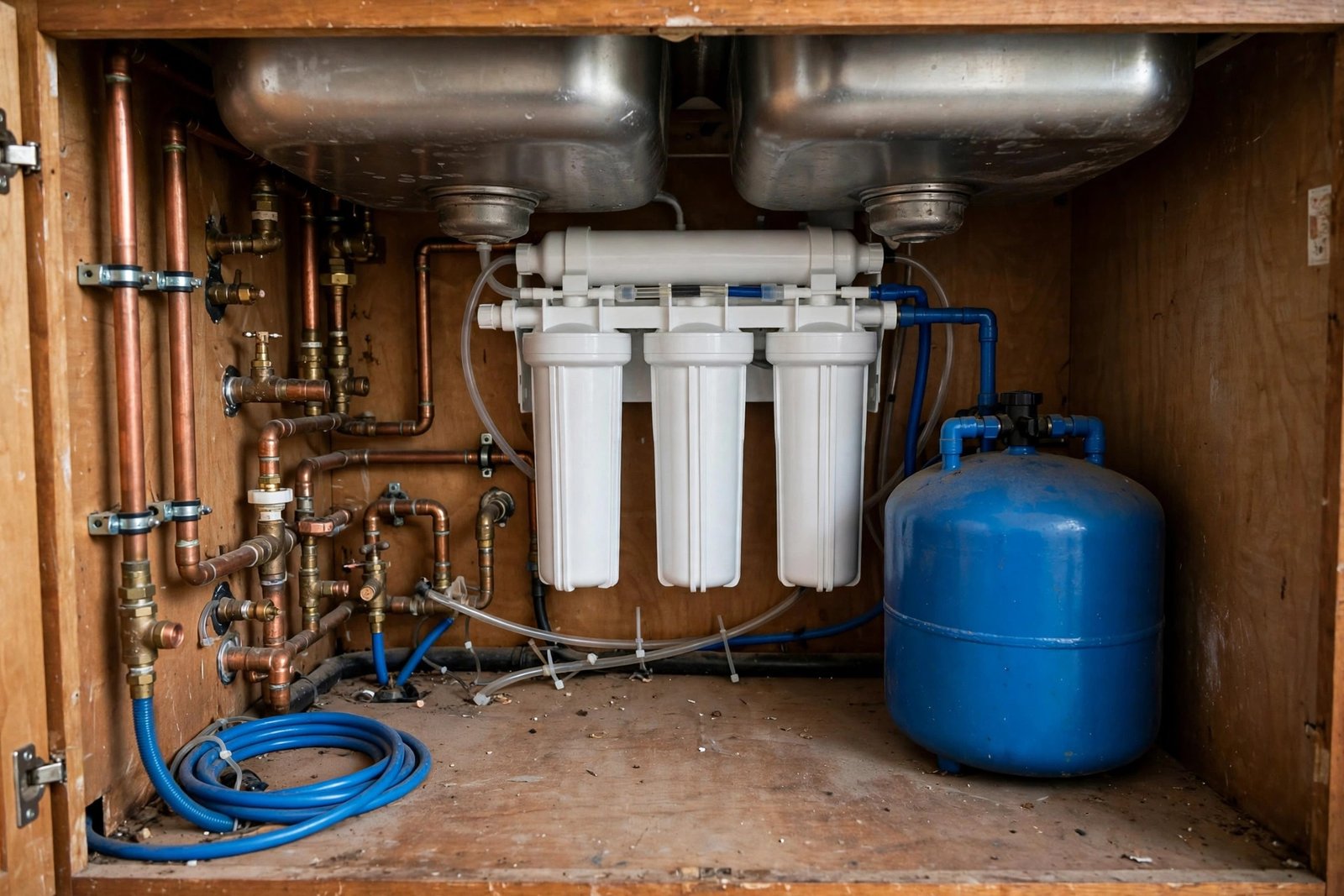
One note from our fluoride guide: RO strips the good ions with the bad — what leaves your RO faucet is low in everything, minerals included. If the taste is too flat, an alkaline remineralization stage is the fix.
FAQ
Does RO remove the sodium my water softener adds?
Yes — and this is RO’s signature use case in softened homes. Documented removal of softener-added sodium from drinking water runs 95–99% for a healthy under-sink system, comfortably in the 90s for the membrane itself. The softener protects the house; the RO cleans the glass you drink.
How much sodium does a water softener add to water?
About 7.5–8 mg/L for every grain per gallon of hardness removed. At 10 gpg that’s ~80 mg/L, at 15 gpg ~120 mg/L, and at 20 gpg ~160 mg/L. A household on 15-gpg water drinking 2 liters a day takes in roughly 240 mg of sodium from water alone.
Is RO water low in sodium?
Compared to softened water, dramatically — a healthy system turning 120 mg/L feed water into roughly 6–12 mg/L, well under the EPA’s 20 mg/L advisory for very-low-sodium diets. Against unsoftened city water (~20–40 mg/L), the difference is smaller.
Does boiling water remove sodium?
No — it concentrates it. Evaporation removes pure water and leaves the sodium behind, so a boiled-down pot is saltier than what you started with. Boiling is for pathogens, not ions.
Do regular water filters remove sodium?
No. Carbon filters, sediment filters, and pitcher filters do essentially nothing to dissolved sodium ions. Only reverse osmosis, distillation, or deionization remove it — of which RO is the only practical one under a kitchen sink.
Does RO remove minerals I need?
RO removes most dissolved minerals along with sodium — calcium, magnesium, potassium included. But the mineral contribution of water is small next to food, and remineralization stages exist if you want the taste back. Don’t let the mineral question stop you from addressing sodium if your situation genuinely calls for it.